Speaking and Writing - PTE Academic / UKVI

Write Essay

Write Essay is one item, twenty minutes, 200–300 words, and seven scored traits. Three of them are 0–6 scales judged by Pearson’s AI and a human reviewer: Content, Development and Coherence, and General Linguistic Range. Here is what each trait actually asks for, a plan that fits twenty minutes, and the difference between a 65 essay and a 79 essay.

20 min
to write
200–300
words for full Form credit
1
item per test
26
marks across seven traits

The task

Write Essay closes the Speaking and Writing part in PTE Academic. One item, one prompt, one twenty-minute timer. It does not appear in PTE Core.

Appears inPTE Academic / UKVI only — Speaking & Writing part
Items per test1
PromptTwo or three sentences stating a topic and an instruction
Time to write20 minutes
Word limit200–300 words — 120–199 or 301–380 score 1 on Form; under 120 or over 380 score 0
Scoring7 traits: Content 0–6; Development, Structure & Coherence 0–6; General Linguistic Range 0–6 (Pearson: AI plus examiner review); Form, Grammar, Vocabulary Range, Spelling 0–2 each
Negative markingNone
Skills creditedWriting
In the exam
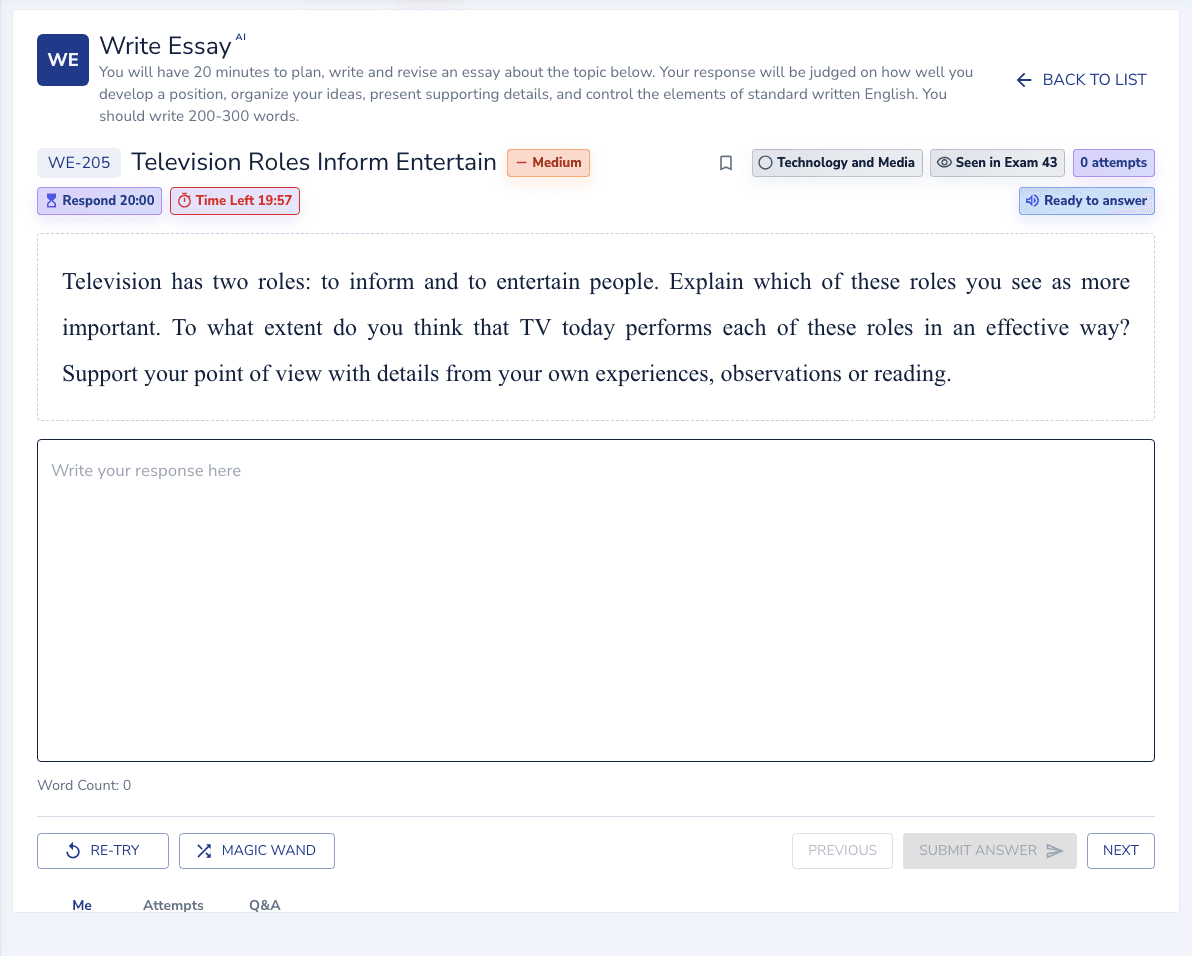
  1. The prompt and the answer box appear together

    A prompt of two or three sentences states a topic and asks you to take a position, discuss both sides, or explain a view, and tells you to support it with your own experience, observation or reading. A word counter and Cut, Copy and Paste buttons sit with the box.

  2. Twenty minutes for planning, writing and checking

    The countdown starts when the item opens. There is no separate planning time, so the plan has to be quick: two to three minutes at most.

  3. The item closes at twenty minutes or when you click Next

    The text in the box is the essay. Nothing is saved from a draft elsewhere, and unused time is not carried anywhere, so the last two minutes belong to checking.

  4. Topics are general and argumentative

    Technology, education, work, environment, media, society. No specialist knowledge is needed. What the prompt asks for, agree or disagree, discuss, or explain, decides the structure.

How one item is scored

Question

“Television has two roles: to inform and to entertain people. Explain which of these roles you see as more important… Support your point of view with details from your own experiences, observations or reading.” Write 200–300 words in 20 minutes. (Real bank question — shown in the player below.)

Answer

Model introduction: “While television’s capacity to entertain is undeniable, its fundamental duty to inform the public is ultimately of greater social importance. An informed citizenry is essential for a functioning democracy and a cohesive society. Regrettably, modern television often falls short in fulfilling this critical role effectively.” The full essay then develops one paragraph on information as a public good, one on entertainment’s value and limits, and a conclusion — 200–300 words total.

Why it scores

The introduction states a clear position and previews the argument — the content, development and coherence traits reward exactly this.

What loses marks

“Television has two roles: to inform and to entertain people. Some people think informing is more important and some people think entertaining is more important. In my opinion both are important. Firstly, informing is important because people need information. Secondly, entertaining is important because people need entertainment. In conclusion, both roles are important for different reasons.” It repeats the prompt’s language, never takes a position the prompt asked for, supports nothing with an example, and would need to be padded to 200 words with more of the same. Content 2, Development 2, Range 3, and Form 0 at this length.

How it is scored

Seven traits with partial credit, all counting towards Writing. Content, Development/Structure/Coherence and General Linguistic Range are 0–6 scales scored in the live test by Pearson’s AI and reviewed by a Pearson examiner. Form, Grammar, Vocabulary Range and Spelling are 0–2.

Content: 0–6 for addressing the prompt in depth

A 6 fully addresses the prompt, reformulates the issue in its own words, expands on important points with specificity, and supports the argument convincingly with subsidiary points and examples throughout. A 4 addresses the main point but lacks depth and supports some points but not others. A 2 is superficial, generic, and over-reliant on repeating the prompt’s language.
Development, Structure and Coherence: 0–6

A 6 has a clear logical structure with a well-developed introduction and conclusion, ideas organised cohesively into logically sequenced paragraphs, and connectives used consistently to show relationships between ideas. A 4 has the conventional structure mostly present but ideas not well connected and some paragraphs poorly linked. A 2 has little recognisable structure.

General Linguistic Range: 0–6

A 6 uses a variety of expressions with ease and precision and no sign of limitation, with errors rare and minor. A 4 is sufficient for basic ideas but shows limitations on complex ones, with repetition and circumlocution. A 3 is narrow and simple with errors that disrupt the reader.

Form: 2 for 200–300 words

A 2 is 200–300 words. A 1 is 120–199 or 301–380. A 0 is under 120 or over 380, or an essay in capital letters, without punctuation, or in bullet points or very short sentences.

Grammar and Vocabulary Range: 0–2 each

Grammar 2 is consistent control of complex language with errors rare and hard to spot; 1 is a relatively high degree of control with no mistakes that cause misunderstanding. Vocabulary Range 2 is command of a broad repertoire including idiomatic expression; 1 is a good range for general academic topics with some imprecision.

Spelling: 2, 1 or 0

Correct spelling throughout scores 2. One error scores 1. More than one scores 0. Any consistent standard, British or American, is accepted. Spelling is the cheapest trait to lose and the easiest to protect with two minutes of checking.

Three of the seven traits are about the same thing from different angles: does the essay say something specific and support it? A memorised opening paragraph that fits any topic scores low on Content (generic), on Development (not developed) and on Range (repetition) at once. That review is part of Pearson’s live test. EdKnot practice scoring is entirely automated: no person sees or scores any practice response.

Templates that score full marks

Every template below is taught inside EdKnot and verified against the same AI scoring engine that marks your practice — out of 26 for this task.

Template 1 — opinion (agree/disagree): memorise the shape, never the sentences
Paragraph 1: [restate the issue in your own words] + [your position].
Paragraph 2: One clear reason is [REASON]. For example, [SPECIFIC EXAMPLE with details].
Paragraph 3: [SECOND REASON]. For instance, [SECOND EXAMPLE].
Paragraph 4: [restate position in fresh words].
Template 2 — discuss both views, then decide
Paragraph 1: [restate the debate in your own words] + [which side you will support].
Paragraph 2: Those who favour [VIEW A] argue [REASON]. [SPECIFIC EXAMPLE].
Paragraph 3: Supporters of [VIEW B], however, point to [REASON]. [SPECIFIC EXAMPLE].
Paragraph 4: [weigh the two views] + [your position in fresh words].
Template 3 — problem and solution
Paragraph 1: [describe the problem in your own words] + [preview your solutions].
Paragraph 2: The main cause is [CAUSE]. [SPECIFIC EXAMPLE of its impact].
Paragraph 3: The most effective response is [SOLUTION]. [SPECIFIC EXAMPLE of it working].
Paragraph 4: [restate why the solution addresses the problem].
Worked example — Preserving Green Spaces in Urban Growth

Whenever cities expand, parks and woodlands tend to be the first casualties, traded away for housing and roads. I believe urban greenery survives only where governments set firm rules and residents…

Template 1 · 243 words · own position, one specific example per body paragraph - scored 26/26 on this scoring engine.

How to answer it

Twenty minutes divides cleanly: three to plan, fourteen to write, three to check. The plan is what makes the three 0–6 traits reachable, because it fixes the position and the two specific supports before you start writing.

  1. Minutes 0–1: decode the prompt

    Underline the instruction: “which is more important”, “agree or disagree”, “discuss both views”, “explain”. It decides whether you argue one side, weigh two, or explain a cause. Answering a different instruction is the fastest route to a Content 3.

  2. Minutes 1–3: position and two supports

    One sentence stating your position in your own words. Then two reasons, each with a specific example you can write in three sentences: a named situation, a place, a consequence. “Studies show” is not an example; “when my city switched to a 24-hour news channel” is.

  3. Minutes 3–7: introduction and first body paragraph

    Introduction of three sentences: reformulate the issue, state your position, preview the two reasons. First body paragraph: topic sentence, the example, what the example shows. Five to six sentences.

  4. Minutes 7–14: second body paragraph and conclusion

    Same shape for the second reason. If the prompt says “discuss both views”, this paragraph carries the other side fairly before you return to your position. Conclusion of two or three sentences restating the position and its consequence, in different words from the introduction.

  5. Minutes 14–17: word count and Form

    Check the counter: 200–300. Under 200 means an example is missing, not that you need more sentences of the same kind. Over 300 means the introduction or conclusion is repeating itself. Confirm four paragraphs with a blank line between them.

  6. Minutes 17–20: spelling, then grammar

    Read every word for spelling first, because one error costs a full point and two cost two. Then read each sentence for a subject and a verb that agree, and for connectives that actually show a relationship: “as a result”, “in contrast”, “for instance”.

Common mistakes

MistakeWhy it costs marksWhat to do instead
Memorised introduction and conclusionWhy it costs marksGeneric statements and repeated prompt language are the Content 2 descriptor, and a template that fits any topic cannot be “developed at length” for Development.What to do insteadReformulate the issue in your own words and state a position that could only belong to this prompt.
Not answering the instructionWhy it costs marksDiscussing both views when asked which is more important, or never choosing, fails to address the main point of the prompt.What to do insteadUnderline the instruction and state your answer to it in the introduction.
No specific examplesWhy it costs marksSupporting detail “missing or inappropriate” is the Content 3 descriptor. “Many people think” is not support.What to do insteadOne concrete situation per body paragraph: a place, a case, a consequence you can describe in three sentences.
Under 200 or over 300 wordsWhy it costs marksForm drops to 1 immediately and to 0 below 120 or above 380. Long essays also run out of checking time.What to do insteadFour paragraphs of 50–75 words each. Check the counter at minute fourteen.
Two spelling errorsWhy it costs marksSpelling is 2, 1 or 0. Two errors cost the whole trait, which is worth as much as Grammar.What to do insteadRead for spelling alone in the last three minutes, before grammar.
Linking with “and”, “but” and “also” onlyWhy it costs marksSimple linear connectives are named in the Development 1 and 2 descriptors. The top bands need connectives that show cause, contrast and consequence.What to do insteadOne relationship connective per paragraph at least: “as a result”, “whereas”, “for instance”, “despite this”.
Long, ambitious sentences that breakWhy it costs marksGrammar 2 requires control of complex language, not just use of it. A broken 40-word sentence scores below a correct 15-word one.What to do insteadMix lengths. One complex sentence per paragraph that you are sure of, the rest clear and medium-length.

How to practise

Essay skill is built by writing whole essays under the clock and reviewing them trait by trait, not by memorising paragraphs. Two timed essays a week with honest review beats ten untimed ones.

  1. Write under the twenty-minute timer with the counter visible

    Use the real countdown. Note at the end whether you had three minutes left for checking. If not, the plan or the paragraph shape is taking too long, and that is what to fix next.

  2. Review one 0–6 trait at a time

    Content: is there a specific example in each body paragraph? Development: does every paragraph start with a topic sentence and use a connective that shows a relationship? Range: how many sentences start the same way? The scoring review shows the seven traits separately, so the weakest one is visible each time.

  3. Replace generic support with specific support

    Take your last essay and rewrite every “many people” and “studies show” as a concrete situation. Specificity is the word that appears in the Content 6 descriptor, and it is a habit.

  4. Build a connective set you actually control

    Ten connectives across contrast, cause, example and sequence, each used correctly in a sentence you wrote. Misused connectives cost Development marks; “firstly, secondly, in conclusion” alone caps the trait.

  5. Keep a spelling list

    Every word you misspelled in a timed essay goes on a list you read before the next one. Most learners have a personal set of ten to twenty words that account for nearly all their spelling errors.

  6. Vary the prompt type

    Rotate agree/disagree, discuss both views, and explain prompts, because each needs a different paragraph plan, and the exam gives you no choice.

Practice set

12 prompts with answers

Items from the EdKnot bank, each with its answer, on one page. Every item opens in the practice player with its timer, recording and scoring.

Write Essay practice inside the EdKnot question player

What 65 and 79 need

Write Essay is one item, so it moves the Writing score less than the two Summarize Written Text items combined with the listening writing tasks. These are the typical profiles behind each level.

65

A clear position with two reasons in four paragraphs, 200–300 words, with support that is present for one reason and thinner for the other. Connectives mostly simple, a few grammar slips that do not cause misunderstanding, one spelling error. Content 4, Development 4, Range 4.

79

A position stated in reformulated language, two reasons each with a specific example and its consequence, paragraphs linked by relationship connectives, and a conclusion that adds a consequence rather than repeating. Varied sentence lengths, no spelling errors, rare grammar errors. Content 5 or better, Development 5, Range 5, Form 2.

Frequently asked questions

How many words should PTE Write Essay be?

Aim for 200–300 words, which scores full Form credit. Essays of 120–199 or 301–380 words score 1 on Form, and under 120 or over 380 scores 0. You have 20 minutes for the single item.

Is Write Essay in PTE Core?

No. Write Essay is an Academic-only task; it does not appear in PTE Core.

How is PTE Write Essay scored?

Seven traits: Content 0–6; Development, Structure and Coherence 0–6; General Linguistic Range 0–6; Form 0–2; Grammar 0–2; Vocabulary Range 0–2; and Spelling 0–2. The three 0–6 traits are scored by Pearson’s AI and reviewed by a Pearson examiner in the live test.

Do essay templates work in PTE Write Essay?

Memorised openings that fit any topic are penalised on three traits at once: they are generic (Content), undeveloped (Development) and repetitive (Range). A planning template of four paragraphs with two specific examples helps; a memorised text does not.

How many paragraphs should a PTE essay have?

Four: an introduction that reformulates the issue and states your position, two body paragraphs each with one reason and a specific example, and a short conclusion. That shape lands naturally in 200–300 words.

How much does spelling matter in PTE Write Essay?

Correct spelling throughout scores 2, one error scores 1, and more than one scores 0. Either British or American spelling is fine if used consistently. Check spelling before grammar in your final minutes.

A clear position, argued in paragraphs with specific support, inside 200–300 words.

Practise Write Essay with the real clock and see the answer the moment you submit.

Practise Write Essay