Speaking and Writing - PTE Academic / UKVI, PTE Core
Read Aloud
Read Aloud practice builds clear pronunciation, steady phrasing, and fluent delivery from written prompts.
Task facts at a glance
| Appears in | PTE Academic / UKVI and PTE Core — Speaking & Writing part |
|---|---|
| Items per test | 6–7 |
| Text length | Up to 60 words |
| Preparation time | 30–40 seconds |
| Time to speak | Speak when the microphone opens; recording stops after 3 seconds of silence |
| Scoring | Partial credit — Content, Oral fluency, Pronunciation |
| Negative marking | None |
| Skills credited | Speaking and Reading |
Worked example
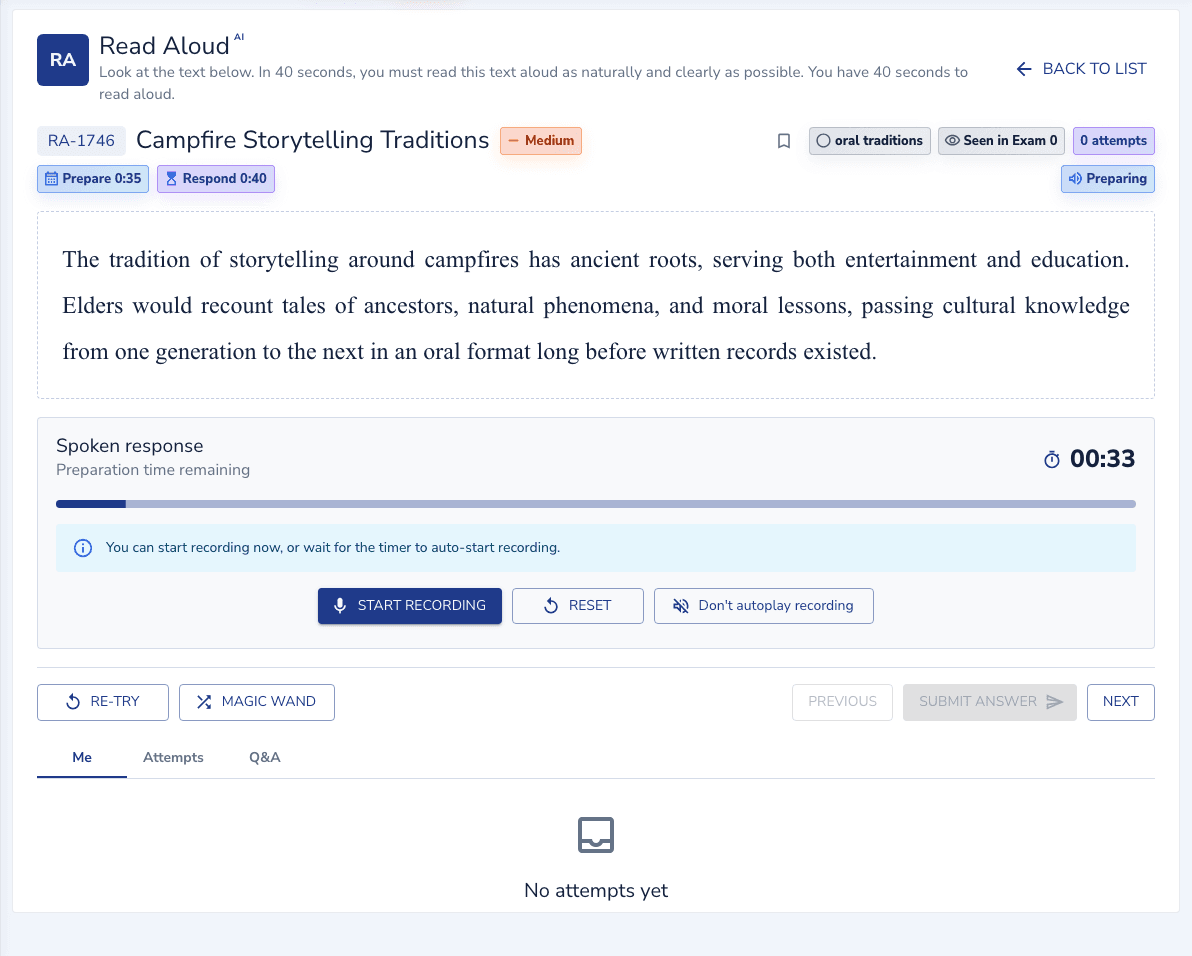
“The tradition of storytelling around campfires has ancient roots, serving both entertainment and education. Elders would recount tales of ancestors, natural phenomena, and moral lessons…” (Real bank question, 44 words — shown in full in the player below. 30–40 seconds to prepare.)
Read in meaning chunks with brief pauses at commas: “The tradition of storytelling around campfires | has ancient roots, | serving both entertainment and education.” Stress the content words (tradition, storytelling, ancient, entertainment, education), keep grammar words light, and hold a steady pace to the end — the recording stops after 3 seconds of silence.
Why this scores well: Accurate word-for-word reading protects Content; chunked phrasing and steady pace lift Oral fluency and Pronunciation.
Scoring traits to watch
ContentOral fluencyPronunciation
Key takeaways
Group words naturally before speaking.
Keep pace steady instead of rushing for speed.
Review pronunciation and fluency together after each recording.
How to practise Read Aloud
Read Aloud improvement comes from controlled delivery. Practise phrase grouping and clarity before increasing speed.
- Preview punctuation and phrase groups.
- Record once under the timer.
- Listen for pauses, stress, and unclear sounds.
Practice framework
- Preview punctuation and phrase groups.
- Record once under the timer.
- Listen for pauses, stress, and unclear sounds.
- Repeat with one specific correction.
Common mistakes
- Rushing through punctuation and losing clarity.
- Pausing in the middle of phrase groups.
- Practising pronunciation without checking fluency.
Frequently asked questions
How much time do you get for Read Aloud in PTE?
You get 30–40 seconds to prepare, and you speak when the microphone opens. The text itself is up to 60 words long.
How many Read Aloud questions are there in PTE?
Expect 6–7 Read Aloud items, in both PTE Academic and PTE Core. The task contributes to both your Speaking and Reading scores.
What happens if I pause too long in Read Aloud?
The recording stops after 3 seconds of silence, so avoid long pauses. If you stumble on a word, keep going rather than stopping to restart.
This task inside EdKnot