Speaking and Writing - PTE Academic / UKVI, PTE Core

Repeat Sentence

Repeat Sentence is the most frequent speaking task in the test and the one that feeds two skill scores at once. Ten to twelve sentences, each heard once, each repeated straight away. Here is how Content is actually counted, why half a sentence still scores, and how to train the memory it needs.

15 s
to answer
3–9 s
of audio, plays once
10–12
items — the most frequent speaking task
13
marks: Content 3, Fluency 5, Pronunciation 5

The task

Repeat Sentence follows Read Aloud. There is no preparation time and nothing to read: the whole item is an audio clip and your voice.

Appears inPTE Academic / UKVI and PTE Core — Speaking & Writing part
Items per test10–12 — the most frequent speaking task
Audio length3–9 seconds, plays once
Time to answer15 seconds
ScoringPartial credit — Content 0–3 (words in the correct sequence), Oral fluency 0–5, Pronunciation 0–5
Negative markingNone
Skills creditedSpeaking and Listening
In the exam
  1. The audio plays by itself

    A sentence of 3–9 seconds plays once, automatically. There is no play button and no replay. The status box shows “Playing” while it runs, and you cannot start recording early.

  2. The microphone opens the instant the audio ends

    The status box switches to “Recording” with no gap. You have 15 seconds, but you do not need them: a repeated sentence takes three to five. Start within three seconds or the recorder closes on silence.

  3. One attempt, then the next sentence

    The recording stops when you fall silent for three seconds or the bar completes. Say the sentence once and stop. Saying it a second time to “improve” it adds repetitions that cost fluency marks and cannot raise Content.

  4. Ten to twelve items in a row

    Sentences vary in length and topic, and a hard one is followed immediately by the next. Let a bad item go the moment it ends. Carrying it into the next sentence costs two items instead of one.

How one item is scored

Question

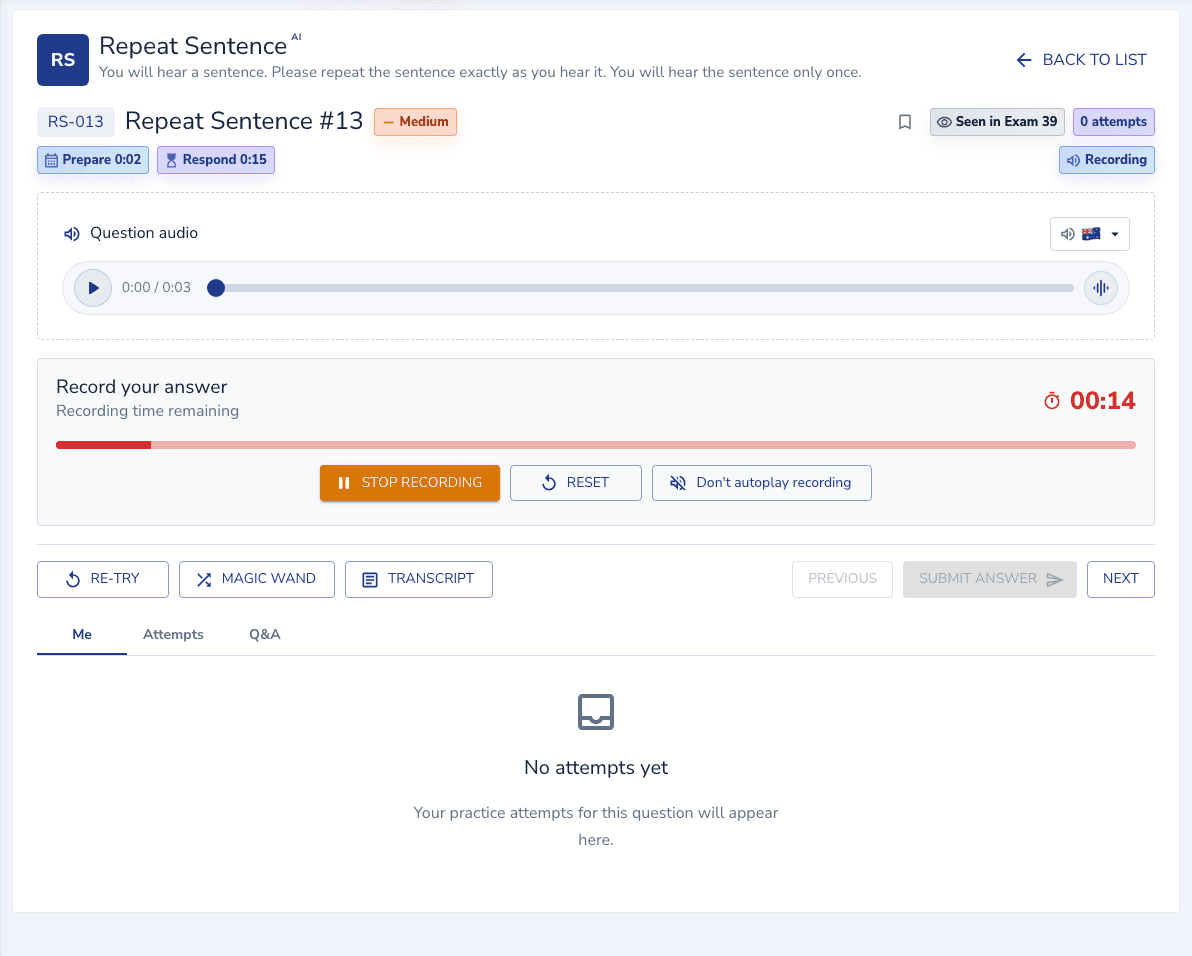
You hear (3–9 seconds, once): “He has been awarded a research grant because of his excellent work.” You have 15 seconds to repeat it. (Real bank question — shown in the player below.)

Answer

He has been awarded a research grant because of his excellent work.

Why it scores

Content scores on words repeated in the correct sequence with word-level partial credit — an exact, fluent repetition takes the maximum.

What loses marks

“He… he has been, um, awarded a grant… research grant for his work.” The false start and the filler are ignored for Content, but “a grant research grant” breaks the sequence and “because of his excellent” is gone. Roughly half the words survive in order, so Content is a 2 rather than a 3, and the restart plus the filled pause put Oral fluency in the Intermediate band.

How it is scored

Three traits are scored with partial credit, and the item counts towards both Listening and Speaking. Because there are so many items, Repeat Sentence moves those two scores more than any other single task.

Content: 0–3 on words in the right sequence

The full 3 needs every word from the prompt in the correct order. At least half the words in sequence scores 2. Fewer than half scores 1, and almost nothing scores 0. Only replacements, omissions and insertions count as errors: hesitations, filled pauses like “um”, and anything you say before or after the sentence are ignored for Content.
Oral fluency: 0–5 for rhythm

The top band has no hesitations, repetitions or false starts. One of those drops you a band. Because the sentence is short, a single restart is a large share of the whole response, which is why “um, he has been… he has been awarded” scores well below a clean attempt with one missing word.

Pronunciation: 0–5 for clarity

The scorer needs to recognise each word for it to count as Content, so clear consonants and correct word stress protect two traits at once. Mumbling the words you are unsure of does not hide the gap; it turns a possible 2 into a 1.

The Content bands are the key. Half the sentence in order is worth two-thirds of the marks, so a confident first half beats a mumbled attempt at the whole thing.

How to answer it

You cannot take notes and you cannot replay, so the whole method is about what you do with your attention during the three to nine seconds of audio.

  1. Listen for meaning, not for words

    Ask “what is this sentence saying?” as it plays. A sentence you understood is a sentence you can rebuild; a string of sounds is not. This is the single change that moves most learners from 1s to 2s and 3s.

  2. Hold the rhythm, not just the words

    Sentences are spoken in two or three natural chunks. Notice where the speaker breathes. Repeating in the same chunks gives your memory a scaffold and gives the scorer the phrasing it rewards.

  3. Start the moment recording begins

    Delay lets the sentence fade. Begin with the first chunk immediately and let the rest follow; the act of saying the beginning often pulls the end back.

  4. If part is gone, keep the order you have

    Say the words you remember in the sequence you remember them, without fillers and without stopping. Two correct chunks with a gap between them still score for the words in order. Inventing words to fill the gap adds insertions and can break the sequence.

  5. Say it once and stop

    Do not add “sorry” or try again. Extra material after the sentence is ignored for Content, but every repetition and restart is counted against fluency.

Common mistakes

MistakeWhy it costs marksWhat to do instead
Trying to memorise every wordWhy it costs marksWord-by-word memorisation overloads working memory on anything over ten words, and the sentence collapses in the second half.What to do insteadListen for what the sentence means and for its two or three chunks. Meaning carries the words.
Dropping the small grammar wordsWhy it costs marksArticles, prepositions and auxiliaries are words too. Each one missing is an omission, and enough of them takes you below the half-the-words line.What to do insteadRepeat the phrase as a unit, “has been awarded a”, rather than the content words alone.
Restarting after a stumbleWhy it costs marksThe restart is a false start and a repetition against Oral fluency, and it cannot add Content that was already in sequence.What to do insteadContinue from where you are. One correct sequence with a gap outscores a clean restart.
Filling gaps with guessed wordsWhy it costs marksInvented words are insertions and can split a correct sequence into two shorter ones, which lowers the Content band.What to do insteadSay what you have in order, then stop.
Giving up on a long sentenceWhy it costs marksSilence scores 0. The first half of the sentence, said in order, would have scored 2.What to do insteadAlways say the opening chunk. It is usually the easiest to hold and worth most of the marks.
Speaking too fast to keep up with memoryWhy it costs marksRushed delivery blurs consonants and stress, so words the scorer cannot recognise stop counting as Content.What to do insteadMatch the speaker’s pace. It was recorded at a normal speed for exactly this reason.

How to practise

Repeat Sentence is trainable in a way few tasks are, because it is largely working memory and the working memory for English sentences grows with exposure. This routine builds it in short daily sessions.

  1. Do sets of ten under exam conditions

    One play, immediate response, no pausing between items. On EdKnot the audio plays and the recorder opens automatically, like the test; do not use the replay or Re-Try buttons in practice, because the exam has neither. Ten items take under three minutes.

  2. Score each one against the transcript

    Check which words you dropped, replaced or added, and where the sequence broke. The pattern matters more than the count: most learners lose the same kind of word every time, usually articles, auxiliary verbs or the final phrase.

  3. Sort misses by length

    If sentences under twelve words are clean and longer ones fall apart in the second half, the problem is chunking, not vocabulary. Practise listening for the two or three chunks and repeating them as units.

  4. Shadow when you are not practising

    Repeat sentences from podcasts or lectures a beat behind the speaker for five minutes a day. It builds the same rhythm-and-meaning memory the task tests, without a timer.

  5. Track your Content average

    A steady average above 2 across a set of ten means the task is contributing well to both skills. Below 1.5, keep the sets short and daily until the average moves.

Practice set

30 sentences with answers

Items from the EdKnot bank, each with its answer, on one page. Every item opens in the practice player with its timer, recording and scoring.

Repeat Sentence practice inside the EdKnot question player

What 65 and 79 need

With ten to twelve items, the average across the set is what matters. These are the typical profiles behind each level on this task.

65

Most sentences at Content 2 or 3, with the longest one or two dropping to 1. Delivery has an occasional hesitation or a single restart, with most words in continuous phrases. Pronunciation is clear enough that every attempted word is recognised.

79

Content 3 on the majority of items and 2 on the rest, with no item at 0. No restarts, at most one hesitation in the whole set, and the sentence repeated in the speaker’s own chunks. Stress and consonants clear on every word, including the grammar words.

Frequently asked questions

How is Repeat Sentence scored in PTE?

Content is scored 0–3 on the words you repeat in the correct sequence: all words scores 3, at least half in sequence scores 2, fewer than half scores 1. Hesitations, filled pauses and anything before or after the sentence are ignored for Content. Oral fluency and Pronunciation are each scored 0–5. The task contributes to both your Speaking and Listening scores.

How many Repeat Sentence questions are in PTE?

There are 10–12 items, making it the most frequent speaking task in the test. It appears in both PTE Academic and PTE Core.

How long is the audio in PTE Repeat Sentence?

Each sentence lasts 3–9 seconds and plays once, automatically. The microphone opens the moment it ends and you have 15 seconds to repeat it, though a repeated sentence rarely needs more than five.

Do I still get marks if I only remember half the sentence?

Yes. At least half the words in the correct sequence scores 2 out of 3 for Content. Say the part you remember in order, without fillers or guesses, and stop.

Can I hear the sentence again in Repeat Sentence?

No. The audio plays once and there is no replay button. If you miss the start, repeat the part you heard in order rather than staying silent, which scores 0.

Why does Repeat Sentence matter so much for the Speaking score?

Because it has the most items of any speaking task and every item counts towards both Listening and Speaking, so a consistent Content average moves both scores.

Words in the right order, spoken as one smooth phrase.

Practise Repeat Sentence with the real clock and see the answer the moment you submit.

Practise Repeat Sentence