Speaking and Writing - PTE Academic / UKVI

Retell Lecture

Retell Lecture is the speaking task with the most to listen to and the least time to say it: up to 90 seconds of lecture, 10 seconds to prepare, 40 seconds to retell. Content is scored 0–6 on how well you paraphrase the main ideas in your own words, and Pearson’s human reviewer checks it in the live test. Here is how to take notes that turn into a 40-second answer.

10 s
to prepare
40 s
to speak
2–3
items per test
16
marks: Content 6, Fluency 5, Pronunciation 5

The task

Retell Lecture appears in PTE Academic only, after Describe Image. Two or three items, each with its own recording, and sometimes an image or slide that goes with the audio.

Appears inPTE Academic / UKVI only — Speaking & Writing part
Items per test2–3
Audio lengthUp to 90 seconds, plays once
Preparation time10 seconds
Time to speak40 seconds
ScoringPartial credit — Content 0–6 (Pearson: AI plus examiner review), Oral fluency 0–5, Pronunciation 0–5
Negative markingNone
Skills creditedSpeaking and Listening
In the exam
  1. The lecture plays once

    Audio of up to 90 seconds starts automatically after a short countdown. An image related to the topic may be shown alongside it. You can take notes on the erasable booklet from the first second.

  2. Ten seconds to prepare

    When the audio ends, a 10-second countdown runs before the microphone opens. Use it to read your notes once and decide your first sentence. It is not enough time to write anything new.

  3. The microphone opens for 40 seconds

    The status box shows “Recording” and the bar starts. Start within three seconds. The recording ends when the bar completes or when you stop for three seconds, so keep talking until the closing point is said.

  4. Two or three items

    Topics are academic and general: science, history, economics, environment. You are not expected to know the subject, only to report what the speaker said.

How one item is scored

Question

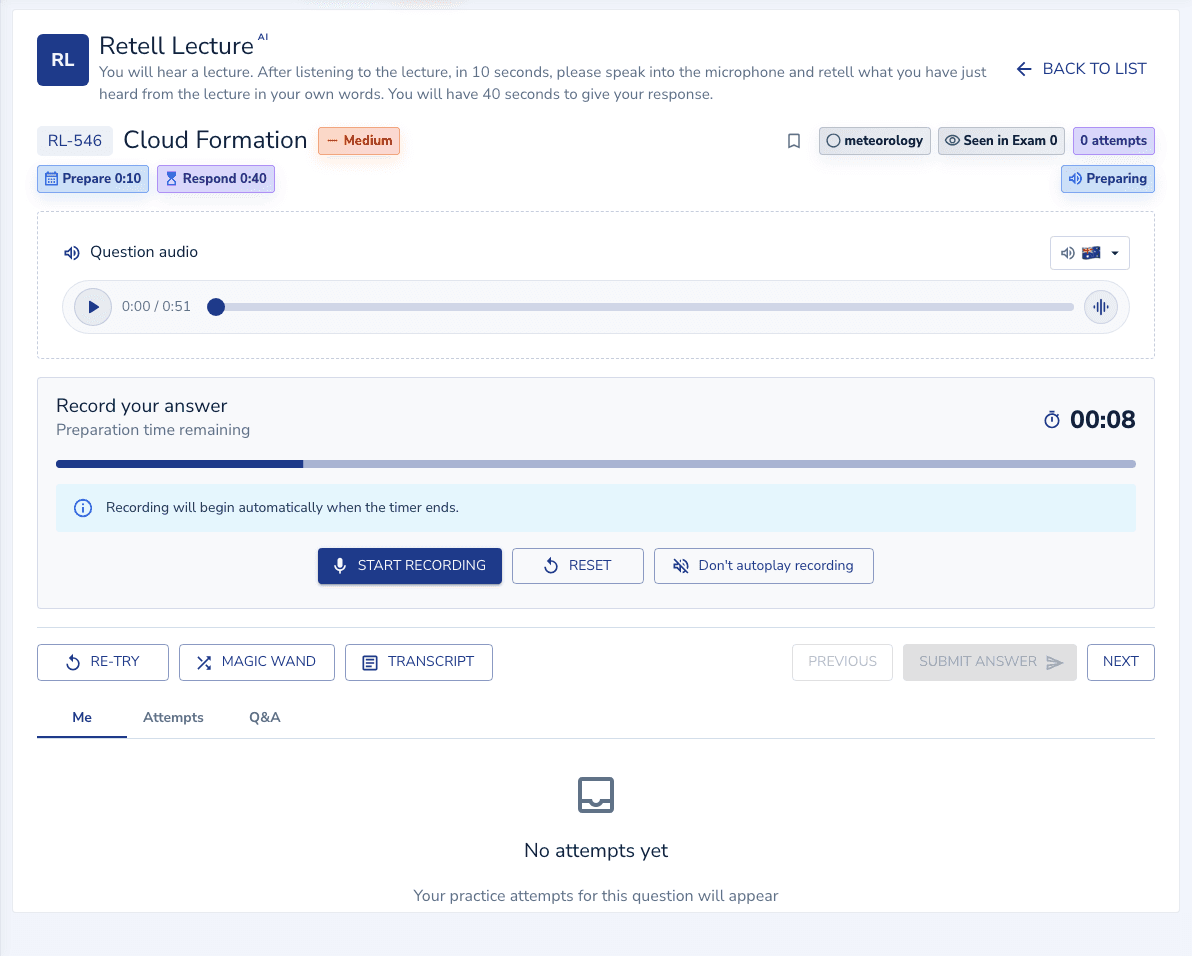
You hear a lecture on cloud formation: “Clouds are a familiar part of our sky, but how exactly do they form? The process requires three key ingredients…” (Real bank question, ~90-second lecture — shown in the player below. 10 seconds to prepare, 40 to speak.)

Answer

The lecture explains how clouds form. It states that three ingredients are needed: water vapor, cooling, and condensation nuclei. When warm, moist air rises, it expands and cools. As the air cools, water vapor condenses around tiny particles called condensation nuclei, such as dust, salt, or pollution. These nuclei provide a surface for the water to condense upon, forming tiny droplets that group together to create clouds. Without condensation nuclei, clouds would not form easily.

Why it scores

It reproduces the lecture’s structure — the three ingredients, the process, and the closing point — in a fluent 40-second retelling.

What loses marks

“The lecture is about clouds. Clouds… water vapor. Cooling. Condensation nuclei, dust, salt, pollution. The air rises and cools. Clouds form.” It contains most of the key terms and nothing else: no explanation of how the three ingredients relate, no sequence, and long pauses while the speaker reads the next word from the notes. Isolated words and phrases with no hierarchy of ideas is a Content 1 or 2, and the pauses put fluency in the Limited band.

How it is scored

Three traits with partial credit, counting towards both Listening and Speaking. Content is scored by Pearson’s AI and reviewed by a Pearson examiner in the live test, and its descriptors are explicit about what is rewarded: paraphrase, main ideas, and connection between them.

Content: 0–6 for comprehension shown in your own words

A 6 paraphrases the main ideas seamlessly in your own words, expands on important points with specific detail, and connects the ideas in a logical sequence. A 5 captures the main ideas and some important details with minor inconsistencies. A 4 has some main ideas but the connections are weak or the order is hard to follow. A 3 repeats language from the lecture without reformulation and cannot tell important points from details. Anything that is mostly isolated words and phrases from the audio is a 1 or 2.
Oral fluency: 0–5 for continuous speech from notes

The scale is the same as the other speaking tasks: no hesitations, repetitions or false starts for the top band, one for the next. The fluency risk on this task is reading notes aloud, which produces staccato phrases and long pauses between them.

Pronunciation: 0–5 for clarity

Technical terms from the lecture are the words that get distorted. If you are unsure how the speaker said a term, use the general word instead. “Tiny particles” is a paraphrase; a mangled “condensation nuclei” is a pronunciation error.

The descriptors penalise repeating the lecture’s language without reformulation, so a retelling built from your own sentences outscores one that strings together phrases you wrote down verbatim. That review is part of Pearson’s live test. EdKnot practice scoring is entirely automated: no person sees or scores any practice response.

Templates that score full marks

Every template below is taught inside EdKnot and verified against the same AI scoring engine that marks your practice — out of 16 for this task.

Template 1 — connected retelling
The lecture discusses [TOPIC]. The speaker explains [POINT 1], mentioning [DETAIL OR FIGURE]. They also cover [POINT 2], emphasising [DETAIL]. In conclusion, [THE SPEAKER'S TAKEAWAY].
Template 2 — sequential retelling
The speaker introduced [TOPIC]. First, they talked about [POINT 1], mentioning [DETAIL]. They went on to discuss [POINT 2 WITH ITS FIGURE OR EXAMPLE]. As the lecture closed, they emphasised [CONCLUSION].

How to answer it

Everything depends on notes you can speak from. The goal during the audio is a structure, not a transcript: the topic, the two or three main points, and one detail under each.

  1. Write the topic in the first ten seconds

    Lecturers state the subject early. Write it as two or three words at the top. Your first sentence will be “The lecture is about…” plus this.

  2. Note the main points as they arrive

    Listen for signposts: “three ingredients”, “first”, “the reason is”, “however”. Each one starts a new line. Write two or three words per point, not sentences. Aim for three lines; more than five means you are transcribing.

  3. Add one detail under each point

    A number, an example, a cause. One is enough. The Content 6 descriptor rewards “expanding on important points with specificity”, and one specific detail per point does exactly that.

  4. Use the ten seconds to pick your ending

    Decide the closing sentence: the lecturer’s conclusion, or the consequence of the process. Knowing the last line means you never trail off.

  5. Speak in your own sentences, in the lecture’s order

    Topic, then each point with its detail, joined by connectives: “first”, “as a result”, “without this”. Look at the notes for the next point, not for the words. If you lose your place, say the next point you can see; order matters less than continuous speech.

Common mistakes

MistakeWhy it costs marksWhat to do instead
Writing everything downWhy it costs marksTranscribing the first half means missing the second, and long notes cannot be spoken from in 40 seconds.What to do insteadTopic, three main points, one detail each. Two or three words per line.
Reading the notes aloudWhy it costs marksIsolated phrases with pauses between them score low on both Content (no connection between ideas) and Oral fluency (staccato, multiple hesitations).What to do insteadGlance at the next point, then say a full sentence about it while looking away from the page.
Repeating the lecturer’s sentencesWhy it costs marksThe Content descriptors explicitly penalise repetition of language from the lecture without reformulation; Pearson’s human reviewer is checking for it.What to do insteadKeep the key terms, rebuild the sentences.
Listing details without the main ideaWhy it costs marksDetails with no hierarchy read as “focus on less important details” and sit at Content 3 or below.What to do insteadSay the main point first, then the detail that supports it.
Filling time with a templateWhy it costs marks“The speaker was discussing an important topic and made several key points” contains nothing from the lecture. Reviewers score it as irrelevant material.What to do insteadEvery sentence should carry one idea from the audio.
Stopping earlyWhy it costs marksTwenty seconds of speech leaves half the main points unsaid, and the recording closes on three seconds of silence.What to do insteadPlan the closing sentence during the 10-second countdown and speak until you reach it.

How to practise

Retell Lecture practice is note-taking practice with a timer. Three lectures a session, with review of both the notes and the recording, builds the skill in a couple of weeks.

  1. Practise with real timing and one play

    Up to 90 seconds of audio, 10 to prepare, 40 to speak, once. On EdKnot the lecture plays and the countdown runs automatically; ignore the replay and Re-Try buttons in practice, because the exam has neither.

  2. Review the notes before the recording

    Compare your notes with the transcript. Did you catch the topic, the main points, one detail each? If your notes are mostly the first thirty seconds, you are writing too much early on and missing the rest.

  3. Check the retelling for paraphrase

    Listen back and mark every phrase that is the lecturer’s wording. Two or three key terms are fine; whole sentences are what the Content 3 descriptor penalises. EdKnot’s review gives you the transcript with the Content score, so the copied phrases are there to find.

  4. Count the pauses

    Every silence over a second while you read notes is a hesitation. If there are more than two, practise speaking from three-word notes until the sentences come from you rather than the page.

  5. Listen to lectures without the task

    Ten minutes a day of academic talks, pausing every minute to say the main point aloud in one sentence, trains the summarising reflex the task rewards.

Practice set

12 lectures with answers

Items from the EdKnot bank, each with its answer, on one page. Every item opens in the practice player with its timer, recording and scoring.

Retell Lecture practice inside the EdKnot question player

What 65 and 79 need

Retell Lecture is scored per item and combined with the other speaking and listening tasks. These are the typical profiles behind each level on this task.

65

The topic and most main points are stated in mostly your own words, with a detail or two. Connections between ideas are basic and there are a few hesitations while checking notes. Content around 4, fluency in the Good band.

79

Topic, every main point in the lecture’s order, and a specific detail under each, joined by connectives and finished with the lecturer’s conclusion. No sentence copied from the audio, at most one hesitation, technical terms said clearly or paraphrased. Content 5 or better.

Frequently asked questions

Is Retell Lecture in PTE Core?

No. Retell Lecture appears in PTE Academic and UKVI only, with 2–3 items per test. PTE Core does not have it.

How long is the lecture in PTE Retell Lecture?

The audio lasts up to 90 seconds and plays once. You then get 10 seconds to prepare and 40 seconds to speak.

How is Retell Lecture scored in PTE?

Content is scored 0–6 on how well you paraphrase the main ideas in your own words, expand on important points and connect them in order; in the live test it is scored by Pearson’s AI and reviewed by a Pearson examiner. Oral fluency and Pronunciation are each scored 0–5. The item contributes to both Speaking and Listening.

Can I take notes during Retell Lecture?

Yes. You can write on the erasable notebook from the moment the audio starts. Keep notes short: the topic, two or three main points and one detail each, so you can speak from them rather than read them.

Should I repeat the lecturer’s exact words in Retell Lecture?

Repeating the lecturer’s sentences without reformulation is explicitly penalised in the Content descriptors. Keep the key terms and rebuild the sentences in your own words.

What if I lose my place while retelling the lecture?

Say the main points you have in any order rather than stopping. Continuous speech with the ideas slightly reordered scores far better than three seconds of silence, which ends the recording.

The main ideas in your own words, connected in order, in 40 seconds.

Practise Retell Lecture with the real clock and see the answer the moment you submit.

Practise Retell Lecture