Speaking and Writing - PTE Academic / UKVI, PTE Core

Answer Short Question

Answer Short Question is the quickest item in the test: a spoken question of a few seconds, ten seconds to answer, one point for the right word. It is scored on Vocabulary alone, so the whole task is knowing the word and saying it before the recorder closes.

10 s
to answer
1
point per item
5–6
items per test
None
negative marking

The task

Answer Short Question comes after Retell Lecture in PTE Academic and after Respond to a Situation in PTE Core. Five or six items run back to back, each over in about fifteen seconds.

Appears inPTE Academic / UKVI and PTE Core — Speaking & Writing part
Items per test5–6
Audio length3–9 seconds, plays once
Time to answer10 seconds — one word or a few words
ScoringCorrect or incorrect, 1 point per item (Vocabulary)
Negative markingNone
Skills creditedListening (PTE Academic / UKVI); Listening and Speaking (PTE Core)
In the exam
  1. A question plays once

    The audio is 3–9 seconds and plays automatically. Some items also show a small image the question refers to. There is no replay.

  2. The microphone opens as the audio ends

    You have 10 seconds, but the recorder closes if you wait more than three seconds before speaking. Answer the moment you know it.

  3. One word or a short phrase, then stop

    Say the answer once. A full sentence is not needed and a second guess after the first does not help: the item is scored on whether the response contains an appropriate word.

  4. Straight into the next question

    There is no gap. If you did not know one, let it go; the next question is worth exactly the same one point.

How one item is scored

Question

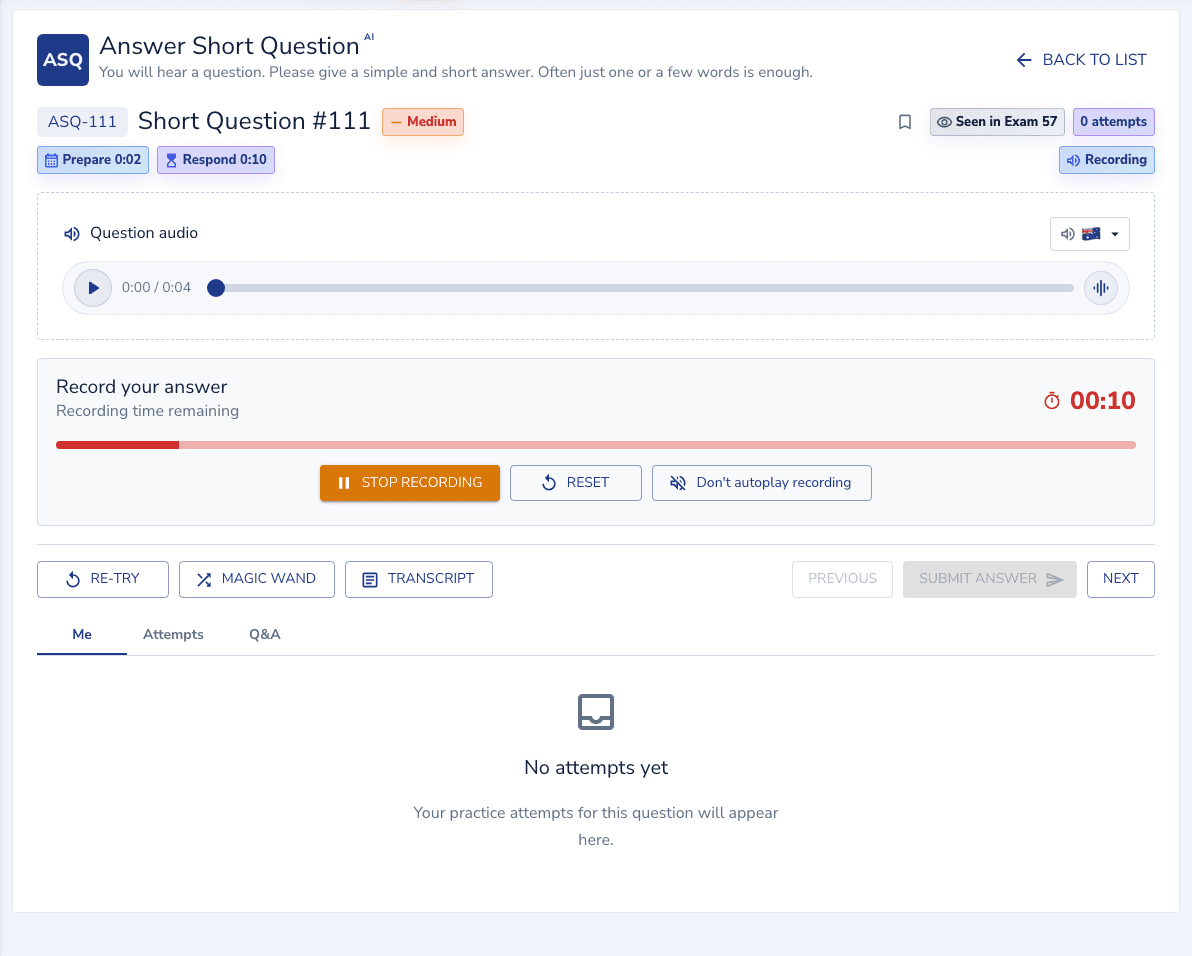
You hear: “What organ controls your speech, feelings, body movement and thoughts?” (Real bank question — shown in the player below.)

Answer

Brain (also accepted: cerebrum).

Why it scores

One word is all the task needs — the item is scored correct or incorrect for 1 point.

What loses marks

The question asks which organ controls speech, feelings and movement. The response is “um… the part of your body which… I think it is the head, or the mind.” It arrives after a two-second pause, wraps the answer in a sentence, and the words it lands on, “head” and “mind”, are not the organ. Scored 0, where “brain” alone in the first second would have scored 1.

How it is scored

The item is scored correct or incorrect for one point on a single trait, Vocabulary. In PTE Academic the point goes to your Listening score. In PTE Core it counts towards Listening and Speaking.

Vocabulary: 1 for an appropriate word, 0 otherwise

The scorer checks whether the response contains an appropriate word for the question. Synonyms and equivalent forms count, so “cerebrum” is as correct as “brain”. A correct word inside a short sentence still scores; a wrong word said confidently scores 0.
Content: understood the question

There is no separate Content mark, but the question tests listening comprehension: the words it uses are ordinary, and the concept it asks about is general knowledge. If you misheard the key word, no amount of vocabulary saves the item.

Fluency and pronunciation: not scored, but the word must be recognisable

No 0–5 scale applies. The only pronunciation requirement is that the word is clear enough to be recognised as the word you mean, so say it slowly and in full.

Because each item is a single point and there is no negative marking, always answer. A guess costs nothing and silence scores the same as a wrong answer.

How to answer it

There is nothing to prepare and nothing to plan, so the method is a set of reflexes: hear the question type, find the word, say it.

  1. Catch the question word

    What, which, how many, where. It tells you the shape of the answer before the question finishes: a thing, a category, a number, a place.

  2. Listen for the defining phrase

    Most questions are a definition turned around: “What organ controls…”, “What do we call a person who…”. The last few words carry the clue, so keep listening to the end even when you think you know.

  3. Say the word, not a sentence

    The first appropriate word wins. Adding “I think it is…” delays the answer and gives you room to talk yourself out of it.

  4. If two words come to mind, say the more common one

    “Brain” over “cerebrum”, “thermometer” over the technical name. Both usually score, but the common word is the one the question was written around.

  5. Unsure? Guess and move on

    A related word sometimes scores and a blank never does. Do not spend the ten seconds thinking; the question after this one needs your attention more.

Common mistakes

MistakeWhy it costs marksWhat to do instead
Answering in a full sentenceWhy it costs marksIt delays the answer, risks the three-second silence limit at the start, and adds words that can obscure the one that scores.What to do insteadOne word or a short phrase. Then stop.
Waiting to be sureWhy it costs marksThree seconds of silence closes the recorder, and the item scores 0 whether you knew the answer or not.What to do insteadSay your best word within a second of the audio ending.
Answering the first half of the questionWhy it costs marksMany questions narrow at the end: “…that is used at night”, “…in a hospital”. Answering early gives the general word when a specific one was asked for.What to do insteadListen to the last word before you speak. Ten seconds is plenty.
Staying silent when unsureWhy it costs marksThere is no penalty for a wrong answer, so silence is the only way to guarantee 0.What to do insteadSay the closest word you have. Related words sometimes score.
Changing the answer mid-responseWhy it costs marks“Brain… no, heart” contains a wrong word and a hesitation. The scorer is looking for an appropriate word; giving two makes the response ambiguous.What to do insteadCommit to the first word.

How to practise

Answer Short Question rewards breadth of everyday and general-academic vocabulary. The routine is short daily sets, with the misses sorted by topic so the gaps close rather than repeat.

  1. Do sets of twenty without pausing

    One play, immediate answer, no replay, no thinking time between items. Twenty items take about five minutes and the pace matters as much as the words.

  2. Sort every miss by theme

    Science, geography, jobs, tools, units, everyday objects, body, time. Almost everyone has two or three weak themes and the rest is fine. Note the theme of every miss in a list; the pattern is visible after a few sets.

  3. Repeat only the missed items

    Run the missed questions again the next day until the answer arrives in the first second. Do not re-run the whole set; you are training recall of specific words, not the task.

  4. Learn definitions, not translations

    The questions are definitions in disguise, so practise recognising a word from its description. Reading dictionary definitions of common nouns and naming the word is direct training.

  5. Return to mixed sets weekly

    Once the weak themes have closed, mixed sets under the timer confirm the reflex works when you cannot predict the topic.

Practice set

30 questions with answers

Items from the EdKnot bank, each with its answer, on one page. Every item opens in the practice player with its timer, recording and scoring.

Answer Short Question practice inside the EdKnot question player

What 65 and 79 need

Every item is one point, so this task is about the hit rate across the set rather than the quality of any single answer.

65

Four out of five or six answered correctly, with the miss usually on a technical or less common word. Answers arrive within a second or two, as single words.

79

All items correct, answered in the first second, including the ones that narrow at the end of the question. The vocabulary covers general science, geography, occupations, everyday objects and units without hesitation.

Frequently asked questions

How long do you get for Answer Short Question in PTE?

The question audio lasts 3–9 seconds and plays once. You then have 10 seconds to answer, but the recorder closes if you stay silent for more than three seconds, so answer straight away.

How is Answer Short Question scored in PTE?

Each item is scored correct or incorrect for 1 point on a single trait, Vocabulary: whether the response contains an appropriate word for the question. In PTE Academic the point goes to your Listening score; in PTE Core it counts towards Listening and Speaking.

Do I need to answer in a full sentence for Answer Short Question?

No. The task asks for one word or a few words, so a full sentence is unnecessary and delays the answer. There are 5–6 items in both PTE Academic and PTE Core.

Do synonyms count in Answer Short Question?

Yes, when it is an appropriate word for the question. “Cerebrum” scores the same as “brain”. Choose the common word when two come to mind, because the question was written around it.

What happens if I answer wrongly in Answer Short Question?

Nothing. There is no negative marking, so a wrong answer scores the same as silence. Always say your best word.

Does Answer Short Question count towards Speaking in PTE Academic?

No. Since the 2025 update, Answer Short Question in PTE Academic contributes to the Listening score only. It still contributes to Speaking in PTE Core.

The one right word, said clearly, inside three seconds.

Practise Answer Short Question with the real clock and see the answer the moment you submit.

Practise Answer Short Question