Speaking and Writing - PTE Academic / UKVI

Summarize Written Text

Summarize Written Text gives you a passage of up to 300 words and ten minutes to compress it into one sentence of 5–75 words. It counts towards both Reading and Writing, and one formatting rule decides whether the rest of the marks are even available. Here is how the four traits are scored and a sentence shape that passes all of them.

10 min
to write
5–75
words in one sentence
2
items per test
9
marks: Content 4, Form 1, Grammar 2, Vocabulary 2

The task

Summarize Written Text is the first writing task, after the speaking items. Two items, each with its own ten-minute timer and its own passage.

Appears inPTE Academic / UKVI — Speaking & Writing part (integrated task)
Items per test2
Passage lengthUp to 300 words
Time to write10 minutes
Answer ruleONE single, complete sentence of 5–75 words — otherwise Form scores 0
ScoringPartial credit — Content 0–4 (Pearson: AI plus examiner review), Form 0–1, Grammar 0–2, Vocabulary 0–2
Negative markingNone
Skills creditedReading and Writing
In the exam
  1. The passage and the answer box appear together

    A text of up to 300 words sits above an empty box. A word counter under the box updates as you type, and Cut, Copy and Paste buttons work inside the box. The ten-minute countdown starts immediately.

  2. You read, plan and write inside the same ten minutes

    There is no separate reading time. Most people need two to three minutes to read and mark the main ideas, three to four to write, and the rest to check the sentence.

  3. The item closes at ten minutes or when you click Next

    Whatever is in the box at that moment is your answer. Clicking Next early does not bank time for the next item, so use what is left to check the sentence.

  4. Two items, then Write Essay

    Passages are academic in tone: science, society, economics, history. You are not expected to know the subject, only to identify what the author is saying.

How one item is scored

Question

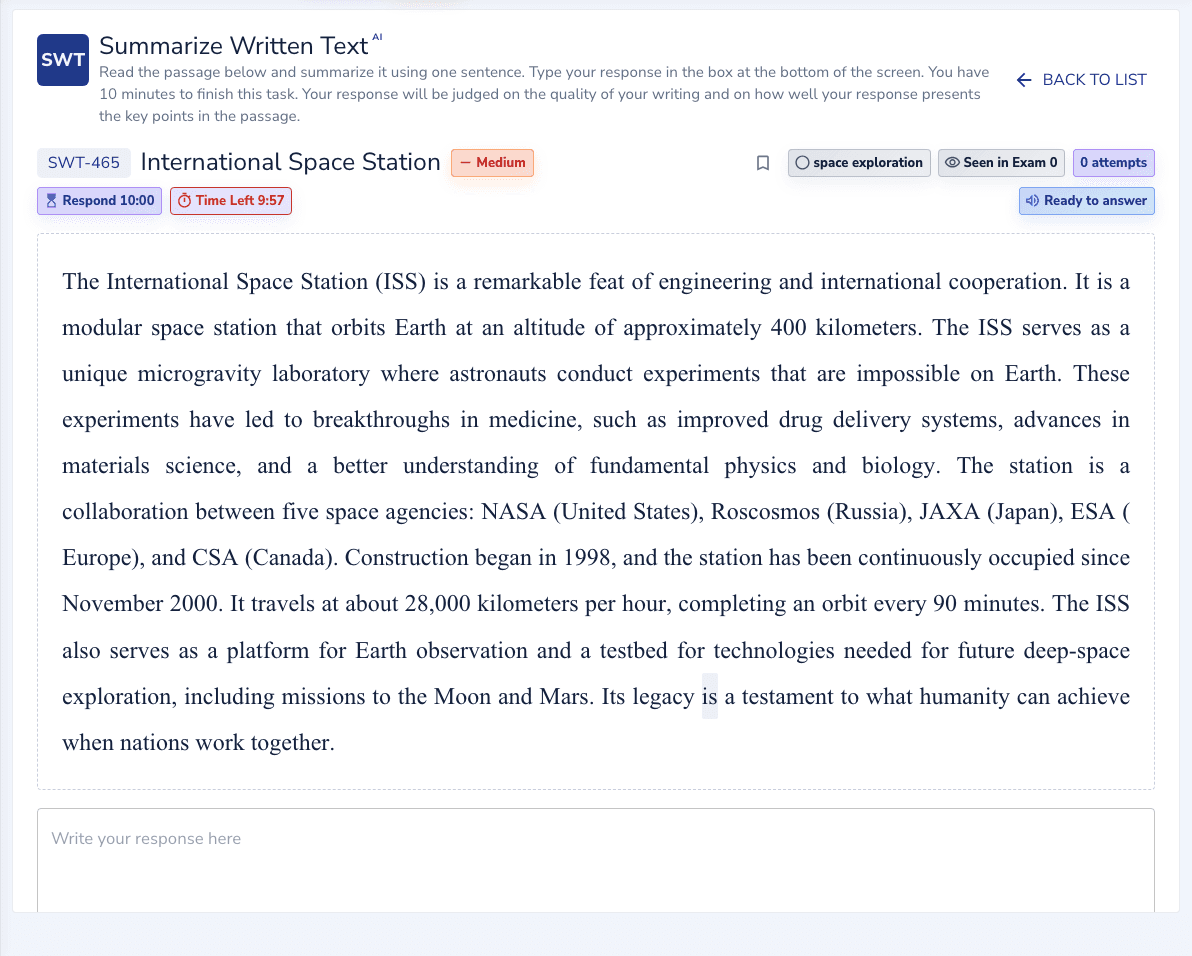
A ~300-word passage describes the International Space Station: its orbit, its role as a microgravity laboratory, and the five collaborating space agencies. Summarize it in ONE sentence of 5–75 words within 10 minutes. (Real bank question — shown in the player below.)

Answer

The International Space Station (ISS), a modular space station in low Earth orbit that has been continuously inhabited since 2000, is a collaborative project of five space agencies and serves as a microgravity laboratory where research has advanced medicine, materials science, and our understanding of the universe.

Why it scores

One grammatical sentence of 47 words — inside the 5–75 word rule that Form requires.

What loses marks

“The ISS is a space station. It was launched in 1998 and is in low Earth orbit. Five space agencies work on it. Astronauts do experiments there.” Four sentences, so Form is 0. The ideas are all lifted from the passage’s own phrasing, the research outcomes are missing, and nothing is connected, so Content sits at 2 even before Form is counted.

How it is scored

Four traits with partial credit, counting towards both Reading and Writing. Content is scored by Pearson’s AI and reviewed by a Pearson examiner in the live test. Form is a single yes-or-no check that every other trait depends on.

Form: 1 if it is one single, complete sentence of 5–75 words

Form scores 0 if the response is more than one sentence, fewer than 5 words, more than 75 words, or written in capital letters. A full stop in the middle, a fragment, or a second sentence tacked on the end fails this check. It is the one rule in the task with no partial credit.
Content: 0–4 for a comprehensive, paraphrased summary

A 4 summarises the passage comprehensively, paraphrases effectively, removes extraneous detail and synthesises all the main ideas concisely. A 3 identifies the main ideas with minor omissions and paraphrases inconsistently. A 2 shows basic comprehension with no distinction between main points and peripheral detail and relies on repeating excerpts from the text. Disconnected excerpts with no synthesis are a 1.

Grammar: 0–2

A 2 has correct grammatical structure. A 1 has errors that do not hinder communication. A 0 has defective structure that could. A 50-word sentence has many places to go wrong, which is why the sentence shape matters as much as the ideas.

Vocabulary: 0–2

A 2 has appropriate word choice throughout. A 1 has lexical errors with no hindrance to communication. Copying the passage’s exact phrases does not earn Vocabulary marks and costs Content marks, because paraphrase is what both traits reward.

The Content descriptors say “extraneous details are removed” for a 4 and “no discernment between main points and peripheral detail” for a 2. The summary is judged on what you leave out as much as on what you keep. That review is part of Pearson’s live test. EdKnot practice scoring is entirely automated: no person sees or scores any practice response.

Templates that score full marks

Every template below is taught inside EdKnot and verified against the same AI scoring engine that marks your practice — out of 9 for this task.

Template 1 — elucidates / while simultaneously / ultimately indicating
The passage elucidates [MAIN IDEA + defining detail], while simultaneously highlighting [POINT 1] and [POINT 2], ultimately indicating that [CONCLUSION].
Template 2 — discusses / highlights / emphasizing
The passage discusses [MAIN IDEA] and highlights [DETAIL], emphasizing [IMPACT].
Template 3 — explains / while also highlighting / indicating
The passage explains [POINT], while also highlighting [POINT], indicating that [CONCLUSION].
Worked example — Forest Bathing and Health Benefits

The passage elucidates forest bathing, or shinrin-yoku, named in Japan in 1982 amid rising urban stress, while simultaneously highlighting research that links it to lower cortisol, reduced blood…

Template 1 · 69 words · one sentence, all six key points covered and almost none of the passage's original phrasing reused.

How to answer it

The passage has two to four main ideas and a lot of support for them. The job is to find the main ideas, join them in one grammatical sentence, and say them in your own words. Ten minutes is enough for all three if you do them in order.

  1. Minutes 0–3: read once and mark the main ideas

    Read the whole passage before writing anything. Then find the topic sentence of each paragraph and the author’s conclusion, if there is one. Two to four ideas is normal; a list of six means some are supporting detail.

  2. Minute 3: choose the sentence shape

    One main clause carrying the central idea, with the other ideas attached as subordinate clauses: “Although X, Y, which means Z.” Or a list joined by semicolons is not a sentence, and neither is a dash between two clauses. Use “which”, “because”, “while”, “and” to join.

  3. Minutes 3–7: write it in your own words

    Keep the passage’s technical terms and names; change everything else. Replace each main idea’s phrasing with a paraphrase as you write, rather than copying and editing afterwards, which almost always leaves excerpts behind.

  4. Minutes 7–9: check Form first, then grammar

    Count the full stops: there must be exactly one, at the end. Check the word counter: between 5 and 75, ideally 30–55. Then read the sentence aloud in your head for a subject and verb in every clause and agreement between them.

  5. Minute 9–10: cut what is not a main idea

    If the sentence is over 60 words, something in it is a detail. Remove the example or the number, not the idea. A tight 40-word sentence with every main point scores higher than a 74-word one with two examples.

Common mistakes

MistakeWhy it costs marksWhat to do instead
Writing two sentencesWhy it costs marksForm scores 0 the moment there is a second full stop, and the Reading and Writing credit for the item goes with it.What to do insteadJoin the second idea with “which”, “while” or “and”. One full stop, at the end.
Copying the passage’s phrasingWhy it costs marksRepeating excerpts without reformulation is the Content 2 descriptor, and copied phrases earn nothing for Vocabulary.What to do insteadKeep names and technical terms, paraphrase everything else as you write.
Including examples and numbersWhy it costs marksThe Content 4 descriptor requires extraneous details removed. Details also push the sentence towards the 75-word limit and add grammar risk.What to do insteadOne clause per main idea, no examples. Under 55 words is a good sign.
Summarising only the first paragraphWhy it costs marksMissing main ideas is the difference between a 4 and a 3, and passages usually carry a second idea or a conclusion in the final paragraph.What to do insteadRead to the end before writing. Mark one idea per paragraph.
A grammatically broken long sentenceWhy it costs marksDefective structure that could hinder communication is Grammar 0, and a sentence with no clear main verb may also fail the Form check.What to do insteadBuild from one main clause and attach the rest with connectors you use confidently.
Leaving no time to checkWhy it costs marksA missed full stop or a stray capital is a Form 0 that ten seconds of checking would have caught.What to do insteadStop writing at seven minutes. Count full stops, read the counter, read the sentence.

How to practise

This task rewards a repeatable sentence shape more than any other writing item. Practise the shape on many passages until the one-sentence constraint stops being the thing you think about.

  1. Write under the ten-minute timer, one passage at a time

    Use the real countdown and the real word counter. If you run out of time, note where the minutes went: reading, writing, or checking. Most learners over-spend on reading.

  2. Check Form yourself before looking at the score

    One sentence, 5–75 words, not capitals. Make it a reflex. Then compare your main ideas with the passage’s paragraph topics: did you keep all of them, and did you keep any detail that was not one?

  3. Mark copied phrases

    Underline every run of four or more words that appears in the passage. More than one or two means the paraphrase habit is not built yet. Rewrite those phrases and compare.

  4. Fix one grammar pattern per week

    Long sentences expose the same errors repeatedly: relative clauses without a verb, subject-verb agreement across a long noun phrase, comma splices. Find the one that recurs in your summaries and drill it.

  5. Read academic passages for their structure

    Five minutes a day identifying the topic sentence of each paragraph in a news or science article trains the reading half of the task without a timer.

Practice set

12 passages with answers

Items from the EdKnot bank, each with its answer, on one page. Every item opens in the practice player with its timer, recording and scoring.

Summarize Written Text practice inside the EdKnot question player

What 65 and 79 need

Summarize Written Text is scored per item and contributes to both Reading and Writing. These are the typical profiles behind each level on this task.

65

One grammatical sentence inside the limit with the main ideas present, one or two phrases lifted from the passage, and perhaps one supporting detail that did not need to be there. Content 3, Grammar and Vocabulary at 1 or 2.

79

One sentence of 30–55 words carrying every main idea and nothing else, in your own words, with subordinate clauses that read naturally. Content 4, Grammar 2, Vocabulary 2, Form 1, checked with a minute to spare.

Frequently asked questions

How many words should PTE Summarize Written Text be?

In Academic it must be one single, complete sentence of 5–75 words. Writing more than one sentence, or falling outside that range, scores 0 on Form. PTE Core is different: 25–50 words with no single-sentence rule.

How long do I get for Summarize Written Text and how many come up?

You get 10 minutes per item, and the passage is up to 300 words. Academic has 2 items.

What is Summarize Written Text scored on?

Four traits: Content 0–4 for a comprehensive, paraphrased summary of the main ideas; Form 1 or 0 for one complete sentence of 5–75 words; Grammar 0–2; and Vocabulary 0–2. Content is scored by Pearson’s AI and reviewed by a Pearson examiner in the live test. The item counts towards both Reading and Writing.

Can I copy phrases from the passage in Summarize Written Text?

No. Copying the passage’s wording is explicitly described in the Content 2 descriptor, and copied phrases earn no Vocabulary credit. Keep names and technical terms and paraphrase the rest.

What is the ideal length for a Summarize Written Text answer?

Between 30 and 55 words is comfortable: long enough for two to four main ideas joined by subordinate clauses, short enough to stay grammatical and inside the 75-word limit.

Does a semicolon count as one sentence in Summarize Written Text?

Yes. Joining clauses with commas, semicolons or dashes without a conjunction is not one grammatical sentence and risks a Form 0. Use “which”, “while”, “because” or “and” to join ideas.

One grammatical sentence that carries every main idea of the passage, in your own words.

Practise Summarize Written Text with the real clock and see the answer the moment you submit.

Practise Summarize Written Text