Speaking and Writing - PTE Core

Respond to a Situation Core

Respond to a Situation in PTE Core gives you an everyday scenario on screen and in audio, 20 seconds to think, and 40 seconds to say what you would say to the person. It is scored on Appropriacy, fluency and pronunciation, with no separate Content mark, so the whole task is doing the right social thing, politely, in natural continuous speech.

20 s
to prepare
40 s
to speak
2–4
items per test
13
marks: Appropriacy 3, Fluency 5, Pronunciation 5

The task

Respond to a Situation comes after Describe Image in PTE Core, with two to four items. Scenarios are practical and Canadian-everyday: neighbours, workplaces, shops, appointments, transport.

Appears inPTE Core — Speaking & Writing part
Items per test2–4
ScenarioUp to 60 words — read on screen and heard
Preparation time20 seconds (Academic version: 10 seconds)
Time to speak40 seconds
ScoringPartial credit — Appropriacy 0–3, Oral fluency 0–5, Pronunciation 0–5
Negative markingNone
Skills creditedSpeaking
In the exam
  1. The scenario appears and is read aloud

    A description of up to 60 words is shown on screen and played as audio. It tells you who you are speaking to, what has happened, and what you need to do. The text stays on screen throughout the item.

  2. Twenty seconds to prepare

    Twice the preparation time of the Academic version. Use it to fix the listener, the register, and the language function the situation calls for: apologise, ask, decline, complain, explain.

  3. Forty seconds to speak, in role

    The status box shows “Recording”. Start within three seconds. Speak directly to the person as if they were there. The recording ends when the bar completes or on three seconds of silence.

  4. Two to four items

    Each scenario asks for a different social move and often a different register, from a friend to a landlord to a customer-service line. The register is what is scored.

How one item is scored

Question

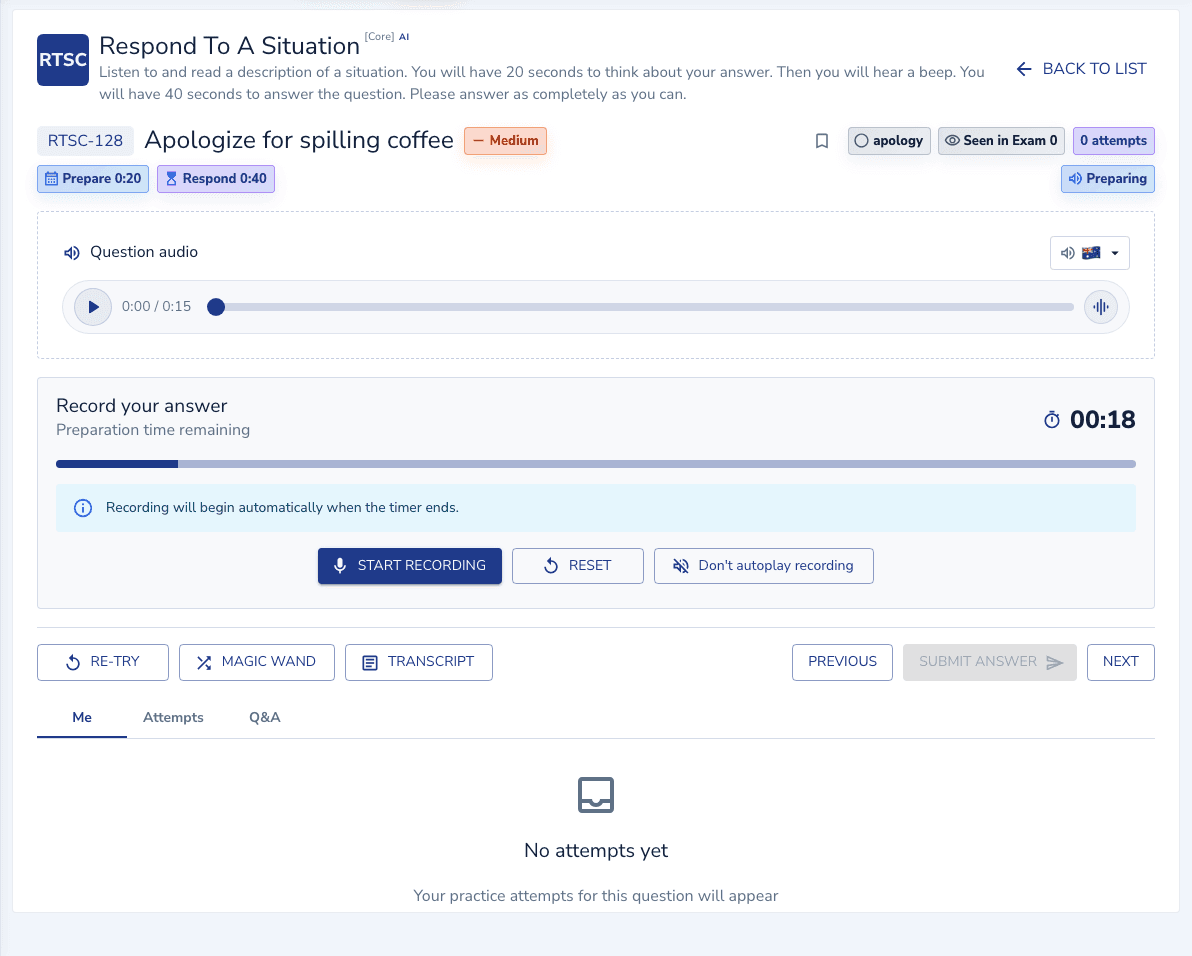
“You are in a hurry at a coffee shop and accidentally bump into another customer, causing their coffee to spill on their shirt. The person looks upset. You want to apologize sincerely and offer to make it right.” (Real bank question — shown in the player below. 20 seconds to prepare in Core.)

Answer

“Oh, I’m so sorry! I wasn’t looking where I was going. Let me help you clean that up. I feel terrible about your shirt. Please let me pay for the dry cleaning or buy you a new coffee. Is there anything else I can do? I really apologize for my carelessness.”

Why it scores

A sincere apology, an offer to fix the problem, and an open follow-up — exactly the Appropriacy the task scores.

What loses marks

“Hello. I am very sorry for this situation. I hope you understand. Thank you for your understanding. Have a nice day.” It is polite, but it is the same five sentences that could follow any scenario: it never mentions the coffee, the shirt, or what the speaker will do about it, so the social demands of the situation are not represented. That is an Appropriacy 1, pre-packaged routines, and it ends at ten seconds with the bar mostly unused.

How it is scored

Three traits with partial credit, all counting towards Speaking. Unlike the Academic version, PTE Core scores Appropriacy as its own trait and has no Content trait, so the marks come from doing the right thing in the right tone, delivered fluently and clearly.

Appropriacy: 0–3 for the right language function in the right register

A 3 expresses the language functions the situation calls for clearly and politely, in a formal or informal register that suits the situation and the person, with the social demands of the situation represented in an appropriate level of detail. A 2 performs the right functions in a mostly appropriate register. A 1 uses the simplest common expressions and basic routines that may be inappropriate for the situation. A 0 is a few short, isolated, pre-packaged phrases that do not relate coherently to the scenario.
Oral fluency: 0–5 for natural continuous speech

The top band has smooth rhythm with no hesitations, repetitions or false starts; the next allows one. Planning pauses while you decide what to say are the usual cost on this task, which is what the 20 seconds are for.

Pronunciation: 0–5 for clarity and stress

Being easily understood by a regular listener, with correct word and sentence stress. Politeness lives partly in intonation, so stress on the softening words (“really”, “I’m afraid”, “would you mind”) carries the register that Appropriacy rewards.

The Appropriacy descriptors are about function and register, not about how much you say. A short, polite, complete apology in the right tone scores 3; a long, memorised template that fits any situation is exactly what the 0 descriptor describes.

Templates that score full marks

Every template below is taught inside EdKnot and verified against the same AI scoring engine that marks your practice — out of 13 for this task.

Template 1 — professional register
Hello [NAME], this is [YOUR NAME] calling about [SITUATION]. [SPECIFIC DETAIL]. I apologise for any inconvenience - would it be possible to [RESOLUTION]? Thank you for understanding.
Template 2 — personal register
Hey [NAME], it's [YOUR NAME]! About [SITUATION] - [SPECIFIC DETAIL]. Could we [REQUEST]? Let me know what works. Thanks!

How to answer it

Every situation calls for one main language function and the same four-part shape: acknowledge, do the function, give the reason or detail, and move things forward. Twenty seconds is enough to plan all four.

  1. Seconds 1–5: who is the listener?

    Friend, neighbour, boss, landlord, shop assistant, stranger. This sets the register: first names and contractions for a friend, “I’m afraid” and “would it be possible” for a landlord or a manager.

  2. Seconds 5–10: what is the function?

    Apologise, ask permission, make a request, decline, complain, explain a problem, offer help. Say it to yourself in one word. Appropriacy is scored on whether you performed that function, so it must be unmistakable in the response.

  3. Seconds 10–20: pick the specific detail

    One detail from the scenario that shows you are dealing with this situation and not a generic one: the spilled coffee, the noise last night, the shift you need to swap. That detail is what the 3 descriptor means by “represented in an appropriate level of detail”.

  4. Speak: acknowledge, then do the function

    Open by recognising the person or the situation (“Oh no, I’m so sorry”, “Hi, thanks for picking up”), then perform the function in a full sentence with the specific detail in it.

  5. Give the reason and move forward, then close

    One sentence of reason or context, one sentence that resolves things (offer to pay, suggest a time, ask what they would prefer), and a closing line in the same register. Four parts, two sentences each, fills 30–38 seconds without a pause.

Common mistakes

MistakeWhy it costs marksWhat to do instead
A memorised all-purpose answerWhy it costs marksThe Appropriacy 0 descriptor is “isolated, mainly pre-packaged forms that may not relate coherently to the situation”. Generic politeness with no detail from the scenario sits at 0 or 1.What to do insteadInclude one specific from the scenario in the second sentence and one in the resolution.
Wrong registerWhy it costs marksCasual language to a landlord or stiff formality to a friend is “inappropriate in register for the social demands of the situation”, the 1 descriptor.What to do insteadDecide the listener in the first five seconds and pick the opener to match.
Describing what you would sayWhy it costs marks“I would apologise and offer to pay” does not perform the language function, so there is nothing for Appropriacy to credit.What to do insteadSay it to the person: “I’m so sorry, please let me pay for the cleaning.”
Doing the function without resolving anythingWhy it costs marksThe social demands of a situation include what happens next. An apology with no offer, or a request with no reason, does not represent them in enough detail for a 3.What to do insteadAlways add the move forward: an offer, an alternative, a question.
Planning out loudWhy it costs marksRestarts and long pauses while deciding what to say drop Oral fluency to Intermediate or Limited.What to do insteadUse the full 20 seconds to plan the four parts. Once recording starts, begin with the acknowledgement.
Stopping at 15 secondsWhy it costs marksThree seconds of silence ends the recording, and short responses have usually skipped the reason and the resolution.What to do insteadFour parts, two sentences each. The structure fills the time.

How to practise

The task rewards a small set of social functions done in two registers. Practise them as a set so the shape is automatic and the preparation time goes on the specifics of each scenario.

  1. Drill by function

    Five apologies, then five requests, then five polite refusals, then five complaints. Sort the scenarios you practise by function as you go, so you can run one kind at a time.

  2. Record under exam timing, once

    Twenty seconds to prepare, 40 to speak, one take, in role. If you hear yourself narrating (“I would tell him…”), stop and restart the set speaking to the person.

  3. Check the register and the detail

    Listen back: would this listener find the tone natural? Did you name a specific from the scenario? EdKnot’s review scores the response on the official Appropriacy, fluency and pronunciation bands and shows the transcript, so check the register and the detail against it.

  4. Time the response

    Aim for 30–38 seconds. Under 20 usually means the reason or the way forward is missing.

  5. Build two phrase banks

    Ten openers and closers for informal listeners, ten for formal ones. Practise switching between them until the choice is instant.

Practice set

12 situations with answers

Items from the EdKnot bank, each with its answer, on one page. Every item opens in the practice player with its timer, recording and scoring.

Respond to a Situation Core practice inside the EdKnot question player

What 65 and 79 need

Respond to a Situation is scored per item and combined with the other speaking tasks. These are the typical profiles behind each level on this task; on the CLB scale, 65 sits around CLB 7 and 79 around CLB 9 for Speaking.

65

The right function performed in a mostly appropriate register, with a reason and one detail from the scenario. The resolution may be thin and there are a couple of hesitations. Appropriacy 2, fluency in the Good band, 25–30 seconds of speech.

79

Acknowledgement, the function, a specific reason and a concrete resolution, in a register that fits the listener from the first word to the last, with at most one hesitation over 30–38 seconds. Appropriacy 3, fluency Advanced, stress carrying the politeness.

Frequently asked questions

Is Respond to a Situation different in PTE Core?

PTE Core gives 20 seconds of preparation instead of Academic’s 10, and scores the task differently: Core has an Appropriacy trait (0–3) with Oral fluency and Pronunciation, while Academic scores Content, Oral fluency and Pronunciation. Both versions give you 40 seconds to answer.

How many Respond to a Situation questions are in PTE Core?

PTE Core has 2–4 items, compared with 2–3 in PTE Academic.

How long is the scenario in Respond to a Situation?

The scenario is up to 60 words, and you both read it on screen and hear it before you respond.

What does Appropriacy mean in PTE Core Respond to a Situation?

Appropriacy, scored 0–3, is whether you performed the language function the situation calls for, clearly and politely, in a formal or informal register that suits the situation and the person, with enough detail to show you are dealing with this scenario rather than a generic one.

Is Content scored in PTE Core Respond to a Situation?

No. The Core version scores Appropriacy, Oral fluency and Pronunciation only. There is no Content trait, but the Appropriacy descriptors reward detail from the scenario and penalise pre-packaged phrases, so the response still has to be specific.

How long should my Respond to a Situation answer be?

Aim for 30–38 seconds: acknowledge the person, perform the function with a specific detail, give a reason, and resolve it. The recording stops after three seconds of silence.

The right language function, in the right register, said naturally for 40 seconds.

Practise Respond to a Situation Core with the real clock and see the answer the moment you submit.

Practise Respond to a Situation Core