Speaking and Writing - PTE Core

Summarize Written Text Core

Summarize Written Text in PTE Core gives you a short passage and ten minutes to write a 25–50 word summary. Unlike the Academic version there is no one-sentence rule, and Content is scored on whether every relevant aspect of the text is there. It counts towards both Reading and Writing.

10 min
to write
25–50
words, any number of sentences
1–2
items per test
8
marks across four traits

The task

Summarize Written Text comes after the speaking items in PTE Core, before Write Email. One or two items, each with its own passage and ten-minute timer.

Appears inPTE Core — Speaking & Writing part (integrated task)
Items per test1–2
Passage lengthUp to 200 words
Time to write10 minutes
Word limit25–50 words — partial credit at 5–24 / 51–60, zero below 5 or above 60
Answer ruleMay be more than one sentence (unlike Academic)
ScoringPartial credit — Content 0–2, Form 0–2, Grammar 0–2, Vocabulary 0–2
Negative markingNone
Skills creditedReading and Writing
In the exam
  1. The passage and the answer box appear together

    A text of up to 200 words sits above an empty box with a live word counter and Cut, Copy and Paste buttons. The ten-minute countdown starts as soon as the item opens.

  2. Read, plan and write inside the ten minutes

    There is no separate reading time. Two minutes to read and mark the aspects, four to write, and the rest to count words and check grammar is a comfortable split.

  3. The item closes at ten minutes or when you click Next

    The text in the box at that moment is the answer. Unused time is not carried over, so use it to check.

  4. Passages are everyday and general

    Core texts cover topics like technology in daily life, work, health and community rather than academic research. The task is the same: say what the passage says, shorter and in your own words.

How one item is scored

Question

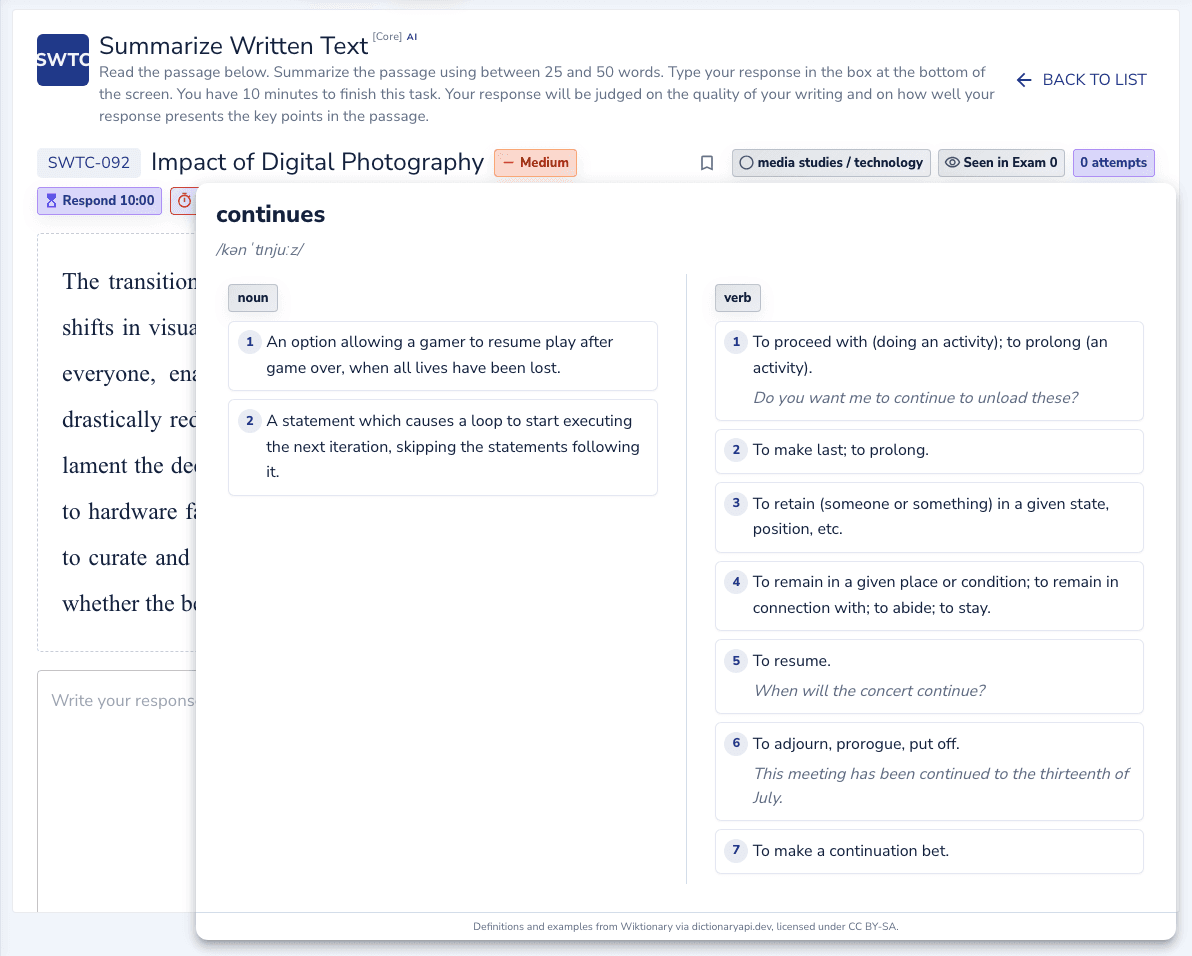
A passage examines the move from analog film to digital photography — instant sharing and lower costs versus lost darkroom craft and fragile digital files. Write a 25–50 word summary in 10 minutes. (Real bank question — shown in the player below.)

Answer

The shift from film to digital photography made image capture instant and universal, cutting the cost and waste of film, but it raised concerns about image permanence, curation, and the loss of darkroom craftsmanship.

Why it scores

At 34 words it sits inside Core’s 25–50 word band — and unlike Academic, more than one sentence would also be acceptable.

What loses marks

“Digital photography is better than film because it is instant and cheap. Everyone can take photos now. The passage says digital photos are easier to share.” It covers the benefits and stops: the concerns about permanence, curation and lost craft, which are half the passage, are missing. At 27 words Form is fine, but Content is 1 for two missing aspects, and “the passage says” wastes words that could have carried one of them.

How it is scored

Four traits with partial credit, counting towards both Reading and Writing. The scales are shorter than in Academic and the Form rule is a word range rather than a sentence count.

Content: 0–2 for covering every relevant aspect

A 2 is a good summary in which all relevant aspects of the text are mentioned. A 1 is a fair summary that misses one or two aspects. A 0 omits or misrepresents the main aspects. The scale is about coverage: a summary that includes every point briefly outscores one that explains two of them well.
Form: 2 for 25–50 words

A 2 is 25–50 words. A 1 is 5–24 words or 51–60 words. A 0 is fewer than 5 or more than 60 words, or a response written in capital letters, with no punctuation, or as bullet points. More than one sentence is fine.

Grammar: 0–2

A 2 has correct grammatical structure. A 1 has errors with no hindrance to communication. A 0 has defective structure that could hinder it. Two or three short sentences are safer than one long one, and Core allows them.

Vocabulary: 0–2

A 2 has appropriate word choice; a 1 has lexical errors with no hindrance; a 0 has defective word choice. Paraphrasing the passage in plain words scores here; copying its phrases does not.

With 25–50 words and a coverage-based Content scale, the winning shape is one short sentence per aspect of the passage, in order, with no examples.

Templates that score full marks

Every template below is taught inside EdKnot and verified against the same AI scoring engine that marks your practice — out of 8 for this task.

Template 1 — explains and highlights
The passage explains [MAIN IDEA]. It highlights [POINT 1] and [POINT 2]. Overall, [CONCLUSION].
Template 2 — highlights and explores
The passage highlights [SUBJECT] and explores [ASPECT]. It also mentions [SECOND POINT]. Overall, it emphasises [CONCLUSION].
Worked example — Vertical Farming: Benefits and Barriers

The passage explains vertical farming, where crops grow in stacked indoor layers under controlled conditions. It highlights major water savings, pesticide-free produce and city-based supply, but…

Template 1 · 41 words · three short sentences - scored 8/8 on this scoring engine.

How to answer it

The Core scale rewards coverage inside a tight word range. Find every aspect of the passage, give each one a short clause, and stop.

  1. Minutes 0–2: read once and list the aspects

    Read the whole passage. Then write, in the box or in your head, a two-word label for each distinct point the author makes. Three to five is typical. If the passage has a “but” or “however”, the point after it is always an aspect.

  2. Minute 2: decide the sentence count

    One sentence per aspect, or two aspects joined by “but” or “and” where they contrast or pair naturally. Two or three sentences of 12–20 words each lands in the 25–50 range on its own.

  3. Minutes 2–6: write in your own words

    Keep the passage’s names and technical terms; replace the rest. Use plain verbs: “made”, “raised”, “cut”, “changed”. Avoid “the passage says” and “the author thinks”; the summary is the content, not a report about it.

  4. Minutes 6–8: check the counter and the coverage

    Between 25 and 50 on the counter. Then tick each aspect from your list against the sentences. A missing aspect is a Content point; add it as a short clause even if the count is already at 45.

  5. Minutes 8–10: check grammar and cut examples

    A subject and verb in every sentence, agreement, and no comma splices. If you are over 50, the extra words are almost always an example or a number, not an aspect.

Common mistakes

MistakeWhy it costs marksWhat to do instead
Summarising the first half onlyWhy it costs marksEach missing aspect costs a Content point on a two-point scale. Passages usually put a contrast or a concern in the second half.What to do insteadRead to the end and label every point before writing. Look for “but”, “however” and “although”.
Copying sentences from the passageWhy it costs marksCopied phrases earn no Vocabulary credit and usually drag examples in, pushing the count over 50.What to do insteadKeep names and terms, paraphrase everything else with plain verbs.
Writing 60 words to be safeWhy it costs marks51–60 words is Form 1, and over 60 is Form 0. The range is 25–50, and every word above it is a lost mark.What to do insteadStop at 45. If an aspect is missing, replace an example with it rather than adding.
One long Academic-style sentenceWhy it costs marksCore does not require it, and a 45-word sentence carries far more grammar risk than three short ones.What to do insteadOne sentence per aspect. Join two only when they contrast or pair naturally.
Opening with “The passage is about…”Why it costs marksIt spends five to eight of your 50 words on nothing the Content trait credits.What to do insteadStart with the first aspect: “Digital photography made image capture instant…”.
Bullet points or no punctuationWhy it costs marksBoth are named in the Form 0 descriptor, regardless of word count.What to do insteadFull sentences with capitals and full stops, every time.

How to practise

This is a coverage task, so practice is about spotting every aspect quickly and writing to a word range without counting on your fingers.

  1. Write under the ten-minute timer with the counter visible

    Use the real countdown and word counter. Aim to finish writing by minute six so checking becomes a habit rather than a luxury.

  2. Score coverage against the passage

    After each attempt, list the passage’s aspects and tick the ones your summary contains. The scoring review shows the Content, Form, Grammar and Vocabulary marks separately, so a coverage gap is visible as a Content 1.

  3. Practise the label step alone

    Take any short article and write a two-word label per point in under a minute. This is the half of the task that decides Content, and it can be practised without writing a summary at all.

  4. Learn your word-length feel

    After a few attempts you will know what 40 words looks like in your handwriting or typing. Check the counter once at the end rather than after every sentence.

  5. Fix one recurring grammar error

    Short sentences expose articles, tense and plural agreement. Find the one that recurs and drill it in isolation for a week.

Practice set

12 passages with answers

Items from the EdKnot bank, each with its answer, on one page. Every item opens in the practice player with its timer, recording and scoring.

Summarize Written Text Core practice inside the EdKnot question player

What 65 and 79 need

Summarize Written Text is scored per item and contributes to both Reading and Writing. On the CLB scale used for Canada, 65 sits around CLB 7 and 79 around CLB 9 for Writing. These are the typical profiles behind each level on this task.

65

Inside 25–50 words with most aspects present and one missing or blurred, a phrase or two lifted from the passage, and a grammar slip that does not obscure meaning. Content 1–2, Form 2, Grammar 1, Vocabulary 1–2.

79

Every aspect of the passage in 30–45 words across two or three clean sentences, in your own words, with no examples and no slips. Content 2, Form 2, Grammar 2, Vocabulary 2, finished with time to check.

Frequently asked questions

How many words should PTE Core Summarize Written Text be?

Aim for 25–50 words, which scores full Form credit. You get partial Form credit at 5–24 or 51–60 words, and zero below 5 or above 60 words.

How is Core Summarize Written Text different from Academic?

Core wants 25–50 words and does not enforce a single sentence, so you may use more than one. Academic requires exactly one sentence of 5–75 words. Core’s Content scale is also shorter: 0–2, based on whether all relevant aspects of the text are mentioned.

How long is Core Summarize Written Text and how many items?

You get 10 minutes per item and there are 1–2 items, each based on a passage of up to 200 words.

What is PTE Core Summarize Written Text scored on?

Four traits: Content 0–2 for covering all relevant aspects; Form 0–2 for the word range; Grammar 0–2; and Vocabulary 0–2. The item counts towards both Reading and Writing.

Can I write more than one sentence in Core Summarize Written Text?

Yes. Two or three short sentences are fine and usually safer for Grammar than one long sentence. Bullet points, capital letters and text without punctuation score 0 on Form.

Can I copy from the passage in Summarize Written Text?

No. Copying the passage earns no Vocabulary credit and tends to drag examples into the summary, pushing the word count over the range. Keep names and technical terms and paraphrase the rest.

All the relevant aspects of the passage in 25–50 words, in clean sentences.

Practise Summarize Written Text Core with the real clock and see the answer the moment you submit.

Practise Summarize Written Text Core