
One point per blank, no deduction
A wrong choice scores 0 for that blank and nothing more. Leaving it empty scores the same 0, so there is never a reason not to choose. Four correct out of five is four points.
Reading - PTE Academic / UKVI, PTE Core
Fill in the Blanks (Dropdown) is the largest reading task: five or six passages with four or five blanks each, every blank a point. There is no per-item timer, so it competes with every other reading item for the same clock. Here is how the points work, how to read around a gap, and how to keep it to two minutes a passage.
The Reading part has one shared clock for all its items, about 23–30 minutes in PTE Academic and 27–37 in PTE Core. Dropdown blanks are mixed in with the other reading types rather than grouped.
| Appears in | PTE Academic / UKVI and PTE Core — Reading part |
|---|---|
| Items per test | 5–6 — the biggest reading type |
| Text length | Up to about 300 words, 4–5 blanks |
| Time | No per-item timer — shared Reading clock |
| Scoring | Partial credit — 1 point per correct blank |
| Negative marking | None |
| Skills credited | Reading (PTE Academic / UKVI); Reading and Writing (PTE Core) |
The text is up to 300 words with four or five blanks. Each blank is a dropdown with four or five options. Nothing is timed per item; the part clock at the top keeps running.
Click a blank, choose, move on. You can change any choice until you click Next. A blank left empty scores 0 for that blank, with no penalty.
There is no going back to a previous item anywhere in the Reading part. Check every blank has a value before clicking Next.
With four or five blanks each, this task alone carries 20–30 of the reading points. Two minutes per passage is the budget that leaves time for the rest of the part.
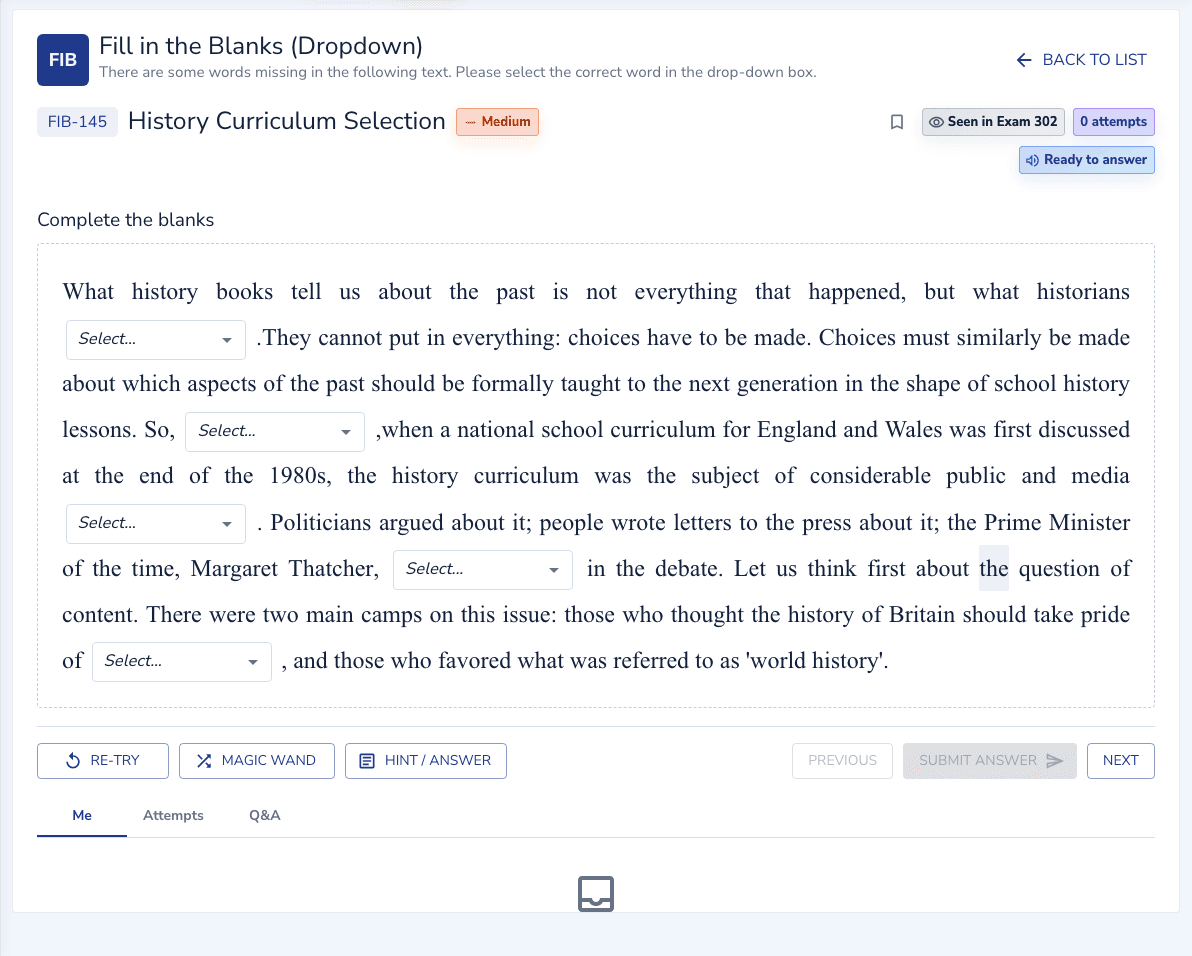
“What history books tell us about the past is not everything that happened, but what historians [1]… when a national school curriculum for England and Wales was first discussed… the history curriculum was the subject of considerable public and media [3]…” Five dropdown blanks. (Real bank question — shown in the player below.)
[1] have selected · [2] for example · [3] interest · [4] intervened · [5] place — each dropdown judged on grammar and collocation, 1 point per blank.
Fixed phrases decide most blanks (“public and media interest”, “intervened in the debate”) — read around the gap before choosing.
The reader opens the first dropdown before reading the sentence, picks the word that sounds academic, then does the same for the next four. Two of the five are wrong because the tense did not match the verb earlier in the sentence and one option collocated with the word before the gap but not the word after. Three points, and four minutes spent, twice the budget.
Partial credit, one point per correctly completed blank, minimum zero. In PTE Academic the points count towards Reading. In PTE Core the task is called Reading and Writing: Fill in the Blanks and counts towards both.
A wrong choice scores 0 for that blank and nothing more. Leaving it empty scores the same 0, so there is never a reason not to choose. Four correct out of five is four points.
Usually one of three things: grammar (tense, part of speech, agreement with the subject), collocation (which word goes with the words either side), or meaning in context (which option fits what the paragraph is arguing). The wrong options are chosen to look plausible on one of those and fail on another.
Academic: Reading. Core: Reading and Writing, because the same blanks measure control of written grammar and collocation. Either way, this is the highest-volume item in the part, and the most efficient place to earn reading points.
Because every blank is worth the same and there is no penalty, the strategy is speed with accuracy on the easy blanks and a fast, reasoned guess on the hard ones, not perfection on every blank.
The blanks reward reading around the gap before touching the dropdown. The method is the same for every blank and takes ten to twenty seconds each.
Twenty seconds. Knowing what the paragraph argues rules out options that fit the grammar but not the meaning.
Decide what kind of word the gap needs: a verb in which tense, a noun singular or plural, a linking phrase. Say the sentence with a placeholder.
Collocation decides most blanks: “considerable public and media ___” wants “interest”, not “concern” or “opinion”. Look one word left and one word right before looking at the options.
Cross off anything that fails the grammar, then anything that fails the collocation. What is left usually fits the meaning too. Two seconds of doubt between the last two: pick the more common phrase.
Check that every blank has a value, click Next. A hard blank is one point; the next passage is five.
| Mistake | Why it costs marks | What to do instead |
|---|---|---|
| Opening the dropdown before reading the sentence | Why it costs marksThe options prime you towards the one that sounds best in isolation, which is exactly how the distractors are chosen. | What to do insteadRead the full sentence, decide the word type and the collocation, then open the menu. |
| Checking only the word before the gap | Why it costs marksDistractors often collocate with the left side and fail on the right, or fail the tense set earlier in the sentence. | What to do insteadOne word left, one word right, and the main verb of the sentence. |
| Spending five minutes on one passage | Why it costs marksThe clock is shared with the whole Reading part. Minutes spent here are taken from Re-order Paragraphs and the other blanks. | What to do insteadTwo minutes per passage, then Next with every blank filled. |
| Leaving a blank empty | Why it costs marksThere is no negative marking, so an empty blank throws away a free chance at a point. | What to do insteadAlways choose something. Eliminate first, then pick. |
| Choosing the most academic-sounding word | Why it costs marksRare words are common distractors. The correct option is usually the ordinary phrase a native writer would use. | What to do insteadPrefer the common collocation over the impressive word. |
The blanks test collocation and grammar knowledge that grows with reading, so daily practice should be short sets plus deliberate reading, not hours of blanks alone.
Two minutes each. If you finish early, use the remainder on the blanks you were unsure of, then check. The time pressure is part of the skill.
Grammar, collocation or meaning? The review shows the correct option for each blank; the classification is yours. Most learners miss one category far more than the others, and it is the one to study.
Write down the correct phrase for every collocation miss, with the two words either side of the gap. Read the list before the next session. Fifty entries cover most of what the test uses.
Ten minutes of a science or economics article, noticing verb-noun and adjective-noun pairs, builds the collocation sense the task depends on faster than any drill.
If tense agreement or part of speech is the recurring miss, do targeted exercises on that alone for a week.
Practice set
12 passages with answers
Items from the EdKnot bank, each with its answer, on one page. Every item opens in the practice player with its timer, recording and scoring.
This task is scored per blank across five or six passages, so consistency matters more than any single item. These are the typical profiles behind each level.
Around three or four of every five blanks correct, with misses on the harder collocations and on tense agreement across long sentences. Passages finished in about two and a half minutes each.
Four or five of every five blanks correct, with grammar and collocation checked before the menu is opened, and two minutes or less per passage leaving time for the rest of the part.
It is the biggest reading type with 5–6 items in both tests. Each passage runs up to about 300 words with four or five blanks, and each blank has its own dropdown menu.
No. There is no negative marking and you earn one point per correctly completed blank, so always choose something for every blank.
In PTE Academic and UKVI it counts towards Reading. In PTE Core, where it is called Reading and Writing: Fill in the Blanks, it counts towards both Reading and Writing.
There is no per-item timer. The whole Reading part shares one clock, about 23–30 minutes in Academic and 27–37 in Core, so budget about two minutes per dropdown passage.
Mostly grammar (tense, part of speech, agreement), collocation (which word goes with the words either side of the gap) and meaning in context. Distractors usually fit one of those and fail another.
Yes, until you click Next. After Next there is no going back to any Reading item, so check every blank has a value first.
Grammar and collocation decide each blank. Read the whole sentence, then choose.
Practise Fill in the Blanks (Dropdown) with the real clock and see the answer the moment you submit.