Reading - PTE Academic / UKVI, PTE Core

Re-order Paragraphs

Re-order Paragraphs gives you four or five jumbled sentences and asks for the original order. It is scored by adjacent pairs, so a sequence that is half right still earns half the points. Here is how the pair scoring works, the links that reveal the order, and why the first sentence is the one to find.

1
point per correctly ordered adjacent pair
4–5
text boxes, up to 150 words
2–3
items per test
None
negative marking

The task

Re-order Paragraphs sits in the Reading part with the other reading items, all on one shared clock: about 23–30 minutes in PTE Academic, 27–37 in PTE Core. Two or three items per test.

Appears inPTE Academic / UKVI and PTE Core — Reading part
Items per test2–3
Text lengthUp to 150 words, 4–5 boxes
TaskDrag text boxes into the original order
TimeNo per-item timer — shared Reading clock
ScoringPartial credit — 1 point per correctly ordered adjacent pair
Negative markingNone
Skills creditedReading
In the exam
  1. Four or five text boxes appear on the left, jumbled

    Each box is a sentence or two; the whole text is up to 150 words. The right-hand panel is empty. The boxes are in random order, and the original was a single coherent paragraph.

  2. You drag boxes to the right panel in order

    Drag each box across, or use the arrow buttons to move boxes up and down within the panel. Boxes can be rearranged as many times as you like until Next.

  3. Next locks the item

    There is no returning to a Reading item. Move every box across before clicking Next: a box left on the left scores nothing and breaks a pair.

  4. Two or three items per test

    Two to three minutes each is the budget. The task rewards method more than reading speed, so the time is mostly spent finding links.

How one item is scored

Question

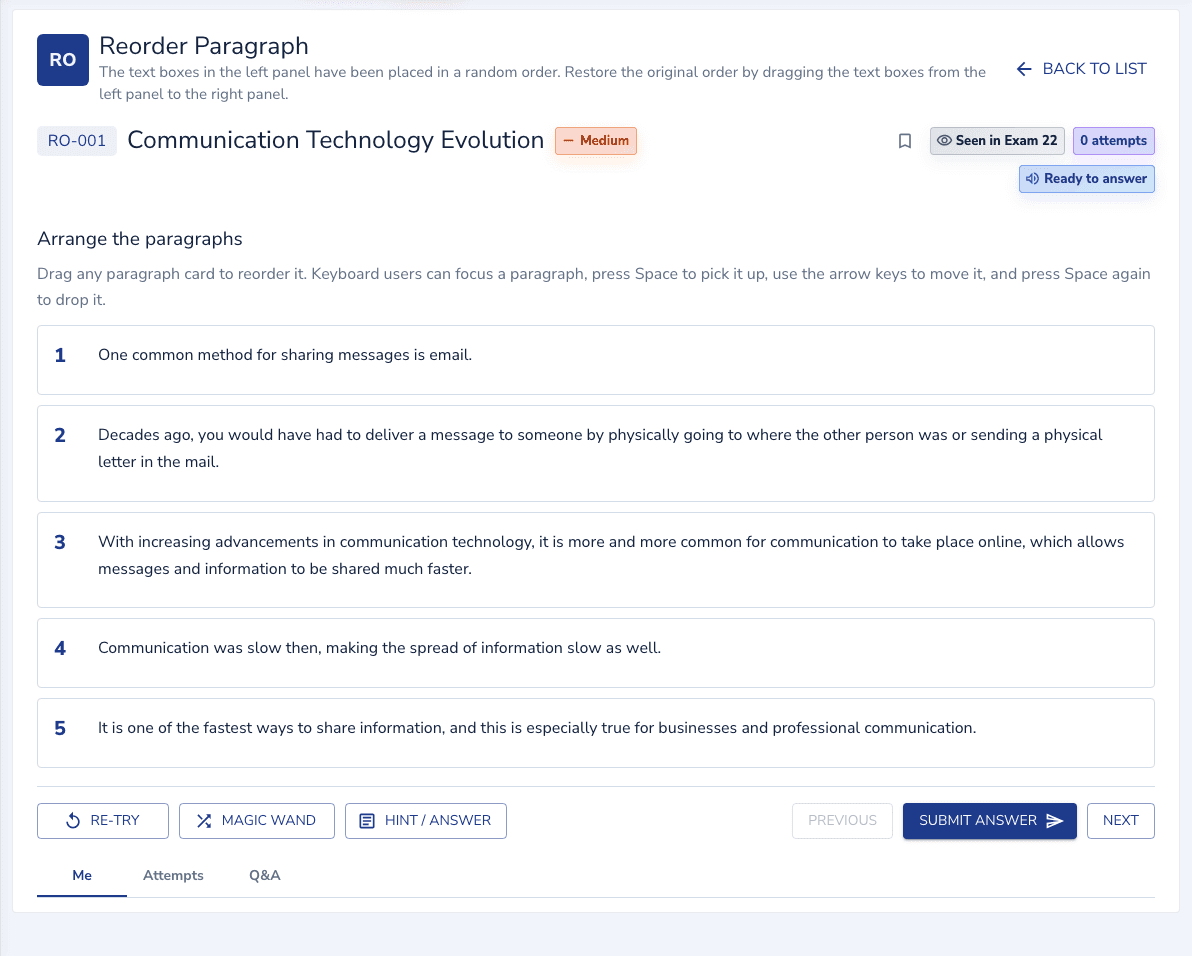
Five sentences about the evolution of communication technology — from hand-delivered letters to email — must be restored to their original order. (Real bank question — shown in the player below.)

Answer

Correct order: 2 → 4 → 3 → 1 → 5. “Decades ago…” sets the scene, “Communication was slow then…” refers back to it, “With increasing advancements…” pivots to the present, “One common method… is email” introduces the example, and “It is one of the fastest ways…” expands on email.

Why it scores

Referential links (“then”, “it”) decide the order — and each correctly ordered adjacent pair earns credit even if the full sequence isn’t perfect.

What loses marks

The reader picks the longest, most general sentence as the opener, then arranges the rest by topic similarity. The real opener, the one with a full noun phrase and no pronoun, ends up third, so every pair around it is wrong. One point out of four, from a set of sentences they understood perfectly.

How it is scored

Partial credit, one point for each pair of boxes that are correctly ordered and adjacent, minimum zero. Five boxes have four possible pairs, so the maximum is four. The task counts towards Reading in both tests.

One point per correct adjacent pair

If the correct order is 2-4-3-1-5 and you submit 2-4-1-3-5, the pairs 2-4 and 3-5 are… not quite: 2-4 is correct, 4-1 is wrong, 1-3 is wrong, 3-5 is wrong. One point. Submit 2-4-3-5-1 instead and 2-4 and 4-3 are right: two points. Every correct link earns, no matter what happens elsewhere.
No deduction for wrong pairs

A wrong pair scores 0, not minus one. There is no reason to leave boxes unplaced, and a partly confident order always beats an unfinished one.

Skills credited

Reading. The item tests whether you can follow how sentences refer to each other: pronouns, articles, time words and logical connectors.

Because scoring is by pairs, the goal is to get as many links right as possible, not to get the whole sequence right. Two sure links placed adjacent to each other are two points even if the rest is guessed.

How to answer it

Paragraphs are held together by references: a sentence with “it”, “this”, “then” or “these results” must follow the sentence that introduced them. The method is to find the sentence with no references, then chain forward.

  1. Find the opener: the sentence that needs nothing before it

    It names the topic with a full noun phrase, not a pronoun, and usually sets a scene or states a general point: “Decades ago, communication…”. It contains no “this”, “it”, “however” or “also”. Place it first.

  2. Follow each reference to its source

    For every other sentence, underline the word that points backwards: “it”, “these”, “such”, “then”, “the same”. Ask which sentence introduced that thing. That sentence goes immediately before.

  3. Use time and logic words to order the rest

    “Then”, “later”, “now”, “with increasing…”, “as a result”, “however” mark sequence and contrast. A sentence beginning with “however” follows a sentence it contradicts.

  4. Lock the pairs you are sure of

    If two boxes clearly belong together, place them adjacent even if you are unsure where the pair sits. That pair is a point regardless.

  5. Read the final order once as a paragraph

    Thirty seconds. If a sentence introduces something the previous one already assumed, swap them. Then Next, with every box on the right.

Common mistakes

MistakeWhy it costs marksWhat to do instead
Choosing the opener by importanceWhy it costs marksThe most general or longest sentence is often a conclusion, not an opener. A wrong opener breaks the first pair and usually the second.What to do insteadThe opener is the sentence with a full noun phrase and no backward reference.
Ordering by topic similarityWhy it costs marksAll the sentences share a topic. Similarity does not tell you which came first; references do.What to do insteadFollow pronouns, articles and time words to the sentence that introduced them.
Leaving a box on the leftWhy it costs marksAn unplaced box scores nothing and destroys the pair it belonged to.What to do insteadEvery box on the right before Next, even the one you are least sure of.
Aiming for the perfect sequenceWhy it costs marksPoints come from adjacent pairs. Time spent agonising over one uncertain position is time the shared clock takes from the other reading items.What to do insteadLock the sure pairs, place the rest sensibly, move on at three minutes.
Ignoring the last sentenceWhy it costs marksClosers often begin with “therefore”, “as a result” or “in this way”, which pins them to the sentence before, a free pair.What to do insteadIdentify the closer as well as the opener; both are usually easy to spot.

How to practise

The skill is reference tracking, and it transfers from ordinary reading. Practise short sets with review of which links you got right, and read paragraphs for their joints.

  1. Do three items against a nine-minute clock

    Three minutes each. Note whether you found the opener within the first thirty seconds; if not, that is the step to drill.

  2. Review by pairs, not by sequence

    The review shows the correct order. Count which adjacent pairs you had right and, for each wrong pair, find the reference word you missed. The misses are almost always a pronoun or an article whose antecedent you did not track.

  3. Practise finding openers alone

    Take any five-sentence set and identify the opener in fifteen seconds without ordering the rest. When this is reliable, most of the points follow.

  4. Read paragraphs for their joints

    In any article, mark the word in each sentence that refers back to the one before. Ten minutes a day makes the references visible in the exam.

  5. Keep a connector list

    Contrast, sequence, cause, addition, example. Knowing what each connector implies about the previous sentence turns guesses into links.

Practice set

12 texts with answers

Items from the EdKnot bank, each with its answer, on one page. Every item opens in the practice player with its timer, recording and scoring.

Re-order Paragraphs practice inside the EdKnot question player

What 65 and 79 need

Scored by adjacent pairs across two or three items, so a consistent method matters more than any single item. These are the typical profiles behind each level.

65

The opener found on most items and two or three of the four pairs correct, with a miss where two middle sentences could plausibly swap. About three minutes per item.

79

Opener and closer identified quickly, every reference traced to its source, and all pairs correct on most items in under two and a half minutes.

Frequently asked questions

How is PTE Re-order Paragraphs scored?

It is scored by correctly ordered adjacent pairs: one point for each pair of boxes that are next to each other in the right order, minimum zero. Five boxes have four possible pairs, so the maximum is four points.

How many Re-order Paragraphs questions are there?

There are 2–3 items in both PTE Academic and PTE Core.

Can I get partial marks if my order is only partly right?

Yes. Every correctly ordered adjacent pair earns a point, so an order that is half right earns half the points. There is no deduction for wrong pairs.

How do I find the first sentence in Re-order Paragraphs?

Look for the sentence that needs nothing before it: it names the topic with a full noun phrase rather than a pronoun and contains no backward reference such as “this”, “it”, “however” or “also”.

How long should I spend on Re-order Paragraphs?

There is no per-item timer. The Reading part shares one clock, so budget two to three minutes per item and move on once the sure pairs are placed.

Can I leave a box unplaced in Re-order Paragraphs?

No. A box left on the left panel scores nothing and breaks the pair it belonged to. Move every box across before clicking Next.

Find the sentence that needs nothing before it, then follow the references.

Practise Re-order Paragraphs with the real clock and see the answer the moment you submit.

Practise Re-order Paragraphs