
One point or zero
The right option scores one. A wrong option or no option scores zero. There is no partial credit and no negative marking, so a guess is free.
Reading - PTE Academic / UKVI, PTE Core
Reading Multiple Choice (Single) is one point per item, no penalty, and two or three items in Academic, one or two in Core. It is the lowest-value reading task and the easiest place to lose time. Here is how to answer it in ninety seconds and why you should never leave it blank.
Single-answer multiple choice sits in the Reading part with the other reading items, all on one shared clock: about 23–30 minutes in PTE Academic, 27–37 in PTE Core.
| Appears in | PTE Academic / UKVI and PTE Core — Reading part |
|---|---|
| Items per test | Academic 2–3 · Core 1–2 |
| Passage length | Up to 300 words |
| Time | No per-item timer — shared Reading clock |
| Scoring | Correct or incorrect, 1 point per item — low score weight |
| Negative marking | None — always select an answer |
| Skills credited | Reading |
The text is up to 300 words. The question asks for the main idea, a specific detail, the writer’s purpose, or what a phrase means in context. Exactly one option is correct.
Click a radio button. Clicking another replaces it. The choice can be changed until Next.
No returning to a Reading item. Make sure an option is selected before Next; an unanswered item is a certain zero and there is no penalty for a wrong one.
One point each. Ninety seconds per item is the budget, and it is rarely worth more.
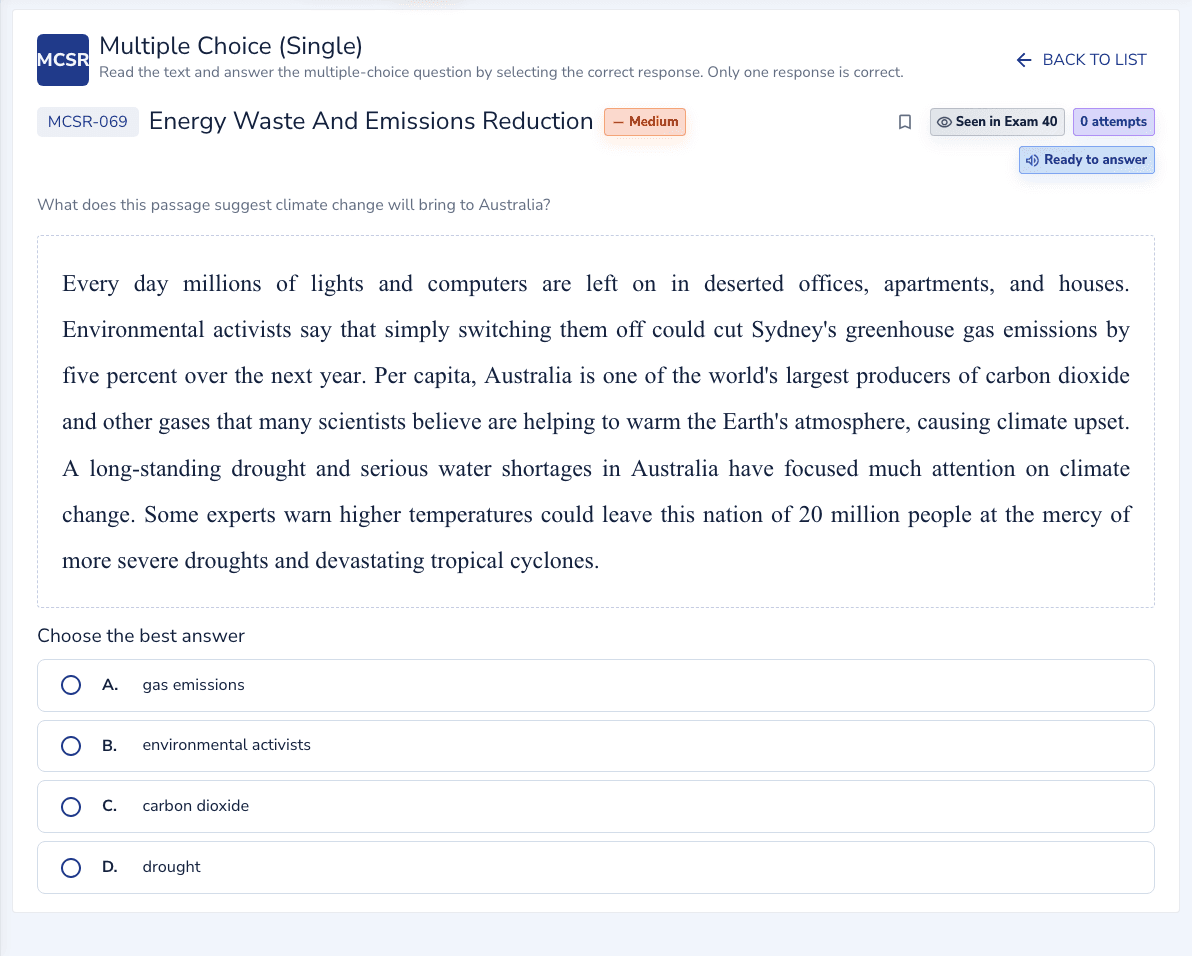
A passage on Australia’s energy waste and emissions notes the country’s high per-capita CO₂ output and a long-standing drought. “What does this passage suggest climate change will bring to Australia?” (Real bank question with four options — shown in the player below.)
D — drought. The passage warns higher temperatures could leave Australia “at the mercy of more severe droughts and devastating tropical cyclones”.
The correct option restates the passage’s explicit warning; there is no penalty here, so always answer.
The reader reads the passage carefully from the top, then the question, then re-reads the passage to find the answer, then hesitates between two options and re-reads again. The answer is right, but the item took four minutes, and the last dropdown passage of the part is now rushed for the sake of one point.
Correct or incorrect, one point per item, no deduction. Counts towards Reading in both tests.
The right option scores one. A wrong option or no option scores zero. There is no partial credit and no negative marking, so a guess is free.
With one point per item, this task cannot move the Reading score much either way. The risk is the clock: three minutes here is a dropdown passage’s worth of points lost elsewhere.
Reading. The options test whether you can locate the sentence that answers the question and distinguish it from a close paraphrase that changes one detail.
Always answer. On a four-option item a blind guess is worth a quarter of a point on average, and a guess after eliminating two options is worth half.
Question first, then the options, then the passage with a target. The item is a location task more than a comprehension task.
A detail, the main idea, the writer’s purpose, or the meaning of a phrase. Each is found in a different place: details in one sentence, main ideas in the first and last sentences, purpose in the tone of the whole.
The options usually share most of their wording and differ in one detail: a number, a cause, a direction. That detail is what to check in the passage.
Find the key word from the question, read the sentence and the one before it. For a main-idea question, read the first and last sentences of the passage instead.
Cross off options the sentence contradicts, then options that are true but do not answer the question. What remains is the answer. If two remain, pick the one closer to the passage’s wording.
Never leave it blank. If time is short, choose the best remaining option and move on.
| Mistake | Why it costs marks | What to do instead |
|---|---|---|
| Reading the passage before the question | Why it costs marksWithout a target the passage is read twice, and the item takes three or four minutes for one point. | What to do insteadQuestion, options, then passage with the key word in mind. |
| Choosing an option that is true but off the question | Why it costs marksDistractors often state something the passage does say, just not in answer to the question asked. | What to do insteadRe-read the stem before selecting. Does this option answer that question? |
| Leaving it blank when unsure | Why it costs marksThere is no negative marking. A blank is a guaranteed zero; a guess after elimination is worth half a point on average. | What to do insteadAlways select something. |
| Spending three minutes on one point | Why it costs marksThe Reading clock is shared, and a dropdown passage worth five points may be left unfinished as a result. | What to do insteadNinety seconds, then choose and move on. |
| Picking the option that repeats the passage’s words | Why it costs marksVerbatim options are often the trap; the correct option is frequently a paraphrase. | What to do insteadMatch meaning, not wording. Check the one detail that differs. |
The item rewards a fast locate-and-check routine. Practise it for speed with review of the one detail that made each wrong option wrong.
Ninety seconds each. The clock is the point; accuracy without it is a different skill.
For each item, find the word in the correct option that separates it from the closest wrong one, and the sentence in the passage that decides it. The review shows the correct answer; the reasoning is the practice.
Detail, main idea, purpose, meaning-in-context. Each has its own place to look. Ten of one type in a row makes the location reflex automatic.
On any article, state the main idea of each paragraph in one sentence after reading only its first and last sentences, then check. This is the main-idea question without the options.
If the average is above two minutes, the fix is reading the question and options first, not reading faster.
Practice set
12 questions with answers
Items from the EdKnot bank, each with its answer, on one page. Every item opens in the practice player with its timer, recording and scoring.
Worth one point per item and only a few items per test, this task moves the Reading score less than any other. These are the typical profiles behind each level.
Most items correct, with an occasional miss on a close paraphrase, and around two minutes each.
Items correct and answered in about ninety seconds each, with the time saved spent on the higher-value blanks.
No. It is worth 1 point, marked simply correct or incorrect, with no penalty for a wrong answer, so always choose an option.
It has a low score weight, one point per item, so do not overspend time on it. About ninety seconds per item on the shared Reading clock is enough.
Yes. There are 2–3 items in PTE Academic and 1–2 in PTE Core, each with a passage of up to 300 words.
Read the question stem and the options first, underline the detail that differs between options, then scan the passage for the sentence that decides it. Eliminate options the sentence contradicts, then options that are true but off the question.
Usually one of four things: a specific detail, the main idea, the writer’s purpose, or the meaning of a word or phrase in context. Each is found in a different part of the passage.
Yes, until you click Next. After Next there is no returning to any Reading item.
One point, no penalty, ninety seconds. Find the sentence, pick, move on.
Practise Reading Multiple Choice (Single) with the real clock and see the answer the moment you submit.