
Plus one for each correct tick
If three options are correct and you tick exactly those three, you score three. Tick two of them and you score two. You are never told how many are correct, so the ceiling is unknown until review.
Reading - PTE Academic / UKVI, PTE Core
Reading Multiple Choice (Multiple) is one of only two reading items with negative marking: every wrong option you tick costs a point. Two or three items in Academic, one or two in Core, each worth a few points at most. Here is how the deduction works, why two sure ticks beat three hopeful ones, and how to keep it under two minutes.
This item sits in the Reading part with the other reading types, all on one shared clock: about 23–30 minutes in PTE Academic, 27–37 in PTE Core.
| Appears in | PTE Academic / UKVI and PTE Core — Reading part |
|---|---|
| Items per test | Academic 2–3 · Core 1–2 |
| Passage length | Up to 300 words |
| Time | No per-item timer — shared Reading clock |
| Scoring | Partial credit — 1 point per correct selection |
| Negative marking | Yes — −1 per wrong selection, item floored at 0. Select only what you can evidence. |
| Skills credited | Reading |
The text is up to 300 words. The question asks which statements are true, which effects are described, what the writer suggests, and so on. More than one option is correct, and you are not told how many.
Click to select, click again to deselect. There is no limit and no indicator of how many are correct. Choices can be changed until Next.
No returning to a Reading item. Review your ticks once before Next: an extra tick is the only thing that can lower the score.
Each carries only a few points, so two minutes per item is the budget. This is not where the Reading score is won, but it is where careless ticks lose it.
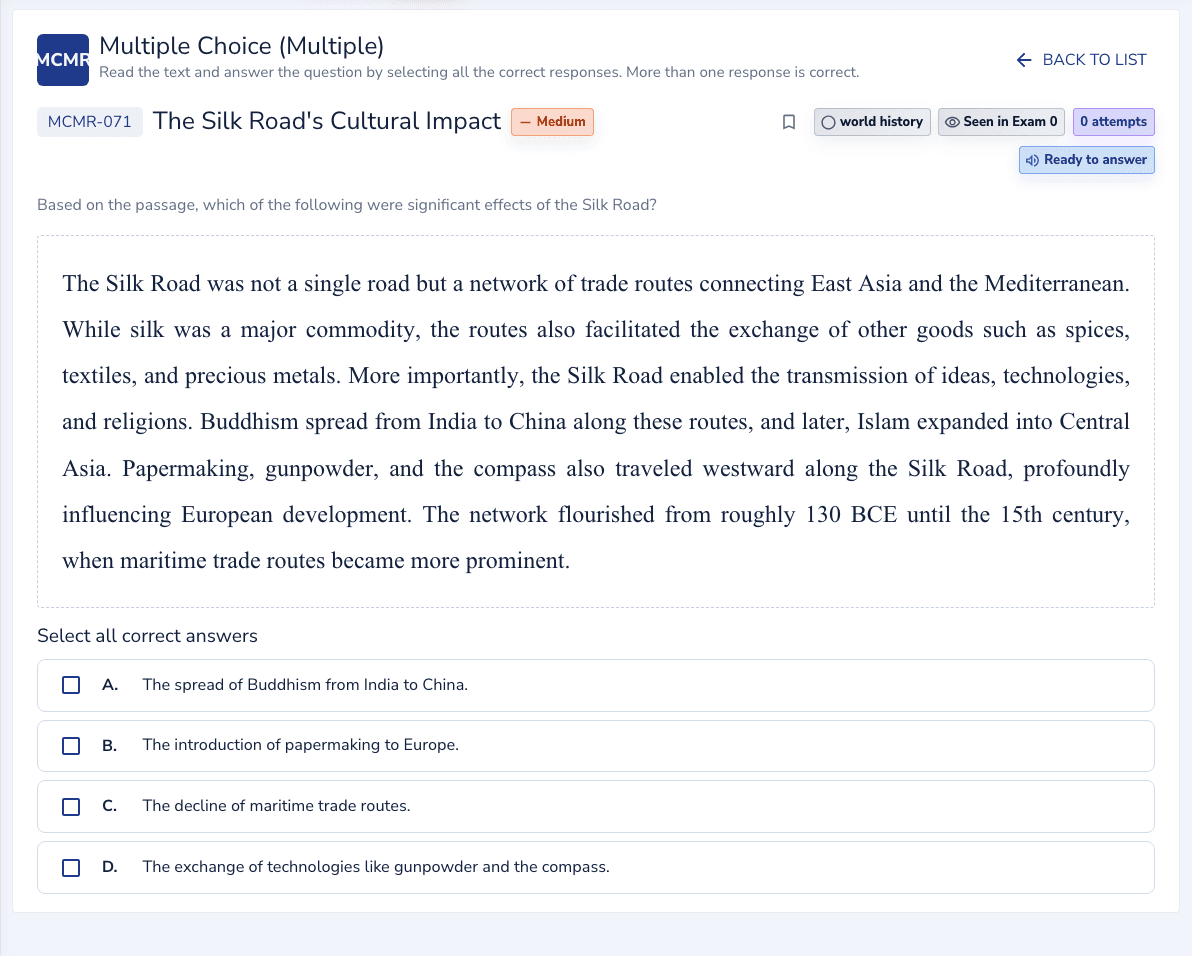
A passage on the Silk Road explains how the trade network spread goods, religions, and technologies between East Asia and the Mediterranean. “Which of the following were significant effects of the Silk Road?” — four options, more than one correct. (Real bank question — shown in the player below.)
A, B and D — Buddhism spreading from India to China, papermaking reaching Europe, and the westward exchange of gunpowder and the compass are all stated in the passage. Option C contradicts it, and selecting it would cost a point.
Every selection is evidenced by a sentence in the passage — the safe strategy under negative marking.
The reader skims the passage, then ticks four of the six options because each “sounds like something the passage said”. Two are correct, two are paraphrases that reverse a detail. Two minus two: zero points, from an item where the two sure ticks alone would have scored two.
Partial credit with deductions: one point for each correct option selected, minus one for each incorrect option selected, minimum zero for the item. Counts towards Reading in both tests.
If three options are correct and you tick exactly those three, you score three. Tick two of them and you score two. You are never told how many are correct, so the ceiling is unknown until review.
Tick two correct and one wrong: two minus one, one point. Tick one correct and two wrong: floored at zero. The floor means a bad item cannot cost you points from elsewhere, but a single careless tick can halve an item.
Reading. The options test whether you can match a claim to the specific sentence that supports or contradicts it, which is why the passage should be checked for every tick.
The arithmetic favours caution: a correct tick and a wrong tick cancel out, so an option you cannot point to in the passage is worth less than nothing on average.
Read the question first, then the options, then the passage looking for evidence. Tick only when you have found the sentence.
“Which of the following were effects” needs effects, not causes. “What does the writer suggest” needs the writer’s view, not a view the writer reports and rejects.
Underline the key word or number in each. Now you know what to look for, and the passage is read once instead of twice.
Scan for the key word. When you find it, read the whole sentence and the one before. Does it say what the option says, or the opposite, or something narrower? Only an exact match earns a tick.
An option with no sentence behind it is not a maybe; it is a likely minus one. Two ticks you can point to beat three you hope for.
For each tick, name the sentence in your head. If you cannot, untick it. Two minutes total.
| Mistake | Why it costs marks | What to do instead |
|---|---|---|
| Ticking anything that sounds familiar | Why it costs marksWrong options are built from the passage’s own words with one detail changed. Familiarity is exactly what they exploit, and each one costs a point. | What to do insteadA tick needs a sentence you can point to that says the same thing. |
| Assuming a fixed number of correct options | Why it costs marksYou are never told how many are correct. Ticking to reach a number you expect adds wrong ticks. | What to do insteadTick what is proven, however many that is. |
| Ticking only one to be safe | Why it costs marksMissing a correct option costs a point too. Excessive caution has a price, just a smaller one than a wrong tick. | What to do insteadIf the sentence proves it, tick it. Caution is about evidence, not count. |
| Reading the passage before the options | Why it costs marksWithout knowing what to look for, the passage is read twice and the item takes four minutes on a shared clock. | What to do insteadQuestion, options, then passage with the key words in mind. |
| Choosing an option that is true but not what was asked | Why it costs marksAn option can be true in general and still not answer the question, for example a cause when effects were asked for. | What to do insteadRe-read the question stem before the final review of your ticks. |
The skill is disciplined evidence checking, and it is learned by reviewing why each wrong tick seemed right. Short sets with careful review beat volume.
Two minutes each. The clock stops you from re-reading the whole passage per option, which is the habit that makes this item slow.
The review shows which options were correct. For each wrong tick, find the sentence that made it look right and the word that made it wrong: a reversed detail, a narrower claim, a view the writer rejects.
A missed correct option costs a point you could have had. Usually it was a paraphrase you did not recognise. Note the pair of phrasings.
On any passage, read the options and predict where in the text each answer lives before you look. This is the reflex that keeps the item under two minutes.
Count ticks you could not point to a sentence for. If the number is above zero after a week, the problem is method, not reading.
Practice set
12 questions with answers
Items from the EdKnot bank, each with its answer, on one page. Every item opens in the practice player with its timer, recording and scoring.
This item is worth only a few points, so its effect on the Reading score comes from avoiding deductions rather than from maximising it. These are the typical profiles behind each level.
Most correct options found, with an occasional wrong tick on a close paraphrase that cancels one of them. Items finished in around two and a half minutes.
Every tick backed by a sentence, no wrong ticks across the items, most correct options found, and under two minutes per item.
Yes. You lose 1 point for each wrong selection, with the item score floored at 0, so only tick options you can evidence from the passage.
Partial credit with deductions: 1 point for each correct option selected, minus 1 for each incorrect option selected, and the item cannot go below 0.
There are 2–3 items in PTE Academic and 1–2 in PTE Core, each with a passage of up to 300 words and five to seven options.
No. You are never told how many options are correct. Tick every option you can prove from a sentence in the passage, and no others.
Read the question stem, then the options, then scan the passage for each option’s key word and read the whole sentence around it. Tick only exact matches. About two minutes per item on the shared Reading clock.
Nothing directly: an untouched wrong option neither adds nor deducts. Missing a correct option simply forgoes its point. The only way to lose points is to tick a wrong option.
Tick only what a sentence in the passage proves. Every wrong tick costs a point.
Practise Reading Multiple Choice (Multiple) with the real clock and see the answer the moment you submit.