Speaking and Writing - PTE Academic / UKVI

Respond to a Situation

Respond to a Situation, added to PTE Academic in August 2025, gives you a short scenario on screen and in audio, 10 seconds to think, and 40 seconds to say what you would actually say to the person. Content is scored 0–6 on whether you achieve the communication goal in a way that fits the situation, and Pearson’s human reviewer checks it in the live test. Here is the shape of a response that does.

10 s
to prepare
40 s
to speak
2–3
items per test
16
marks: Content 6, Fluency 5, Pronunciation 5

The task

Respond to a Situation appears in PTE Academic and UKVI after Retell Lecture, with two or three items. It is the only speaking task where you are playing a role rather than reporting information.

Appears inPTE Academic / UKVI (added August 2025) — Speaking & Writing part
Items per test2–3
ScenarioUp to 60 words — read on screen and heard
Preparation time10 seconds (PTE Core version: 20 seconds)
Time to speak40 seconds
ScoringPartial credit — Content 0–6 (Pearson: AI plus examiner review), Oral fluency 0–5, Pronunciation 0–5
Negative markingNone
Skills creditedSpeaking
In the exam
  1. The scenario appears and is read aloud

    A description of up to 60 words is shown on screen and played as audio at the same time. It tells you who you are talking to, what has happened, and what you want to achieve. The text stays on screen throughout.

  2. Ten seconds to prepare

    A countdown before the microphone opens. Use it to fix two things: your relationship to the listener, and the one outcome the situation asks for.

  3. Forty seconds to speak, in role

    The status box shows “Recording”. Start within three seconds. You speak directly to the person in the scenario, as if they were in front of you. The recording ends when the bar completes or on three seconds of silence.

  4. Two or three items

    Scenarios are everyday and workplace: declining an invitation, apologising, asking a favour, complaining politely, persuading a colleague. Each needs a different tone, and the tone is scored.

How one item is scored

Question

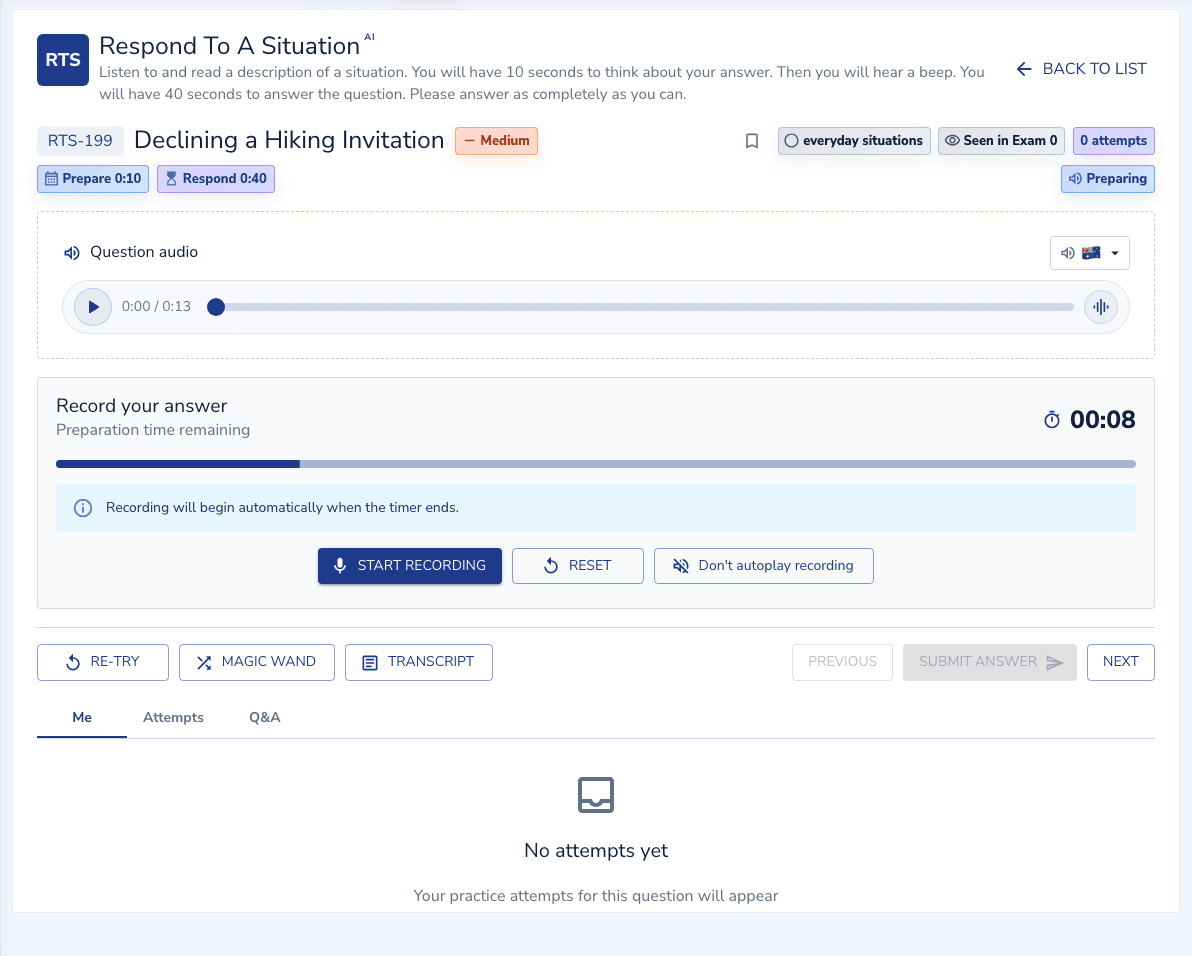
“A friend from your sports club invites you to join a weekend hiking trip. You appreciate the invitation, but you have already promised to visit your grandparents that weekend. You want to decline politely and suggest another time. What do you say?” (Real bank question — shown in the player below.)

Answer

“That’s really kind of you to offer, thank you! Unfortunately, I already have plans to visit my grandparents this weekend, so I won’t be able to join the hiking trip. But I’d love to go on a hike with you another time. Let me know when you’re free next weekend!”

Why it scores

It thanks, declines with a reason, and proposes an alternative — polite register and complete content inside 40 seconds.

What loses marks

“I appreciate the invitation but I have already promised to visit my grandparents that weekend, so I want to decline politely.” It is polite and on topic, but it lifts its sentences straight from the prompt, never actually speaks to the friend, offers no alternative, and stops at twelve seconds. Repeating prompt language without reformulation and only partly achieving the goal puts it at Content 3, and the recording closes on silence with most of the bar unused.

How it is scored

Three traits with partial credit, all counting towards Speaking. Content is scored by Pearson’s AI and reviewed by a Pearson examiner in the live test, and its descriptors combine what most guides call “appropriacy” into one scale: did you achieve the goal, and did you do it in a way that fits the context?

Content: 0–6 for achieving the goal in context

A 6 deals with the situation effectively, achieves the primary communication goal with full consideration of the context, is situationally appropriate, and expands beyond the prompt’s language into a persuasive, fully developed response. A 5 achieves the goal with only minor omissions and uses a variety of appropriate expressions. A 4 partly achieves it with some omissions. A 3 is functional but limited, with inappropriate elements or repeated prompt language. A response that is relevant but does not achieve the goal is a 1 or 2.
Oral fluency: 0–5 for natural continuous speech

Same scale as the other speaking tasks. Because you are speaking as yourself to a person, a natural conversational rhythm is what the top bands sound like: no restarts, no long planning pauses, one hesitation at most.

Pronunciation: 0–5 for clarity

Register lives partly in intonation. A polite decline said flat can read as abrupt to Pearson’s human reviewer; sentence stress on the softening words (“really”, “unfortunately”, “another time”) carries the tone.

Two things separate 4 from 6: the goal must be fully achieved (decline and propose an alternative, not just decline), and the language must go beyond the prompt’s wording. Reusing the scenario’s sentences is explicitly marked down. That review is part of Pearson’s live test. EdKnot practice scoring is entirely automated: no person sees or scores any practice response.

Templates that score full marks

Every template below is taught inside EdKnot and verified against the same AI scoring engine that marks your practice — out of 16 for this task.

Template 1 — request
Hi [NAME], this is [YOUR NAME]. I wanted to reach out about [SITUATION]. [ONE SPECIFIC DETAIL FROM THE PROMPT]. Would it be possible to [REQUEST]? Thanks so much for your help.
Template 2 — apology or issue
Hello [NAME], this is [YOUR NAME] calling about [SITUATION]. I'm sorry about [ISSUE] - [ONE SPECIFIC DETAIL]. Would it be possible to [RESOLUTION]? Thank you for understanding.

How to answer it

Every situation has the same four parts: acknowledge, state your position, give a reason, and move things forward. Ten seconds is enough to fix the register and the outcome; the four parts fill the 40 seconds.

  1. Identify the listener and the register

    Friend, colleague, manager, stranger, customer. This decides your first words: “Hey, thanks so much” for a friend, “Thank you for letting me know” for a manager. Getting the register right is the “situationally appropriate” half of the Content score.

  2. Name the goal in one word

    Decline, apologise, request, persuade, complain, reassure. The goal is what the response must achieve, and the top bands require it to be fully achieved: a decline with an alternative, an apology with a remedy, a request with a reason.

  3. Open by acknowledging the other person

    Thank them, recognise their feeling, or recognise the situation. One sentence. It shows the reviewer you understood the context before you say what you want.

  4. State your position and give a reason

    Say what you can or cannot do and why, in your own words rather than the prompt’s. Two sentences. Specific reasons (“my grandparents are expecting me on Saturday”) read as developed; vague ones (“I am busy”) read as limited.

  5. Move it forward and close

    Propose the alternative, offer the remedy, ask the question, or confirm the plan. Then a closing line that fits the register. This is the part most responses skip, and it is the difference between “partially accomplishes” and “deals with the situation effectively”.

Common mistakes

MistakeWhy it costs marksWhat to do instead
Describing what you would say instead of saying itWhy it costs marks“I would apologise and offer to help” is a report, not a response. It does not achieve the communication goal, which caps Content at 2 or 3.What to do insteadSpeak to the person: “I’m so sorry, let me help you with that.”
Reusing the prompt’s sentencesWhy it costs marksRepetition of language from the prompt without reformulation is named in the Content 3 descriptor, and Pearson’s human reviewer is checking for it.What to do insteadTake the facts from the prompt and put them in your own words.
Stopping at the refusal or the apologyWhy it costs marksThe top bands require the goal to be fully accomplished. A decline without an alternative or an apology without a remedy is “partially accomplishes”.What to do insteadAlways add the move forward: another time, a way to fix it, a specific request.
Wrong registerWhy it costs marksCasual language to a manager or stiff formality to a friend is “situationally inappropriate” and costs Content even when the goal is achieved.What to do insteadDecide the listener in the first two seconds of preparation and choose the opener to match.
Ending at 15 secondsWhy it costs marksSilence ends the recording, and short responses have almost always skipped the reason and the follow-up.What to do insteadFour parts, two sentences each, fills 35 seconds naturally.
Planning out loudWhy it costs marksLong pauses and false starts while deciding what to say drop Oral fluency to Intermediate or below.What to do insteadUse the 10 seconds to decide the goal and the register. Once recording starts, begin with the acknowledgement and let the structure carry you.

How to practise

The task rewards a small set of speech acts done well in different registers. Practise by goal, so the shape of an apology or a polite refusal becomes automatic and the 10 seconds go on the specifics.

  1. Group scenarios by goal

    Five declines in a row, then five apologies, then five requests. The four-part structure is the same; what changes is the reason and the follow-up. Sort the scenarios you practise by goal as you go, so you can drill one kind at a time.

  2. Record under exam timing, once

    Ten seconds to prepare, 40 to speak, one take, speaking to the person rather than about them. If you catch yourself narrating (“I would tell my friend that…”), stop and restart the set in role.

  3. Check the four parts and the register

    Acknowledged? Position with a reason? Moved forward? Closed? Then the tone: would the listener in the scenario find it natural? EdKnot’s review scores the response on the official Content, Oral fluency and Pronunciation bands and shows the transcript, so check the four parts and the register against it.

  4. Time the response

    Aim for 30 to 38 seconds. Under 20 almost always means the follow-up is missing.

  5. Build a phrase bank per register

    Ten openers and ten closers for friends, and ten of each for formal listeners. Say them aloud until the switch between registers is a reflex.

Practice set

12 situations with answers

Items from the EdKnot bank, each with its answer, on one page. Every item opens in the practice player with its timer, recording and scoring.

Respond to a Situation practice inside the EdKnot question player

What 65 and 79 need

Respond to a Situation is scored per item and combined with the other speaking tasks. These are the typical profiles behind each level on this task.

65

In role, in a register that fits, with the goal achieved and a reason given. The follow-up may be thin and some wording may echo the prompt. A couple of hesitations, around 25–30 seconds of speech. Content around 4.

79

Acknowledgement, position, specific reason and a concrete way forward, in language that goes beyond the prompt and sounds like the listener is in the room. Register consistent throughout, one hesitation at most, 30–38 seconds. Content 5 or better.

Frequently asked questions

How much preparation time do you get for Respond to a Situation in PTE?

In PTE Academic you get 10 seconds to prepare; in PTE Core you get 20 seconds. Both versions give you 40 seconds to answer.

How is Respond to a Situation scored in PTE Academic?

Content is scored 0–6 on whether you achieve the communication goal of the situation in a way that fits the context, scored in the live test by Pearson’s AI plus a Pearson examiner. Oral fluency and Pronunciation are each scored 0–5. The item counts towards Speaking.

What is Appropriacy in PTE Respond to a Situation?

In PTE Academic there is no separate Appropriacy score; whether your register and politeness suit the situation is judged inside the Content trait. PTE Core scores Appropriacy as its own trait.

Is Respond to a Situation a new PTE question type?

Yes. The Academic version was added in August 2025. The scenario is up to 60 words and is both read on screen and heard, with 2–3 items in Academic.

Should I speak to the person or describe what I would say?

Speak to the person in the scenario as if they were in front of you. Describing what you would say is a report, not a response, and does not achieve the communication goal.

How long should a Respond to a Situation answer be?

Aim for 30 to 38 seconds: acknowledge the person, state your position with a reason, propose a way forward, and close. Responses under 20 seconds have usually skipped the reason or the follow-up.

Achieve the goal of the situation in the right register, in full sentences, for 40 seconds.

Practise Respond to a Situation with the real clock and see the answer the moment you submit.

Practise Respond to a Situation