Listening - PTE Core

Summarize Spoken Text Core

Summarize Spoken Text in PTE Core is a short recording heard once, then eight minutes to write 20–30 words. The Content scale is 0–2 and based on covering every relevant aspect, and the spelling scale allows one error. Here is how to get every point of the recording into 30 words.

8 min
to write, on its own timer
20–30
words for full Form credit
10
marks across five traits
1–2
items per test

The task

Summarize Spoken Text opens the Listening part in PTE Core, with one or two items, each on its own timer separate from the shared Listening clock.

Appears inPTE Core — Listening part (integrated task)
Items per test1–2
AudioPlays once
Time to write8 minutes, on its own timer
Word limit20–30 words for full Form credit; 5–19 or 31–40 score 1 (Academic version: 50–70 words in 10 minutes)
ScoringPartial credit — Content 0–2, Form 0–2, Grammar 0–2, Vocabulary 0–2, Spelling 0–2
Negative markingNone
Skills creditedListening and Writing
In the exam
  1. A short countdown, then the audio plays once

    A talk or announcement on an everyday topic. There is no replay. You can take notes on the erasable noteboard from the first second.

  2. Eight minutes to write, on a separate timer

    The timer starts when the audio ends. An answer box with a live word counter and Cut, Copy and Paste buttons sits under the audio status box.

  3. The item closes at eight minutes or when you click Next

    The text in the box is the summary. Time left over is not carried anywhere, so use it to check the count and the spelling.

  4. Then the shared Listening clock begins

    The remaining listening types share one clock. This item is separate, so it never needs to be rushed.

How one item is scored

Question

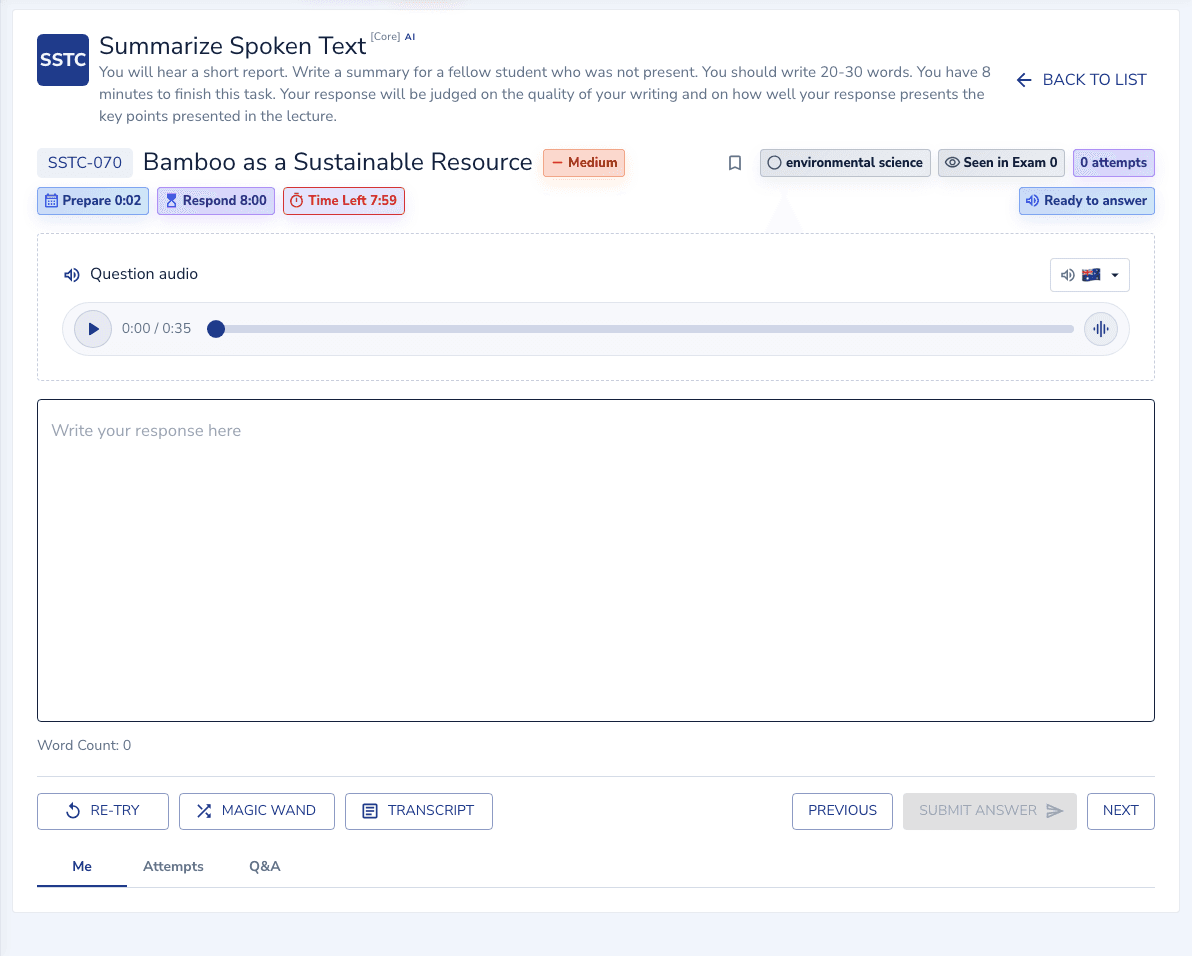
You hear a recording about bamboo as a sustainable resource — growth up to ninety-one centimetres a day, uses in construction and textiles, and climate benefits. Write a 20–30 word summary in 8 minutes. (Real bank question — shown in the player below.)

Answer

Bamboo grows extremely fast, making it a strong, sustainable alternative to timber, while bamboo forests prevent soil erosion and absorb more carbon dioxide than many trees.

Why it scores

At 26 words it fits Core’s tighter 20–30 word band while keeping every main point.

What loses marks

“Bamboo is a plant that grows very fast, up to ninety-one centimetres a day, and it is used for building and for making textiles in many countries.” Twenty-eight words and inside the range, but it spends its words on a number and a list of uses and never mentions the climate benefits, which were half the recording. Content 1 for a missing aspect.

How it is scored

Five traits with partial credit, counting towards both Listening and Writing. The Core scales are short, so each is decided by one or two things you can check before Next.

Content: 0–2 for covering every relevant aspect

A 2 is a good summary in which all relevant aspects are mentioned. A 1 is a fair summary that misses one or two aspects. A 0 omits or misrepresents the main aspects. Coverage, not depth: a clause per aspect beats a full explanation of one.
Form: 2 for 20–30 words

A 2 is 20–30 words. A 1 is 5–19 or 31–40. A 0 is fewer than 5 or more than 40, or a summary in capital letters, without punctuation, or in bullet points or very short sentences.

Grammar and Vocabulary: 0–2 each

Grammar 2 is correct structures; 1 is errors with no hindrance to communication. Vocabulary 2 is appropriate word choice; 1 is lexical errors with no hindrance. One or two sentences of 12–18 words is the natural shape.

Spelling: 2, 1 or 0

One spelling or typing error still scores 2. Two or three score 1. More than three score 0. More forgiving than Academic, but with only 30 words to check there is no reason to leave any.

With 20–30 words and a coverage-based Content scale, the summary is one sentence for the main point and one clause per supporting aspect, joined by “and”, “while” or “but”.

Templates that score full marks

Every template below is taught inside EdKnot and verified against the same AI scoring engine that marks your practice — out of 10 for this task.

Template 1 — minimal summary
The speaker discussed [TOPIC], explaining [POINT 1]. They also emphasised [POINT 2].
Worked example — Fermented Food Benefits

The speaker discussed fermented foods, explaining that their live cultures improve gut health, digestion and immunity. They also emphasised checking labels, since processing can remove active…

Template 1 · 27 words · two sentences - scored 10/10 on this scoring engine.

How to answer it

The recording has two to four aspects. Note them, give each a clause, and stop at 30 words.

  1. During the audio: one short line per aspect

    The topic first, then two or three words for each point the speaker makes. Look for “also”, “another”, “but” as signals of a new aspect. Numbers are detail; write them only if they are the point.

  2. Minute 0–1: count the aspects

    Two aspects means one sentence with “and” or “while”. Three or four means two sentences. Decide before writing.

  3. Minutes 1–4: write in plain words

    Start with the main point, not with “The speaker talks about”. Keep the topic’s key term, rephrase the rest. One clause per aspect, no examples.

  4. Minutes 4–6: check the count and the coverage

    20–30 on the counter, ideally 24–28. Tick each note line against a clause. A missing aspect is a Content point; add it and cut a detail if needed.

  5. Minutes 6–8: spelling and grammar

    Thirty words take thirty seconds to read for spelling. Then a subject and verb per sentence and a full stop at the end.

Common mistakes

MistakeWhy it costs marksWhat to do instead
Missing an aspectWhy it costs marksEach missing aspect drops Content from 2 to 1, and there is only one point below that.What to do insteadOne short note line per aspect during the audio, one clause per line in the summary.
Writing 35 words to be safeWhy it costs marks31–40 is Form 1. The range is 20–30 and every word above it is a lost mark.What to do insteadStop at 28. Replace an example with a missing aspect rather than adding.
Spending words on a number or an exampleWhy it costs marksDetail crowds out aspects in 30 words, and the Content scale credits aspects, not detail.What to do insteadSay what the number shows, not the number: “grows extremely fast”, not “ninety-one centimetres a day”.
Opening with “The speaker talks about…”Why it costs marksFive to seven of your 30 words on nothing that scores.What to do insteadStart with the main point itself.
Bullet points or no punctuationWhy it costs marksBoth are named in the Form 0 descriptor regardless of word count.What to do insteadFull sentences with capitals and full stops.
Leaving typing errorsWhy it costs marksTwo or three errors drop Spelling to 1 on a summary that takes thirty seconds to check.What to do insteadRead every word for spelling before Next.

How to practise

A coverage task with a tight word range: practise catching every aspect quickly and writing to length without counting on your fingers.

  1. Practise with one play and the eight-minute timer

    On EdKnot the audio plays and the timer runs automatically; do not use the replay in practice, because the exam has none. Finish writing by minute four.

  2. Compare your note lines with the transcript

    List the aspects the speaker covered and check your notes had each one. A missed aspect in the notes cannot be recovered in the writing.

  3. Check the summary trait by trait

    Coverage, count, spelling, grammar. The scoring review shows the five traits separately, so a coverage gap is visible as a Content 1.

  4. Learn what 25 words feels like

    After a few attempts, one sentence and a half is 25 words in your typing. Check the counter once at the end rather than after every word.

  5. Keep a spelling list

    Even with the more forgiving scale, the same ten words account for most errors. Read the list before each session.

Practice set

12 transcripts with answers

Items from the EdKnot bank, each with its answer, on one page. Every item opens in the practice player with its timer, recording and scoring.

Summarize Spoken Text Core practice inside the EdKnot question player

What 65 and 79 need

One or two items, counting towards both Listening and Writing. On the CLB scale, 65 sits around CLB 7 and 79 around CLB 9. These are the typical profiles behind each level.

65

Inside 20–30 words with most aspects present and one missing or blurred, a phrase from the audio, and a grammar or spelling slip. Content 1–2, Form 2, Grammar 1, Spelling 1–2.

79

Every aspect in 24–28 words across one or two clean sentences in plain words, no detail, no slips, checked with time to spare. Content 2, Form 2, Grammar 2, Vocabulary 2, Spelling 2.

Frequently asked questions

How many words for the PTE Core Summarize Spoken Text?

The Core version needs 20–30 words for full Form credit; 5–19 or 31–40 scores 1 and outside that scores 0. The Academic test requires 50–70 words. You have 8 minutes to write, and there are one or two of these items.

How long do I get to write the Core summary?

You have 8 minutes to write your 20–30 word summary after the audio, which plays once only. The timer is separate from the shared Listening clock.

How many Summarize Spoken Text items are in the Core test?

The Core test has one or two of these items, each counting towards Listening and Writing.

How is PTE Core Summarize Spoken Text scored?

Five traits: Content 0–2 for covering all relevant aspects, Form 0–2 for the word range, Grammar 0–2, Vocabulary 0–2, and Spelling 0–2, where one error still scores 2, two or three score 1, and more than three score 0.

Can I take notes during Core Summarize Spoken Text?

Yes. You can write on the erasable noteboard from the moment the audio starts. One short line per aspect is enough for a 30-word summary.

Can I write more than one sentence in Core Summarize Spoken Text?

Yes. One or two sentences are fine and usually safer for Grammar than one long one. Bullet points, capitals-only text and missing punctuation score 0 on Form.

All the relevant aspects of the recording in 20–30 words, spelled correctly.

Practise Summarize Spoken Text Core with the real clock and see the answer the moment you submit.

Practise Summarize Spoken Text Core