
One point or zero
The right option scores one; a wrong option or no option scores zero. No partial credit, no negative marking, so always choose.
Listening - PTE Academic / UKVI, PTE Core
Select Missing Word plays a recording of 20–70 seconds whose last word or phrase is replaced by a beep, and asks which option completes it. One point, no penalty, one or two items. Here is what the beep replaces, why the final sentence is a logical continuation of everything before it, and how to answer in thirty seconds.
Select Missing Word sits near the end of the Listening part on the shared clock, after Multiple Choice (Single) and before Highlight Incorrect Words.
| Appears in | PTE Academic / UKVI and PTE Core — Listening part |
|---|---|
| Items per test | 1–2 |
| Audio length | 20–70 seconds, plays once — final word replaced by a beep |
| Time | No per-item timer — shared Listening clock |
| Scoring | Correct or incorrect, 1 point per item |
| Negative marking | None |
| Skills credited | Listening |
Three to five short options are on screen during a short countdown. The recording of 20–70 seconds plays once and ends with a beep where the last word or phrase would be.
Click a radio button; clicking another replaces it. The choice can be changed until Next.
No per-item timer, but the shared clock is running. Thirty seconds after the beep is enough for this item.
No returning to a Listening item. One or two items in both tests.
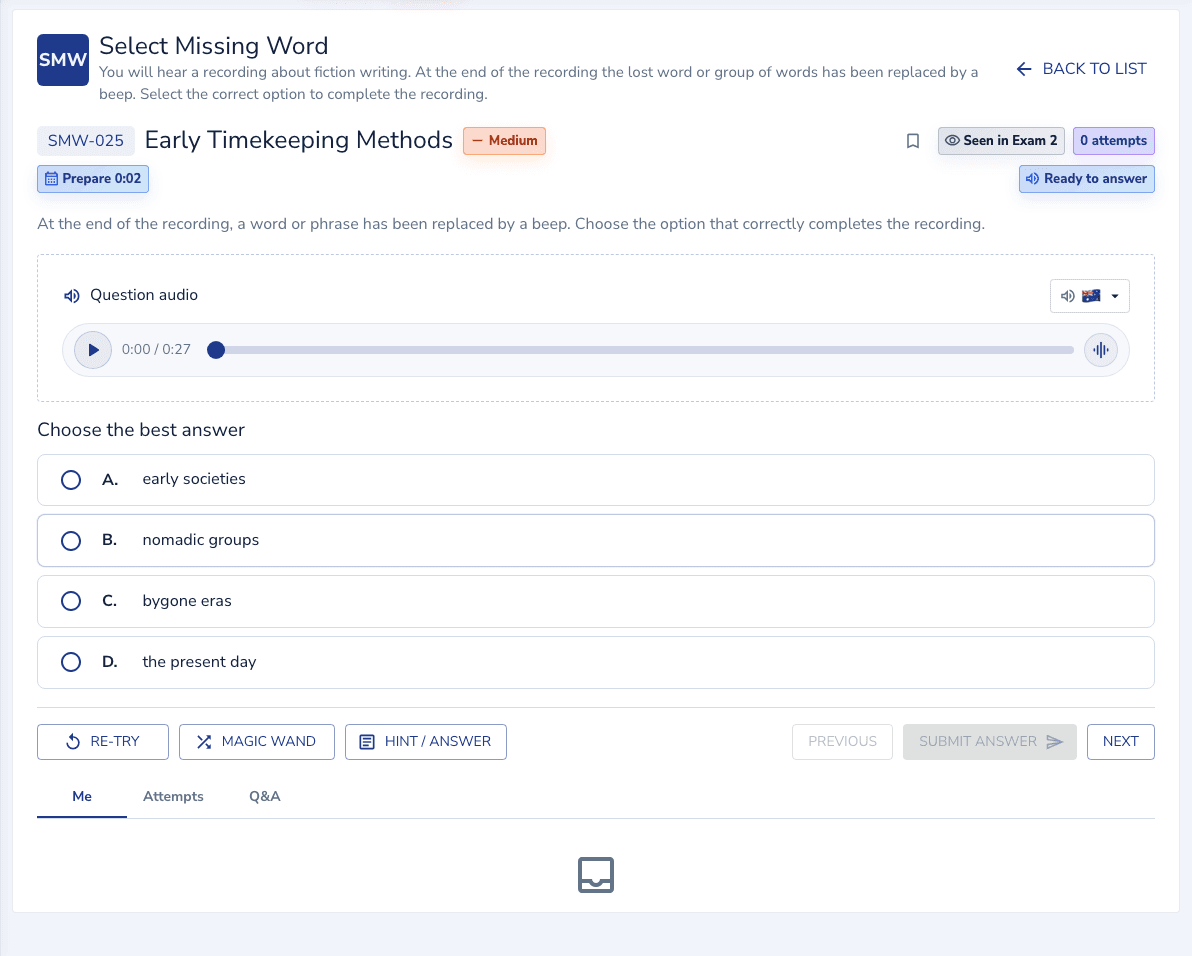
You hear a talk on early timekeeping that ends: “…it served humanity for an immense span, from our earliest ancestors right through to [BEEP]”. Choose the option that completes the recording. (Real bank question with four options — shown in the player below.)
D — “the present day”.
The sentence contrasts “our earliest ancestors” with the other end of the time span, so only D completes the logic.
The learner listens for the last sentence only, hears “from our earliest ancestors right through to [beep]”, and picks “the industrial age” because it sounds historical. The talk had been contrasting early timekeeping with how we live now, so the ending had to be “the present day”. The direction of the whole talk was the clue, and only the last sentence was heard.
Correct or incorrect, one point per item, no deduction. Counts towards Listening in both tests.
The right option scores one; a wrong option or no option scores zero. No partial credit, no negative marking, so always choose.
The final word or phrase of the last sentence, and it is always the logical end of the argument: a conclusion, a contrast, or the other end of a comparison the speaker set up. The wrong options fit the grammar of the sentence but not the direction of the talk.
Listening. The item tests whether you followed the talk well enough to predict its last words, not whether you heard a detail.
The talk answers the question before the beep. If you can say the ending before you hear the beep, the options are just confirmation.
The item rewards following an argument to its natural end. Read the options for their direction, listen for the speaker’s, and predict.
Each option points somewhere: past or present, positive or negative, cause or effect. Knowing the directions lets you listen for which one the talk is heading towards.
What is the speaker contrasting, or building towards? Two or three words on the noteboard for the direction of the talk. Listen to the last sentence with particular care; its structure sets up the ending.
Say the ending in your head as the last sentence unfolds. “From our earliest ancestors right through to…” has one natural end.
If one option matches, select it. If none does exactly, choose the one that continues the direction of the talk.
Never leave it blank; a guess is free and the shared clock is needed later.
| Mistake | Why it costs marks | What to do instead |
|---|---|---|
| Listening only for the last sentence | Why it costs marksThe ending completes the whole argument, and the direction is set by everything before the last sentence. | What to do insteadFollow the talk’s direction from the start and note it in two or three words. |
| Choosing the option that fits the grammar | Why it costs marksAll the options fit the grammar of the sentence. Only one fits the direction of the talk. | What to do insteadMatch the prediction you made before the beep. |
| Not predicting | Why it costs marksWithout a prediction, the options are judged on plausibility, and the distractors are designed to be plausible. | What to do insteadSay the ending in your head as the last sentence unfolds. |
| Leaving it blank | Why it costs marksNo negative marking. An empty item is zero; a guess is worth a quarter or a third of a point. | What to do insteadAlways select something. |
| Spending two minutes deciding | Why it costs marksOne point on a shared clock that Write From Dictation still needs. | What to do insteadThirty seconds, then Next. |
Predicting endings is a listening habit that transfers from any talk or podcast. Short practice with review of the direction you missed is enough.
On EdKnot the audio plays automatically; do not use the replay in practice, because the exam has none. Make a prediction before the beep every time, even if unsure.
The review shows the correct option. For each miss, find the sentence earlier in the talk that pointed to the answer; it is almost always there.
Pause any talk before the end of a sentence and say how it ends. Five minutes a day builds the reflex the beep tests.
“Whereas”, “unlike”, “but now”, “right through to” all set up an ending that mirrors something said earlier. Hearing them is hearing the answer coming.
Thirty seconds after the beep. Longer means the prediction was not made during the audio.
Practice set
12 recordings with answers
Items from the EdKnot bank, each with its answer, on one page. Every item opens in the practice player with its timer, recording and scoring.
One point per item and one or two items, so this task moves the Listening score less than any other. These are the typical profiles behind each level.
Usually correct when the ending mirrors an obvious contrast, with an occasional miss when the direction was set early in the talk and not noted.
Ending predicted before the beep from the direction of the whole talk, confirmed against the options, selected within thirty seconds.
The final word or phrase of the recording is replaced by a beep, and you choose the option that best completes the sentence. It is always the logical end of the talk’s argument, not a random detail.
It is marked correct or incorrect, worth one point with no negative marking, and there are one to two of these items in both PTE Academic and PTE Core.
The recording is 20–70 seconds long and plays once only, ending with the beep.
Read the options during the countdown to see the direction each implies, follow the talk’s argument, predict the ending before the beep, then match your prediction to an option.
No. There is no negative marking, so a guess is free. An empty item scores zero for certain.
Yes, until you click Next. After Next there is no returning to any Listening item.
Follow the argument, predict the ending before the beep, confirm from the options.
Practise Select Missing Word with the real clock and see the answer the moment you submit.