Speaking and Writing - PTE Academic / UKVI

Summarize Group Discussion

Summarize Group Discussion, added to PTE Academic in August 2025, is the longest speaking item in the test: up to three minutes of three people talking, 10 seconds to prepare, two minutes to summarize. Content is scored 0–6 on whether you capture each speaker’s position and how the positions relate. Here is how to take notes on three voices and speak for two minutes from them.

10 s
to prepare
2 min
to speak
2–3
items per test
16
marks: Content 6, Fluency 5, Pronunciation 5

The task

Summarize Group Discussion appears in PTE Academic and UKVI only, near the end of the speaking section. Two or three items, each a separate conversation.

Appears inPTE Academic / UKVI (added August 2025) — Speaking & Writing part
Items per test2–3
Audio lengthUp to 3 minutes, multiple speakers, plays once
Preparation time10 seconds
Time to speak2 minutes
ScoringPartial credit — Content 0–6 (Pearson: AI plus examiner review), Oral fluency 0–5, Pronunciation 0–5
Negative markingNone
Skills creditedSpeaking and Listening
In the exam
  1. The discussion plays once

    Up to three minutes of audio with several speakers, usually three, plays automatically. The voices are distinct and speakers often address each other by name. Take notes from the first second.

  2. Ten seconds to prepare

    A short countdown before the microphone opens. Read your notes once and decide the first sentence: the topic and what was being decided.

  3. Two minutes to speak

    The status box shows “Recording” and a two-minute bar starts. Start within three seconds. The recording ends when the bar completes or when you stop for three seconds, so a summary that runs out at 50 seconds ends there.

  4. Two or three items

    Topics are campus and everyday debates: a proposal, a plan, a problem to solve. There is usually a disagreement in the middle and a compromise or next step at the end.

How one item is scored

Question

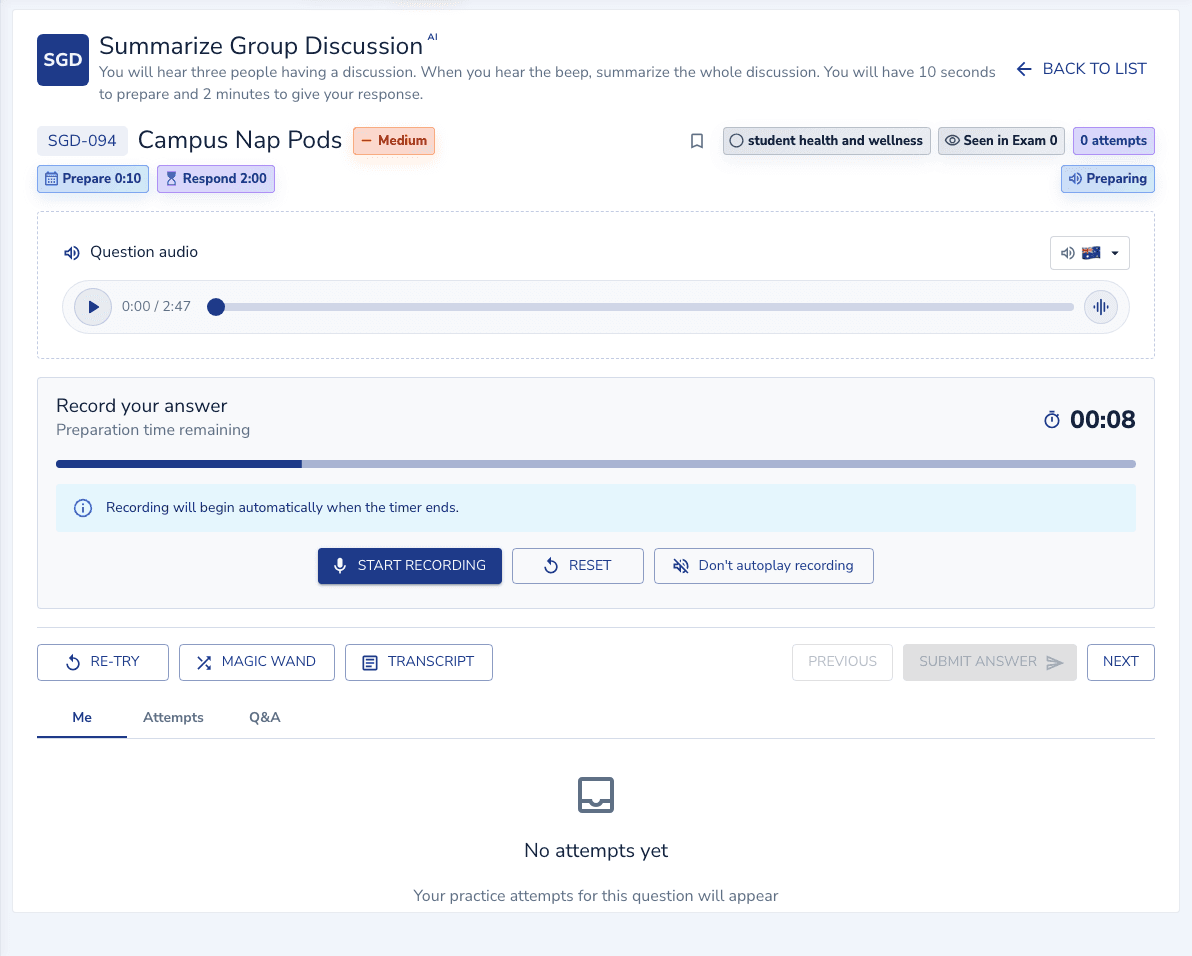
You hear three students debate a proposal to install nap pods in the campus library — support for power naps, hygiene worries, cost objections, and a compromise. Summarize the discussion aloud. (Real bank question, ~3-minute multi-speaker audio — shown in the player below. 2 minutes to answer.)

Answer

Three students discuss installing nap pods in the library. The first strongly supports the idea, citing student sleep deprivation and the focus benefits of power naps. The second raises hygiene and time-management concerns, suggesting disposable covers and a 30-minute limit, which the first accepts. The third opposes the expense, arguing couches suffice and funds should go to books or Wi-Fi, then proposes a cheaper quiet room with yoga mats. They converge on a combined pods-plus-relaxation-room idea, conditionally funded by grants, agree to a pilot program, and conclude that the student council should explore grants after a student survey gauges demand.

Why it scores

It attributes each position to the right speaker, tracks how disagreement moved to a compromise, and states the agreed next steps — the structure the 2-minute answer rewards.

What loses marks

“Three students talk about nap pods. One says it is good. One says hygiene. One says it costs money. Nap pods, library, students are tired, thirty minutes, yoga mats, survey.” Each speaker gets one clause with no detail, the objections are never connected to the responses they got, the compromise and the final decision are missing, and the last half is a list of words from the notes. That is a Content 2 or 3, and the recording closes on silence at around 40 seconds.

How it is scored

Three traits with partial credit, counting towards both Listening and Speaking. Content is scored by Pearson’s AI and reviewed by a Pearson examiner in the live test, and its descriptors are specific to discussions: individual contributions and the relationships between them.

Content: 0–6 for each speaker’s view and how the views relate

A 6 paraphrases the main ideas in your own words, expands on each speaker’s contribution with specificity, and explores the relationships between points of view. A 5 captures the main ideas and some details of each contribution and notes some relationships. A 4 focuses on individual perspectives with only basic attempts at comparison. A 3 includes some accurate information but misses the substance and direction of the whole conversation. Isolated phrases from the audio with no hierarchy are a 1 or 2.
Oral fluency: 0–5 across two minutes

Two minutes is long enough for note-reading to show. The top bands need continuous speech with at most one hesitation; long pauses while finding the next point drop you to Intermediate or Limited.

Pronunciation: 0–5 for clarity

Names and topic terms are repeated many times in a two-minute summary, so a mispronounced name costs on every mention. If a name is unclear, “the first speaker” is a paraphrase, not an error.

The descriptors that separate 4 from 5 and 6 are about relationships: who agreed with whom, what changed a speaker’s mind, and what was decided. A speaker-by-speaker list without that scores in the middle. That review is part of Pearson’s live test. EdKnot practice scoring is entirely automated: no person sees or scores any practice response.

Templates that score full marks

Every template below is taught inside EdKnot and verified against the same AI scoring engine that marks your practice — out of 16 for this task.

Template 1 — contrast and outcome
The discussion was about [TOPIC]. The first speaker argued [VIEW A], emphasising [DETAIL]. In contrast, the second noted [VIEW B]. The third suggested [VIEW C]. Overall, they agreed [OUTCOME].
Template 2 — speaker by speaker
The discussion between [SPEAKERS] was about [TOPIC]. The first speaker felt [VIEW 1], mentioning [DETAIL]. The second was of the view that [VIEW 2]. The third added [VIEW 3]. Overall, they decided [OUTCOME].
Template 3 — compact
The discussion was about [TOPIC]. One speaker [POSITION], suggesting [IDEA], while another raised [CONCERN]. They agreed to [OUTCOME].

How to answer it

The task is a structure problem: three positions, the way they moved, and the outcome, delivered in your own words. Notes in three columns make that structure automatic.

  1. Write the topic and the question being decided

    The first speaker states it within the first twenty seconds. Two or three words at the top of the page: “nap pods in library?”. This is your opening sentence.

  2. Give each speaker a column

    Speaker 1, 2, 3 across the page. Under each, note their position in two words and one reason or detail: “for, sleep-deprived”, “hygiene, 30-min limit”, “cost, couches, books”. Names go in if you catch them; otherwise “first speaker” is fine.

  3. Mark the moves between them

    When a speaker responds to another, draw an arrow: objection to reply, concession, compromise. These arrows are the relationships the top Content bands require, and they are the thing most notes miss.

  4. Catch the ending

    Discussions end with a decision, a compromise or a next step. Write it on the last line. It is your closing sentence and the surest sign to the reviewer that you followed the whole conversation.

  5. Speak in five moves

    Topic and the question. Each speaker’s position with its reason. How the positions interacted, using the arrows. The outcome. One sentence of overall summary. EdKnot’s group-discussion templates lay out the moves with a slot for each speaker and the outcome, so two minutes fill without a pause.

Common mistakes

MistakeWhy it costs marksWhat to do instead
Summarising speaker by speaker onlyWhy it costs marksPositions without the interactions between them is the Content 4 descriptor: individual perspectives with basic attempts at comparison.What to do insteadAfter each position, say how it was answered: who agreed, who objected, what changed.
Missing the outcomeWhy it costs marksThe decision or next step is the direction of the whole conversation; leaving it out is what drops a summary to “misses the substance”.What to do insteadWrite the last line of the discussion as the last line of your notes, and always finish with it.
Running out at one minuteWhy it costs marksSilence for three seconds ends the recording, and a one-minute summary has usually skipped the interactions and the ending.What to do insteadFive moves, with each speaker’s reason included, naturally fills 90 seconds or more.
Reading notes as a listWhy it costs marksIsolated phrases with pauses between them score low on Content and on fluency at the same time.What to do insteadOne glance per speaker, then a full sentence looking away from the page.
Repeating the speakers’ sentencesWhy it costs marksRepetition of language from the discussion without reformulation is penalised in the Content descriptors.What to do insteadReport the point, not the wording: “she was worried about hygiene” rather than the sentence she said.
Guessing namesWhy it costs marksA wrong name attributes a position to the wrong person, which is an inaccuracy in Content.What to do insteadUse “the first speaker” or “the second student” unless you are sure.

How to practise

This task is new, so most learners have never spoken for two minutes from notes on three voices. Two discussions a session, reviewed for coverage and relationships, is the right pace.

  1. Practise with the real audio length and one play

    Three minutes of audio, one listen, 10 seconds, two minutes to speak. On EdKnot the audio, countdown and recorder run automatically, so you learn to keep notes short across the full three minutes. Resist the replay button; the exam does not have one.

  2. Check the notes for three columns and arrows

    After the audio, look at the page. If the columns are uneven, you lost a speaker. If there are no arrows, you captured positions but not the conversation.

  3. Score the summary against the transcript

    For each speaker: position stated? Reason given? For the conversation: disagreement described? Outcome stated? EdKnot’s review gives you the transcript and the Content score; tick each speaker off against the transcript yourself.

  4. Time the speaking

    Aim for 90 to 110 seconds of continuous speech. Under 60 means you are missing moves; running into the bar mid-sentence is fine.

  5. Rehearse relationship language

    “In response”, “agreed on condition that”, “remained opposed until”, “they settled on”. Ten phrases said aloud daily until they come without thought.

Practice set

12 discussions with answers

Items from the EdKnot bank, each with its answer, on one page. Every item opens in the practice player with its timer, recording and scoring.

Summarize Group Discussion practice inside the EdKnot question player

What 65 and 79 need

Summarize Group Discussion is scored per item and combined with the other speaking and listening tasks. These are the typical profiles behind each level on this task.

65

The topic and each speaker’s position are stated with a reason, mostly in your own words, and the outcome is mentioned. Interactions are thin and there are a few pauses while reading notes. Around 70–90 seconds of speech. Content around 4.

79

Topic, three positions with their reasons, the objections and the replies to them, the compromise, and the decision, in a connected sequence with at most one hesitation over 100 seconds or more. Nothing copied from the audio, names right or avoided. Content 5 or better.

Frequently asked questions

How long is the audio in Summarize Group Discussion?

The discussion lasts up to 3 minutes and features multiple speakers, usually three. You then get 10 seconds to prepare and 2 minutes to give your summary.

Is Summarize Group Discussion in PTE Core?

No. It appears in PTE Academic and UKVI only. It was added to the test in August 2025.

How many Summarize Group Discussion questions are there in PTE?

There are 2–3 items per test.

How is Summarize Group Discussion scored?

Content is scored 0–6 on how well you paraphrase each speaker’s contribution and explain the relationships between their points of view, scored in the live test by Pearson’s AI plus a Pearson examiner. Oral fluency and Pronunciation are each scored 0–5. The item counts towards both Speaking and Listening.

Do I need to use the speakers’ names in Summarize Group Discussion?

No, but you do need to attribute positions clearly. “The first speaker” or “one student” is a safe paraphrase. A wrong name is an inaccuracy, so use names only when you are sure.

How long should my Summarize Group Discussion answer be?

Aim for 90 to 110 seconds of continuous speech. The recording stops after three seconds of silence, so a summary that runs out at one minute ends there and has usually missed the interactions and the outcome.

Who argued what, how they disagreed, and what they agreed on, in your own words.

Practise Summarize Group Discussion with the real clock and see the answer the moment you submit.

Practise Summarize Group Discussion