
One point per gap, no deduction
A wrong word scores 0 for that gap and nothing else. An empty gap scores the same 0. Three correct out of four is three points.
Reading - PTE Academic / UKVI, PTE Core
Fill in the Blanks (Drag and Drop) is a short passage, a shared word bank with more words than gaps, and one point per gap. Four or five items, no per-item timer, no penalty. Here is how the word bank is built to mislead, the order to fill the blanks in, and a two-minute routine.
Drag-and-drop blanks sit in the Reading part alongside the other reading types, all on one shared clock: about 23–30 minutes in PTE Academic, 27–37 in PTE Core.
| Appears in | PTE Academic / UKVI and PTE Core — Reading part |
|---|---|
| Items per test | 4–5 |
| Text length | Up to about 80 words, 3–5 gaps |
| Word bank | More words than gaps — some are distractors |
| Time | No per-item timer — shared Reading clock |
| Scoring | Partial credit — 1 point per correctly placed word |
| Negative marking | None |
| Skills credited | Reading |
The text is up to about 80 words with three to five gaps. Under it is a box of words, always more than the number of gaps. The extra words are distractors chosen to fit some of the gaps on grammar or on collocation but not both.
Drag from the bank to the gap. To change a choice, drag the word back or drag another word onto it. Every word used comes out of the bank, so the remaining options narrow as you go.
No returning to a previous Reading item. Check every gap is filled before clicking Next; an empty gap is a certain zero for that gap.
Shorter than the dropdown version and quicker: 90 seconds to two minutes each is the budget.
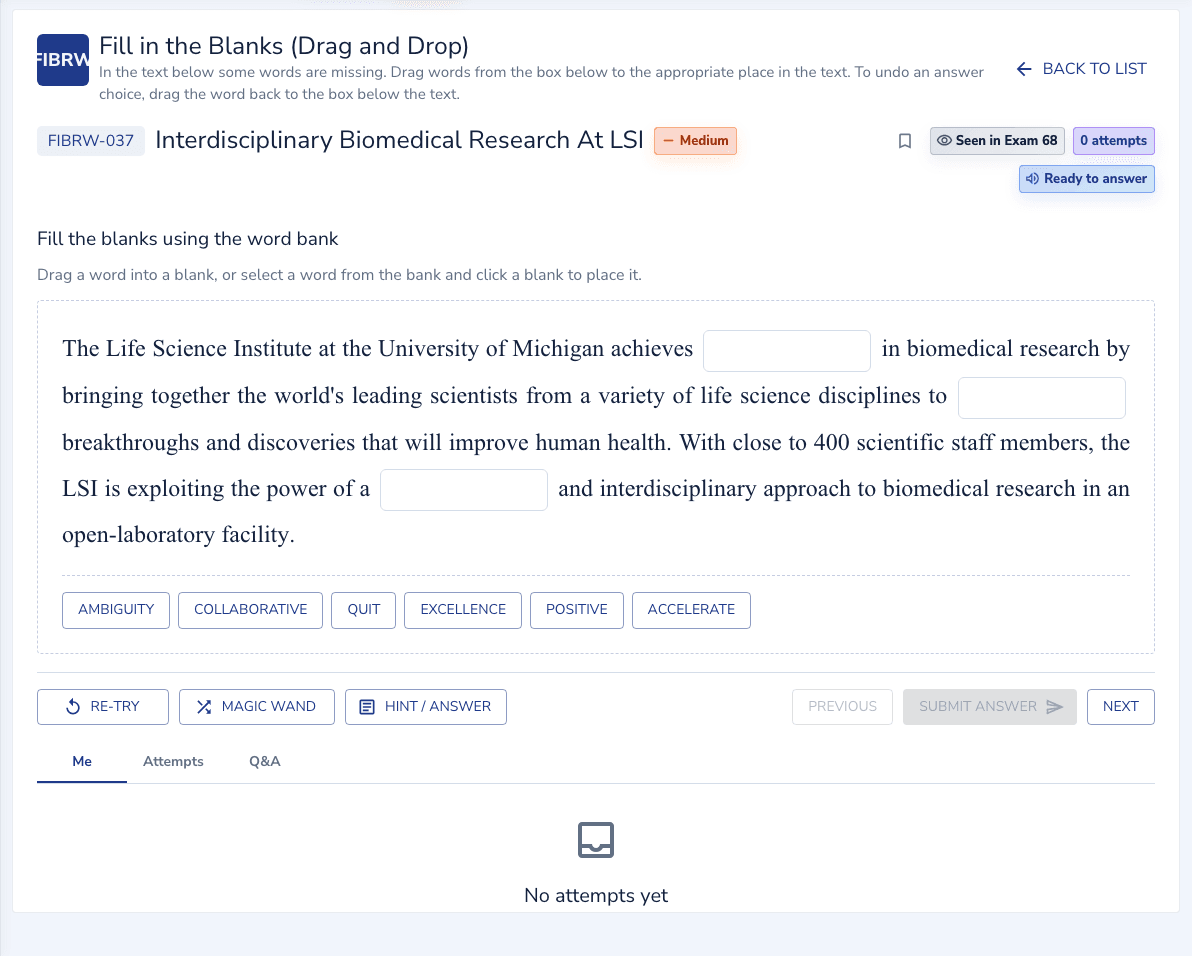
“The Life Science Institute… achieves [1] in biomedical research by bringing together the world’s leading scientists… to [2] breakthroughs… exploiting the power of a [3] and interdisciplinary approach.” Drag the right words from a six-word bank into three blanks. (Real bank question — shown in the player below.)
[1] excellence · [2] accelerate · [3] collaborative. The distractors (ambiguity, quit, positive) stay unused in the word bank.
Each blank earns its own point, and the extra distractor words are there to punish guessing by collocation alone.
The reader starts with the first gap, is unsure, and drags in the word that looks most academic. That word was the answer to the third gap. When they reach the third gap it is gone, so they choose a distractor there too. Two wrong from one early guess, and 90 seconds spent moving words back and forth.
Partial credit, one point per correctly placed word, minimum zero. The task counts towards Reading only, in both PTE Academic and PTE Core.
A wrong word scores 0 for that gap and nothing else. An empty gap scores the same 0. Three correct out of four is three points.
Distractors usually match the part of speech of one gap but the wrong collocation, or the right collocation for a nearby word but the wrong part of speech. A bank of six for three gaps means each gap has one right answer and roughly one plausible wrong one.
Reading. Unlike the dropdown version in Core, drag-and-drop blanks do not feed the Writing score in either test.
Because used words leave the bank, filling the blanks you are sure of first shrinks the choice for the ones you are not. Order matters more here than in any other reading item.
The passage is short enough to read in full, and the bank is small enough to classify. Do both before dragging anything.
Fifteen seconds. Know what the paragraph is about and roughly what each gap needs: a verb, a noun, an adjective, a linking word.
Glance across the bank and sort it in your head: these are verbs, these are nouns. Now each gap has two or three candidates instead of six.
Usually one or two gaps have an obvious collocation: “achieve excellence”, “accelerate breakthroughs”. Place those, and the bank shrinks for the rest.
Say the sentence with the candidate in place. Check the word either side of the gap and the sentence’s tense. The one that fits grammar, collocation and meaning is the answer; if two fit, pick the more common phrase.
Ninety seconds to two minutes is enough. If a gap is still uncertain, place the best remaining candidate rather than leaving it empty.
| Mistake | Why it costs marks | What to do instead |
|---|---|---|
| Filling gaps in order | Why it costs marksAn early guess uses a word another gap needed, turning one uncertainty into two wrong answers. | What to do insteadFill the certain gaps first, in any order, then the rest from the smaller bank. |
| Choosing by meaning alone | Why it costs marksDistractors are picked to fit the meaning but not the grammar or the collocation. Meaning is the last filter, not the first. | What to do insteadPart of speech, then the words either side of the gap, then meaning. |
| Leaving a gap empty | Why it costs marksNo negative marking means an empty gap is a guaranteed zero where a guess is a free chance. | What to do insteadPlace the best remaining word in every gap before Next. |
| Picking the rarest word | Why it costs marksUnusual words are frequent distractors. The correct word is usually the everyday collocation. | What to do insteadPrefer the phrase you have read many times. |
| Spending three minutes moving words around | Why it costs marksThe Reading clock is shared. A minute lost here is a minute taken from a five-point dropdown passage. | What to do insteadClassify, fill, check, Next. Two minutes. |
This task is mostly collocation knowledge under mild time pressure. Practise short timed sets and treat every miss as a phrase to learn.
Two minutes each. Practising without the clock hides the habit of second-guessing, which is what costs points in the exam.
The word before, the answer, the word after. Collocation is learned in pairs, not single words. Read the list before the next session.
Take any word bank and sort it by part of speech in ten seconds. When this is automatic, the task gets faster without any change in vocabulary.
Ten minutes a day of academic prose, underlining verb-noun and adjective-noun pairs, builds the sense of which word belongs next to which.
If verbs are fine and nouns keep missing, the gap is in noun collocations; study those. Most learners have one weak category.
Practice set
12 passages with answers
Items from the EdKnot bank, each with its answer, on one page. Every item opens in the practice player with its timer, recording and scoring.
Scored per gap across four or five items, so a steady hit rate matters more than any single passage. These are the typical profiles behind each level.
About three of every four gaps correct, with the miss usually a collocation where two options both seemed to fit. Items finished in around two minutes.
Nearly every gap correct, sure gaps filled first, the remaining candidates tested in the sentence, and 90 seconds or less per item.
The drag-and-drop version uses a shorter text of up to about 80 words with one shared word bank containing extra words, has 4–5 items, and counts towards Reading only. The dropdown version uses a longer text with a menu per blank, has 5–6 items, and in PTE Core also counts towards Writing.
Yes. The word bank always contains more words than there are gaps, so some are distractors that are never used. They are chosen to fit a gap on grammar or on collocation but not both.
No. There is no negative marking, and you receive one point for each correctly placed word, so fill every gap.
Fill the gaps you are certain of first. Each word you place leaves the bank, so the remaining gaps have fewer candidates. Filling in order from the first gap risks using a word another gap needed.
There is no per-item timer. The whole Reading part shares one clock, so budget about 90 seconds to two minutes per drag-and-drop item.
Yes, until you click Next: drag a word back to the bank or drop another word onto it. After Next there is no returning to any Reading item.
Part of speech first, collocation second, meaning last. Fill the sure blanks, then the rest.
Practise Fill in the Blanks (Drag and Drop) with the real clock and see the answer the moment you submit.