Listening - PTE Academic / UKVI, PTE Core

Write From Dictation

Write From Dictation is the last task in the test and, word for word, the most valuable: three or four sentences of 3–5 seconds each, one point for every word typed correctly, counting towards Listening and Writing at once. Here is exactly how the words are counted, why order does not matter but spelling does, and how to hold a twelve-word sentence.

1
point per correct word, in two skills
3–5 s
of audio, plays once
3–4
items per test
None
negative marking

The task

Write From Dictation closes the Listening part and the whole test. Three or four items, on the shared Listening clock, so the time you have depends on what is left when you reach them.

Appears inPTE Academic / UKVI and PTE Core — Listening part
Items per test3–4
Audio length3–5 seconds, plays once
TimeNo per-item timer — shared Listening clock
Scoring1 point per correct word spelled correctly; 0 per incorrect or misspelled word
Negative markingNone
Why it mattersThe highest-leverage listening task — every word scores in two skills
Skills creditedListening and Writing
In the exam
  1. A sentence plays once

    A short countdown, then 3–5 seconds of audio: one sentence of roughly 8–15 words. No replay. The noteboard is available, and a text box sits under the status box.

  2. You type the sentence

    Type into the box. There is no per-item timer; the shared Listening clock keeps running. You can edit until Next.

  3. Next locks the item

    No returning to a Listening item. Read the sentence once for spelling before Next.

  4. Three or four items, then the test ends

    If the Listening clock is short by this point, the earlier items ate it. Because each word here is worth a point in two skills, the clock should be managed so that these items always get their minute each.

How one item is scored

Question

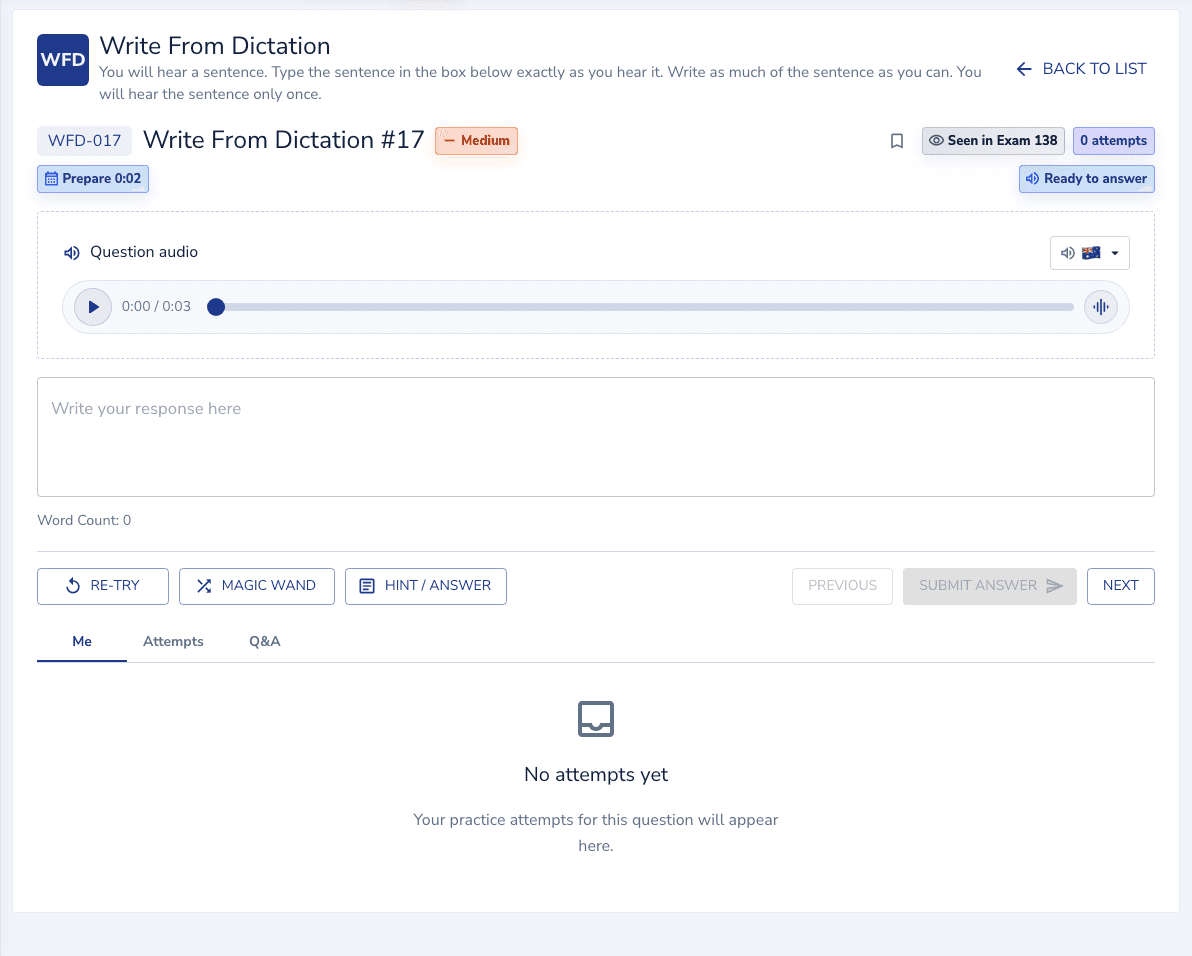
You hear (once, 3–5 seconds): “Many diseases that were once serious have now been eradicated.” Type the sentence exactly. (Real bank question — shown in the player below.)

Answer

Many diseases that were once serious have now been eradicated.

Why it scores

Ten words, each worth a point into both Listening and Writing — spelling counts.

What loses marks

The sentence is “Many diseases that were once serious have now been eradicated.” The response is “Many diseases that were serious have now been eradicate.” Two words lost: “once” was dropped, and “eradicate” is not the word that was said. Eight points out of ten, from a sentence the learner understood completely.

How it is scored

Partial credit: one point for each correct word spelled correctly, zero for each incorrect or misspelled word. Every point counts towards both Listening and Writing, in both tests.

One point per correct word

A ten-word sentence is worth ten points. Nine right and one misspelled is nine. The scoring checks the words you typed against the words in the sentence; a word that is in the sentence and spelled correctly scores wherever it sits.
Spelling is the whole game

A correct word misspelled is zero for that word. “Recieve” scores the same as leaving it out. Capitalisation and punctuation are not what the points are for; the words are.

Skills credited

Listening and Writing, both tests. With three or four items of around ten words each, this task can carry 30–40 points into two skills, which is why it is the highest-leverage item in the test for most learners.

Because points are per word and there is no deduction, half a sentence typed correctly is worth exactly half the points. Never leave the box empty.

How to answer it

A sentence of 3–5 seconds is within working memory if you listen for meaning and hold the rhythm. Type it in the order you heard it, then fix spelling.

  1. Listen for the meaning first

    A sentence you understood is a sentence you can rebuild. Do not start typing during the audio; the first words are the easiest to hold and the last words are the ones you will lose if you are typing.

  2. Type immediately, in order, without stopping

    Start with the first word the moment the audio ends and type through to the end without fixing anything. Speed of recall matters more than accuracy on the first pass.

  3. Fill gaps from the grammar

    If a word is missing, the sentence usually tells you what kind: an article, an auxiliary, a plural. “Diseases that were ___ serious” wants “once”. Grammar rebuilds more than memory does.

  4. Check spelling word by word

    Read the sentence once, one word at a time. Endings are the usual losses: “-ed”, “-s”, “-ly”. A word you cannot spell confidently is better typed than left out, because a near miss might be wrong but an omission is certainly zero.

  5. One minute, then Next

    The shared clock is running. If you cannot recall a word after ten seconds, it is not coming back; move on with what you have.

Common mistakes

MistakeWhy it costs marksWhat to do instead
Typing during the audioWhy it costs marksAttention on the keyboard means the end of the sentence is never heard, and the end is usually the hardest part to reconstruct.What to do insteadListen to the whole sentence, then type.
Leaving a hard word outWhy it costs marksAn omitted word is a certain zero. A misspelled attempt is also zero, but a reasonable attempt is often right.What to do insteadType your best spelling of every word you heard.
Giving up on a long sentenceWhy it costs marksPoints are per word. Six correct words of twelve is six points; an empty box is none.What to do insteadType what you have, in order, and fill gaps from the grammar.
Not checking endingsWhy it costs marks“-ed”, “-s” and “-ly” are the most common losses, and each is a whole point.What to do insteadRead the sentence word by word once before Next.
Running out of clockWhy it costs marksThis task is last. Time overspent on earlier listening items is taken from the highest-value words in the test.What to do insteadBudget the Listening clock so four minutes remain for these items.

How to practise

Write From Dictation is trained the same way as Repeat Sentence, because it is the same memory: sentences heard once and rebuilt. Short daily sets with word-level review are what move it.

  1. Do sets of ten with one play

    Type each sentence immediately after one hearing. On EdKnot the audio plays automatically; do not use the replay in practice, because the exam has none.

  2. Review by word

    The review marks each word you typed against the sentence. Sort your misses: dropped words, wrong words, misspellings. Each has a different fix.

  3. Dropped words: chunk the sentence

    If the losses are grammar words and endings, practise hearing the sentence in two or three chunks and typing chunk by chunk.

  4. Misspellings: keep a list

    The same words recur. A personal list of twenty, read before each session, removes most of them within a fortnight.

  5. Shadow and type

    Five minutes a day typing sentences from a podcast a beat behind the speaker builds the hearing-to-typing link without a timer.

Practice set

30 sentences with answers

Items from the EdKnot bank, each with its answer, on one page. Every item opens in the practice player with its timer, recording and scoring.

Write From Dictation practice inside the EdKnot question player

What 65 and 79 need

Scored per word across three or four items into two skills, so the hit rate across all the sentences is what matters. These are the typical profiles behind each level.

65

Around eight of every ten words correct, with the losses on grammar words in longer sentences and an occasional misspelling of an academic term.

79

Nine or ten of every ten words correct, including the endings, with gaps rebuilt from grammar and every word checked for spelling before Next.

Frequently asked questions

Does spelling matter in Write From Dictation?

Yes. You score one point per correct word spelled correctly, and zero for each incorrect or misspelled word, so accurate spelling is essential.

Why is Write From Dictation so important?

Because every word you type correctly is a point that counts towards both Listening and Writing, and three or four sentences of around ten words each add up to more points than most other listening tasks combined.

How many Write From Dictation questions are there?

There are three to four items in both PTE Academic and PTE Core; each sentence audio lasts 3–5 seconds and plays once only, and you type the sentence exactly.

Do I get partial marks if I remember only part of the sentence?

Yes. Points are awarded per correct word, so half a sentence typed correctly earns half the points. Never leave the box empty.

Can I hear the sentence again in Write From Dictation?

No. The audio plays once and there is no replay. Listen to the whole sentence for meaning before you start typing.

How much time do I get for each Write From Dictation item?

There is no per-item timer; the Listening part shares one clock. Because these items come last, budget the clock so a minute per sentence remains when you reach them.

Every word of the sentence, spelled correctly. Order is not scored; spelling is.

Practise Write From Dictation with the real clock and see the answer the moment you submit.

Practise Write From Dictation