Listening - PTE Academic / UKVI

Summarize Spoken Text

Summarize Spoken Text opens the Listening part: 60–90 seconds of audio heard once, then ten minutes to write 50–70 words. It counts towards Listening and Writing, Content is scored 0–4 by Pearson’s AI plus a Pearson examiner in the live test, and a single spelling error costs a mark. Here is how to take notes that turn into the summary, and the word-count rule that decides Form.

10 min
to write, on its own timer
50–70
words for full Form credit
12
marks across five traits
1
item per test

The task

Summarize Spoken Text is the first item of the Listening part and the only one with its own timer. One item in PTE Academic. It does not share the Listening clock with the items after it.

Appears inPTE Academic / UKVI — Listening part (integrated task)
Items per test1
Audio length60–90 seconds, plays once
Time to write10 minutes, on its own timer
Word limit50–70 words for full Form credit; 40–49 or 71–100 score 1 (Core version: 20–30 words)
ScoringPartial credit — Content 0–4 (Pearson: AI plus examiner review), Form 0–2, Grammar 0–2, Vocabulary 0–2, Spelling 0–2
Negative markingNone
Skills creditedListening and Writing
In the exam
  1. A short countdown, then the audio plays once

    A lecture or talk of 60–90 seconds. There is no replay. You can write on the erasable noteboard from the first second.

  2. Ten minutes to write, on a separate timer

    The ten minutes start when the audio ends. An answer box with a live word counter and Cut, Copy and Paste buttons sits under the audio status box.

  3. The item closes at ten minutes or when you click Next

    The text in the box is the summary. Time left over is not carried into the rest of the Listening part, so use it to check spelling and the count.

  4. Then the shared Listening clock begins

    The remaining seven listening types share one clock of roughly 20–30 minutes. Summarize Spoken Text is separate, so there is no reason to rush it.

How one item is scored

Question

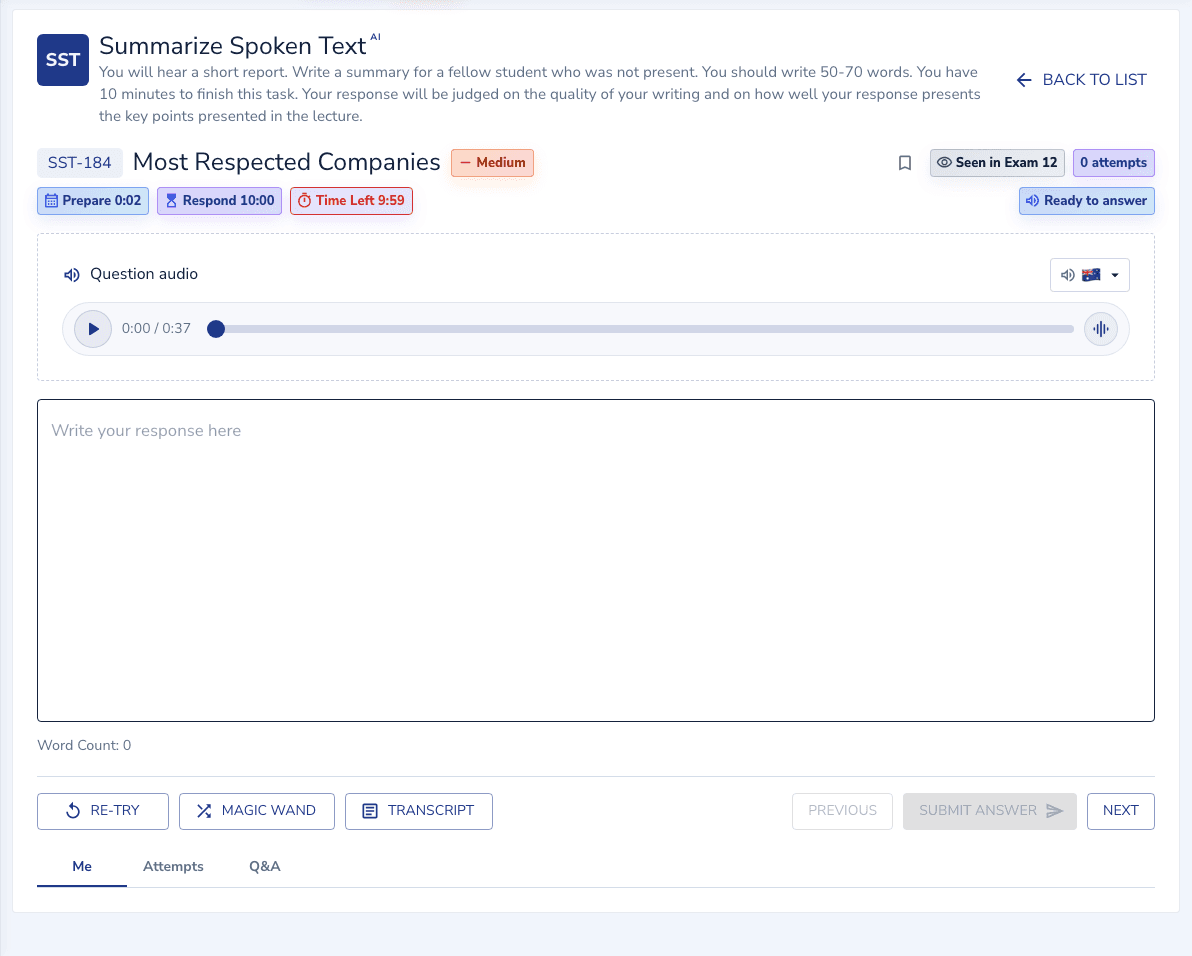
You hear a talk on the Financial Times “Most Respected Companies” survey — Jack Welch, General Electric, Bill Gates, and Microsoft — arguing none achieved status “through playing nice”. Write a 50–70 word summary in 10 minutes. (Real bank question — shown in the player below.)

Answer

Neither of the most respected companies and business leaders has achieved their world-class status through playing nice. For example, Welch is still remembered for the brutal downsizing, while Microsoft has had one of the highest profile cases of bullying market dominance. Similarly, Gates chooses to give lots of money away by being ruthless in business.

Why it scores

At 55 words it sits inside the 50–70 word limit and captures the recording’s single argument with its two examples.

What loses marks

“The speaker talks about respected companies. Jack Welch, General Electric, Bill Gates, Microsoft. They did not play nice. Downsizing and market dominance. Gates gives money away but is ruthless in bussiness.” Thirty-two words, so Form is 0. The names are there but the argument that connects them, that none achieved status through playing nice, is a fragment, and “bussiness” takes Spelling to 1. Content 2 at best.

How it is scored

Five traits with partial credit, counting towards both Listening and Writing. Content is scored by Pearson’s AI and reviewed by a Pearson examiner in the live test. Form, Grammar, Vocabulary and Spelling are short scales decided by things you can check.

Content: 0–4 for a comprehensive, paraphrased summary

A 4 summarises the recording comprehensively, paraphrases effectively, removes extraneous detail and synthesises all the main ideas concisely. A 3 identifies the main ideas with minor omissions and paraphrases inconsistently. A 2 shows basic comprehension with no distinction between main points and detail and relies on repeating phrases from the audio. Disconnected excerpts are a 1.
Form: 2 for 50–70 words

A 2 is 50–70 words. A 1 is 40–49 or 71–100 words. A 0 is under 40 or over 100, or a summary in capital letters, without punctuation, or in bullet points or very short sentences.

Grammar and Vocabulary: 0–2 each

Grammar 2 is correct structures; 1 is errors with no hindrance to communication. Vocabulary 2 is appropriate word choice; 1 is lexical errors with no hindrance. Two or three medium sentences are safer than one long one, and the task allows them.

Spelling: 2, 1 or 0

Correct spelling throughout scores 2. One error scores 1. More than one scores 0. Technical terms from the recording are the usual casualties; if you are not sure how a term is spelled, use the general word instead.

The word range is 50–70, not “at least 50”. A 72-word summary is Form 1. Check the counter before Next. That review is part of Pearson’s live test. EdKnot practice scoring is entirely automated: no person sees or scores any practice response.

Templates that score full marks

Every template below is taught inside EdKnot and verified against the same AI scoring engine that marks your practice — out of 12 for this task.

Template 1 — reported summary
The speaker discussed [TOPIC], explaining [POINT 1] and [POINT 2]. They emphasised [POINT 3], noting [SPECIFIC DETAIL OR NUMBER]. Overall, [THE LECTURE'S CONCLUSION].
Template 2 — enumerated summary
The speaker discussed [TOPIC]. Firstly, they highlighted [POINT 1]. They then explained [POINT 2], noting [DETAIL OR NUMBER]. Finally, they concluded that [CONCLUSION].
Worked example — Biophilia and Well-being

The speaker discussed biophilia, the innate human tendency to connect with nature, explaining that time in green spaces reduces stress hormones, lowers blood pressure and improves concentration. They…

Template 1 · 63 words · key terms and the study detail kept - scored 12/12 on this scoring engine.

How to answer it

The recording has one argument and two or three points that support it. Notes that capture that shape write themselves up in ten minutes.

  1. During the audio: topic, then points

    The speaker states the subject in the first sentence or two; write it as three words. Then one line per point as it arrives, two or three words each, with any name or number that anchors it. Three to five lines is right. A full page means you were transcribing.

  2. Minute 0–1: decide the sentence plan

    One sentence for the main argument, one sentence per supporting point, one closing sentence if the speaker drew a conclusion. Three or four sentences of 15–20 words lands inside 50–70 naturally.

  3. Minutes 1–6: write in your own words

    Keep the names and technical terms; rephrase everything else. Start with the argument, not with “The speaker talks about”, which spends five words on nothing Content credits.

  4. Minutes 6–8: check the count and the coverage

    50–70 on the counter, ideally 55–65. Then tick your note lines against the sentences. A missing point is a Content mark; add it as a short clause even at 65 words.

  5. Minutes 8–10: spelling, then grammar

    Read every word for spelling first, because one error is a full point. Then each sentence for a subject and a verb that agree and for a full stop at the end.

Common mistakes

MistakeWhy it costs marksWhat to do instead
Writing outside 50–70 wordsWhy it costs marks40–49 or 71–100 is Form 1; under 40 or over 100 is Form 0. “A bit over to be safe” is a lost mark.What to do insteadThree or four sentences, check the counter at minute six, cut an example rather than a point.
Copying phrases from the recordingWhy it costs marksRepeating excerpts without reformulation is the Content 2 descriptor, and copied phrases earn nothing for Vocabulary.What to do insteadKeep names and terms, rebuild the sentences.
One spelling error left inWhy it costs marksSpelling is 2, 1 or 0. One error costs half the trait; two cost all of it.What to do insteadRead for spelling alone before anything else in the last two minutes. Use the general word if unsure of a term.
Listing details without the argumentWhy it costs marksNo discernment between main points and detail is the Content 2 descriptor. Names and numbers without the claim they support are detail.What to do insteadFirst sentence: what the speaker is arguing. Then the points that support it.
Opening with “The speaker discusses…”Why it costs marksIt spends words on nothing the Content trait credits and pushes the real content towards the 70-word limit.What to do insteadStart with the argument itself.
Note-taking that becomes transcriptionWhy it costs marksWriting whole sentences during the audio means missing the second half, which usually carries the conclusion.What to do insteadThree words per line, one line per point.

How to practise

This is note-taking plus a fixed writing routine. Two recordings a session with review of both the notes and the summary builds it in a couple of weeks.

  1. Practise with one play and the ten-minute timer

    On EdKnot the audio plays and the timer runs automatically; do not use the replay in practice, because the exam has none. Finish writing by minute six so checking becomes routine.

  2. Compare your notes with the transcript

    Did you catch the argument and each supporting point? If your notes are all from the first thirty seconds, you are writing too much early on.

  3. Check the summary trait by trait

    Coverage against your note lines, then paraphrase (underline any run of four or more words from the transcript), then count, then spelling. The scoring review shows the five traits separately, so the weakest one is visible each time.

  4. Keep a spelling list

    Every misspelled word from a timed attempt goes on a list you read before the next session. Academic terms and doubled consonants account for most of them.

  5. Listen to talks for their structure

    Ten minutes a day of a lecture or podcast, pausing every minute to say the point in one sentence, trains the summarising half of the task without a timer.

Practice set

12 transcripts with answers

Items from the EdKnot bank, each with its answer, on one page. Every item opens in the practice player with its timer, recording and scoring.

Summarize Spoken Text practice inside the EdKnot question player

What 65 and 79 need

One item, counting towards both Listening and Writing. These are the typical profiles behind each level on this task.

65

Inside 50–70 words with the argument and most points present, a phrase or two lifted from the audio, a grammar slip that does not obscure meaning, and possibly one spelling error. Content 3, Form 2, Grammar 1, Spelling 1–2.

79

Every main point in 55–65 words across three or four clean sentences in your own words, technical terms spelled correctly or replaced, checked with a minute to spare. Content 4, Form 2, Grammar 2, Vocabulary 2, Spelling 2.

Frequently asked questions

How many words should I write for Summarize Spoken Text?

In the Academic test you write 50–70 words for full Form credit; 40–49 or 71–100 scores 1 and outside that scores 0. In the Core test the same task requires 20–30 words.

How long is the audio and how much time do I get to write?

The recording lasts 60–90 seconds and plays once only. You then have 10 minutes to write your 50–70 word summary, on a timer separate from the rest of the Listening part.

Which skills does Summarize Spoken Text count towards?

It contributes to both your Listening and Writing scores. It is marked on Content 0–4 (Pearson: AI plus examiner review), Form 0–2, Grammar 0–2, Vocabulary 0–2 and Spelling 0–2.

Can I take notes during Summarize Spoken Text?

Yes. You can write on the erasable noteboard from the moment the audio starts. Keep to the topic plus one short line per point, so you can write from the notes rather than read them.

How much does spelling matter in Summarize Spoken Text?

Correct spelling throughout scores 2, one error scores 1, more than one scores 0. British or American spelling is fine if consistent. If you are unsure how a technical term from the recording is spelled, use the general word instead.

Can I use the speaker’s exact words in Summarize Spoken Text?

No. Copying phrases from the recording is described in the Content 2 descriptor and earns no Vocabulary credit. Keep names and technical terms and paraphrase the rest.

Every main idea of the recording, in your own words, in 50–70 words, spelled correctly.

Practise Summarize Spoken Text with the real clock and see the answer the moment you submit.

Practise Summarize Spoken Text