
One point or zero
The right paragraph scores one. A wrong paragraph or no selection scores zero. No partial credit and no negative marking, so always choose.
Listening - PTE Academic / UKVI
Highlight Correct Summary plays a recording of 30–90 seconds once, then shows four paragraphs and asks which one summarises it. One point, no penalty, counting towards Listening and Reading. Here is why the wrong paragraphs are wrong, why you should not read them during the audio, and how to decide in a minute.
Highlight Correct Summary appears in PTE Academic and UKVI only, on the shared Listening clock, after Fill in the Blanks. It is not in PTE Core.
| Appears in | PTE Academic / UKVI only — Listening part |
|---|---|
| Items per test | 2–3 |
| Audio length | 30–90 seconds, plays once |
| Time | No per-item timer — shared Listening clock |
| Scoring | Correct or incorrect, 1 point per item |
| Negative marking | None |
| Skills credited | Listening and Reading |
Four paragraphs of three or four sentences each appear during a short countdown, and the recording of 30–90 seconds plays. The noteboard is available. The paragraphs are long enough that reading them during the audio means not listening.
Click a radio button beside the paragraph; clicking another replaces it. The choice can be changed until Next.
No per-item timer, but the shared clock is running. A minute to read four paragraphs against your notes is enough.
No returning to a Listening item. Two or three items per test.
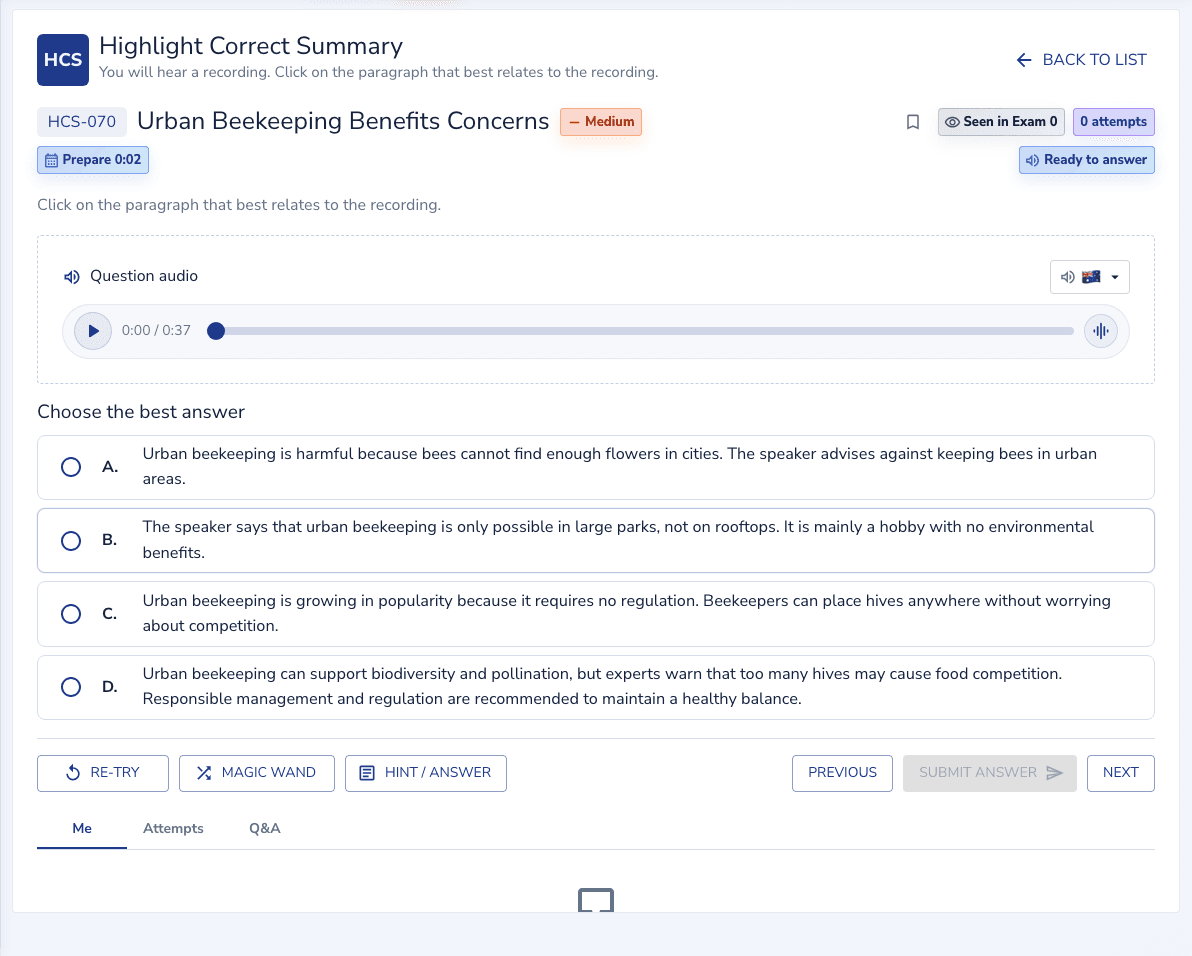
You hear a talk about urban beekeeping — rooftop hives support biodiversity, but too many hives in one area can weaken colonies. Choose the paragraph that best summarizes it. (Real bank question with four options — shown in the player below.)
D — “Urban beekeeping can support biodiversity and pollination, but experts warn that too many hives may cause food competition. Responsible management and regulation are recommended to maintain a healthy balance.”
Only D covers both the benefits and the overcrowding concern with the recommendation; the other options reverse or exaggerate the speaker’s points.
The learner reads the four paragraphs while the talk plays, catches half of it, and picks the paragraph that says urban beekeeping supports biodiversity, which is true, because it contains the most words they remember hearing. The talk also warned that too many hives weaken colonies and recommended regulation, and only one paragraph had both halves.
Correct or incorrect, one point per item, no deduction. Counts towards both Listening and Reading.
The right paragraph scores one. A wrong paragraph or no selection scores zero. No partial credit and no negative marking, so always choose.
Each wrong option does one of three things: reverses a point the speaker made, exaggerates it, or covers only one part of the talk. All four paragraphs use the talk’s vocabulary, so familiarity is not a guide.
Listening and Reading, because the item tests both understanding the talk and reading four dense paragraphs against it quickly.
The correct paragraph covers the talk’s main point and its balance, including any “but” or recommendation. A paragraph that is all benefit or all problem is usually the one that misses half.
The audio is short and the paragraphs are long. Listen fully, note the shape of the talk, then read the paragraphs looking for the one with the same shape.
Ten seconds to see the topic. Do not read further; the paragraphs are similar on purpose, and reading them costs the audio.
Topic, the main claim, any “but”, and the closing recommendation or conclusion. Four or five words on the noteboard. If the speaker changes direction, note that; it is what separates the options.
Read the last sentence of each paragraph first. The paragraph whose ending matches the speaker’s conclusion is usually the answer, and the ones that end on a reversed or exaggerated point are out.
Does it contain both halves of the talk, the point and the caveat? If a paragraph covers only the benefits or only the problem, it is the partial option.
Never leave it blank; a guess is free.
| Mistake | Why it costs marks | What to do instead |
|---|---|---|
| Reading the paragraphs during the audio | Why it costs marksFour dense paragraphs take the whole recording to read, and the talk is heard as background. Half the talk missed means the partial option looks complete. | What to do insteadSkim the first lines in the countdown, then listen with the noteboard. |
| Choosing by familiar words | Why it costs marksAll four options use the talk’s vocabulary. The wrong ones reverse or exaggerate a point in familiar words. | What to do insteadMatch the shape: claim, caveat, conclusion. |
| Picking the paragraph that covers one part well | Why it costs marksThe partial option is the most common trap: accurate about the first half, silent on the rest. | What to do insteadCheck the survivor for both halves of the talk before selecting. |
| Leaving it blank | Why it costs marksNo negative marking. An empty item is zero; a guess after elimination is worth a third or a half of a point. | What to do insteadAlways select something. |
| Spending three minutes reading | Why it costs marksOne point on a shared clock that Write From Dictation still needs. | What to do insteadEndings first, balance check, select. One minute. |
The skill is capturing the shape of a short talk and matching it, which is the same skill Summarize Spoken Text needs. Practising the two together is efficient.
On EdKnot the audio plays automatically; do not use the replay in practice, because the exam has none. Keep your eyes on the noteboard until the audio ends.
The review shows the correct option. Was the one you chose reversed, exaggerated or partial? The same kind of trap tends to catch the same learner.
On any short talk, write topic, claim, caveat, conclusion in four lines. When this is automatic, the matching is quick.
Practise deciding from the last sentence of each option before reading the rest. It is usually enough, and it halves the reading time.
Under a minute after the audio. Longer means the reading is being done from scratch instead of against notes.
Practice set
12 recordings with answers
Items from the EdKnot bank, each with its answer, on one page. Every item opens in the practice player with its timer, recording and scoring.
One point per item, two or three items, counting towards Listening and Reading. These are the typical profiles behind each level.
Most items correct, with an occasional partial option chosen when the talk’s caveat was missed, and a decision taking a couple of minutes.
Items correct, talk’s shape noted in four lines, options decided from their endings and checked for balance within a minute.
No, it appears in the Academic and UKVI tests only. You choose the paragraph that best summarises the recording.
It is marked correct or incorrect, worth one point with no partial credit and no negative marking, and there are two to three of these items.
It contributes to both your Listening and Reading scores.
Skim only the first line of each paragraph during the countdown, then listen with the noteboard. The paragraphs are long and similar, and reading them during the audio means missing the talk.
Each wrong paragraph reverses a point the speaker made, exaggerates it, or covers only one part of the talk. The correct paragraph matches the talk’s shape: its claim, any caveat, and its conclusion.
The recording is 30–90 seconds and plays once. There is no per-item timer after it; the Listening part shares one clock, so aim to decide within a minute.
Listen first, then find the paragraph that matches the whole talk, not one detail.
Practise Highlight Correct Summary with the real clock and see the answer the moment you submit.